
Can a 3kW inverter work with a 24V 150Ah lithium battery?
The voltage can match while the system still falls short. Check the inverter's real output, battery current limit and expected runtime before buying.
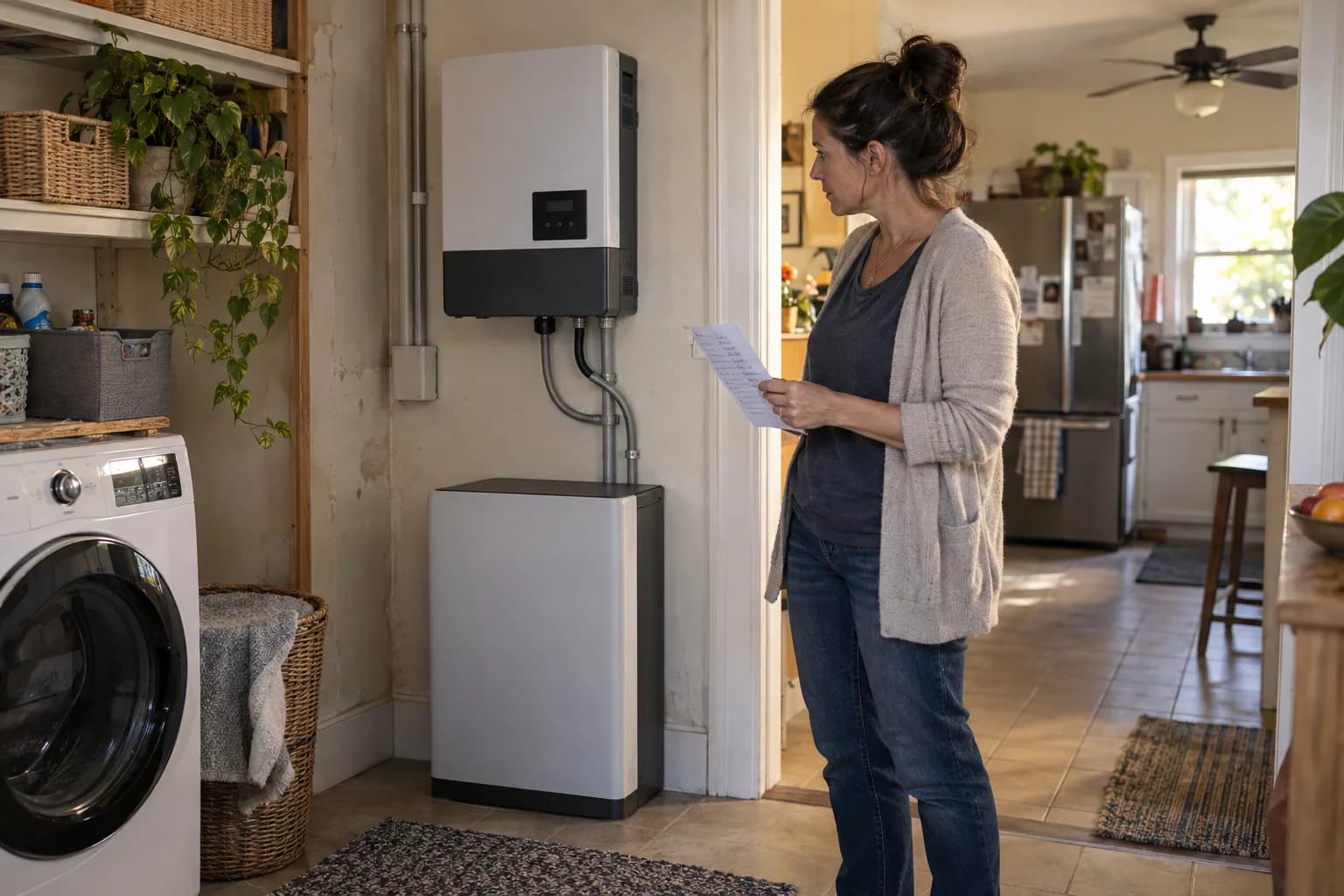
The shopping list sounds reasonable: a 3kW inverter, one 24V 150Ah lithium battery and solar panels added later. The voltage matches. The battery appears large. Does that mean the combination will work?
It can, but those three labels do not settle the question. The inverter must really be a 24V model. The battery's built-in protection system must be able to supply the current the inverter will ask for. The load also has to fit the inverter's continuous output, which may be lower than the large number in the product name.
This guide keeps the checks in ordinary language. It uses a few simplified calculations to show why the current limit and runtime matter. They are teaching examples, not cable sizes, protection settings or a promise that one battery will run a particular home. The exact manuals and the qualified person responsible for the installation still decide the final design. The photographs are illustrative editorial scenes, not customer projects.

Start by separating the five numbers
A product title can place “3kW,” “24V” and “150Ah” on one line, even though each number answers a different question.
The inverter rating describes how much equipment it may be able to supply at one time. Battery voltage tells you which inverter family it can work with. Amp-hours help describe how much charge is stored. The battery's discharge-current limit tells you how quickly that energy can leave the battery. Usable energy gives a more realistic starting point for runtime.
Do not skip the unit beside the inverter rating. A 3kVA inverter is not always a 3kW inverter. One current 24V/3000VA manufacturer example lists 2400W of continuous output at 25°C. That is a useful reminder to read the continuous-watt row instead of assuming the product name is the usable output.
- Number on the product
- 3kW or 3kVA
- What it tells you
- The inverter's power class
- What it does not prove
- Its exact continuous output in watts, especially when the label says kVA
- Number on the product
- 24V
- What it tells you
- The battery-voltage family
- What it does not prove
- That every 24V lithium battery is compatible
- Number on the product
- 150Ah
- What it tells you
- The amount of charge in the battery
- What it does not prove
- How much power the battery can deliver at once
- Number on the product
- BMS current limit
- What it tells you
- How much battery current is allowed continuously or briefly
- What it does not prove
- Runtime or inverter output after conversion losses
- Number on the product
- Usable kWh
- What it tells you
- The stored energy available under stated conditions
- What it does not prove
- Whether the inverter can start a motor or carry several loads together
| Number on the product | What it tells you | What it does not prove |
|---|---|---|
| 3kW or 3kVA | The inverter's power class | Its exact continuous output in watts, especially when the label says kVA |
| 24V | The battery-voltage family | That every 24V lithium battery is compatible |
| 150Ah | The amount of charge in the battery | How much power the battery can deliver at once |
| BMS current limit | How much battery current is allowed continuously or briefly | Runtime or inverter output after conversion losses |
| Usable kWh | The stored energy available under stated conditions | Whether the inverter can start a motor or carry several loads together |
At full load, battery current is the first hard check
A 3kW household load does not draw 3kW directly from a 24V battery without losses. The inverter uses a little energy while changing the battery's DC power into AC power for the appliances.
Here is a deliberately simple example. Assume the AC load is 3000W, the battery is treated as 24V and the inverter is 90% efficient at that operating point:
3000 ÷ 24 ÷ 0.90 = about 139A
If the battery's nominal label says 25.6V, which is common for an eight-cell LiFePO4 pack, the same teaching calculation is about 130A. Real current moves as battery voltage and load change. Temperature, cable losses and the exact inverter efficiency also affect it.
This is why the battery's BMS limit matters. The BMS is the protection and control system inside or paired with the lithium battery. If it permits only 100A continuously, it should not be assumed to support a 130–140A demand. The inverter may still run smaller loads perfectly well, but its full advertised output may be unavailable from that one battery.
Short-duration current is separate from continuous current. A refrigerator compressor, pump or power tool can ask for a brief extra push when it starts. The inverter and battery both need enough supported headroom for that event. A large peak-power claim on the inverter does not help if the battery reaches its own limit first.
A 150Ah battery tells you about time, not strength
At a simple nominal value, 24V multiplied by 150Ah equals 3.6kWh of stored energy. A battery labelled 25.6V and 150Ah works out to 3.84kWh. Use the figure on the exact product rather than switching between the two.
Neither number is the energy that will necessarily reach the appliances. The battery may keep a reserve instead of discharging to empty. The inverter has conversion losses and uses some power itself. Battery temperature, age and protection settings can reduce what is available too.
The difference between a light and heavy load is easy to see. A 3.6kWh nominal battery divided by a steady 3kW load gives 1.2 hours before any reserve or loss is allowed for. At a steady 500W, the same rough division gives 7.2 hours. Actual runtime will be shorter, and household loads rarely stay perfectly steady. These figures explain the method; they are not quoted performance.
Make a small appliance list before choosing the battery. Note which items may run together and roughly how long each one runs. A refrigerator cycles. A kettle draws a lot of power for a short time. Fans and lights draw less but may stay on all evening. One honest load list is more useful than saying the battery should run “a normal house.”
Grid charging only works when the unit is built to charge
An inverter changes battery power into household AC power. That does not automatically mean it can use the grid to recharge the battery.
For a battery-first setup, look for an inverter-charger or an all-in-one solar inverter with a documented AC charging input. In some markets these products are also called solar PCUs. The exact name is less useful than the specification: it should state that the unit can accept AC input and charge the chosen battery type.
The charging side needs its own compatibility check. Confirm the supported battery chemistry, charging-voltage range, maximum charge current and any required communication with the BMS. A factory setting intended for a lead-acid battery should not be assumed suitable for LiFePO4. The battery manufacturer or supported compatibility information should define the allowed method.
Charge current affects waiting time and battery stress. A charger with a high maximum figure can normally be set lower, but the available settings and control method are product-specific. The final setting should stay within the battery's limits and be handled through the documented commissioning process.
Adding solar later needs more than an empty-looking socket
Buying the inverter and battery first can be a sensible way to solve an immediate backup need. Protecting the solar option requires more than a promise that panels can be connected later.
Check whether the exact unit already contains an MPPT solar charger. If it does not, the second stage may need a separate solar charge controller or a different system layout. If it does, record the working solar-voltage range, maximum open-circuit voltage, input-current limit and supported solar power.
The later panel model must fit those limits. Six panels of one model can behave differently from six panels of another. Weather and the way the panels are grouped also affect voltage and current. For that reason, “supports six panels” is not enough information for a future purchase.
Keep a copy of the inverter manual and the original system plan. When panels are finally added, have the current models and site conditions reviewed again. Products, firmware and local installation requirements can change between the two stages.
Is 24V a bad choice for a 3kW inverter?
No. Reputable product ranges include 24V equipment in the 3000VA class, so a blanket claim that every system of this size must be 48V is inaccurate.
The trade-off is current. For the same power, a 48V battery system needs roughly half the DC current of a 24V system. That can give the designer more room when high-power appliances run regularly, several loads overlap or future expansion is likely.
A 24V route may still fit a modest backup system when the everyday load stays well below the inverter limit, large appliances are occasional, the battery has enough supported discharge current and compatible products are readily available. The decision should come from the load and the exact equipment, not from the voltage label alone.
- 1
Mostly lights, Wi-Fi, fans and refrigeration
A supported 24V system may be reasonable after the refrigerator's starting demand and the battery current limit are checked.
- 2
Regular 2–3kW loads or several appliances together
Compare a 48V route before buying. The lower DC current can make a higher sustained load easier to design around.
- 3
You already own the 24V battery
Choose from inverters that support its exact voltage, discharge limit and BMS method. Do not select by wattage alone.
Put these details on one page before you buy
A supplier or installer can give a much better answer when the request contains the actual loads and complete model information. Keep the first brief short enough that somebody will read it, but specific enough to expose a mismatch.
- Appliance names, label watts where available, expected daily hours and which items may run together.
- Exact inverter model, battery-voltage input range, continuous output in watts and stated short-duration output.
- Exact battery model, nominal voltage, nominal and usable energy, plus continuous and short-duration discharge limits.
- Supported BMS communication or approved voltage-based charging method for the proposed pair.
- AC charging input, available charge-current range and the battery limits that commissioning must follow.
- Future panel route: built-in or external solar charger, input limits, intended array range and second-stage responsibilities.
Can a 100A BMS run a 3kW inverter?
It may run the inverter at a lower load, but 100A should not be assumed sufficient for the full 3kW output of a 24V system. A simplified full-load estimate is around 130–140A before design margin. Check the battery's exact continuous limit, inverter efficiency and supported pairing.
How long will a 24V 150Ah battery run a 3kW load?
The simple nominal calculation is about 1.2 hours for a 3.6kWh battery, before inverter losses, battery reserve and operating limits. Actual runtime will normally be shorter and depends on the exact battery, settings, temperature and whether the load really remains at 3kW.
Can I charge from the grid now and add solar panels later?
Yes, when the exact unit includes a supported AC battery charger and has a documented route for the later solar input. Confirm the battery charging method and future PV limits before buying the first stage.
Related Articles

How much should you budget for home solar and battery backup?
Your electricity bill is useful, but it cannot price a solar and battery system by itself. Build the budget around the job, the loads and the complete installed scope.
Read Article→
More solar panels or a better angle? Flat vs tilted solar for a campervan
A smaller array pointed at the sun can work harder per panel, but it first has to recover the watts lost from the roof. Here is a practical way to compare both layouts.
Read Article→
Is there a middle ground between a portable power station and a full DIY solar system?
You can get more choice than a portable power station without building a wall of separate equipment. The catch is knowing what the middle option still requires.
Read Article→