
More solar panels or a better angle? Flat vs tilted solar for a campervan
A smaller array pointed at the sun can work harder per panel, but it first has to recover the watts lost from the roof. Here is a practical way to compare both layouts.
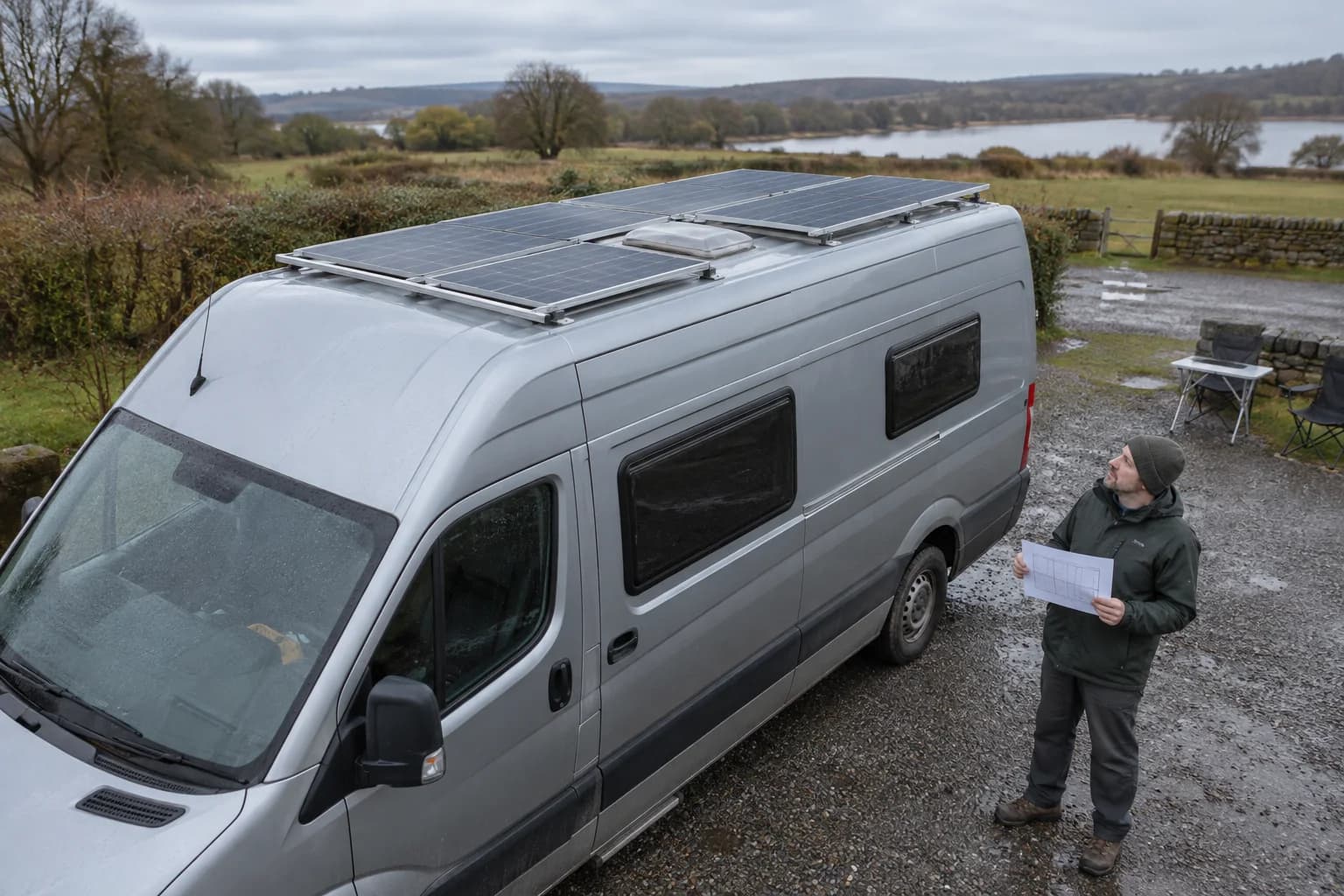
A campervan roof has a hard limit. Once the vent, aerial and walking space are allowed for, you may face a choice like this: fit 1,200W of panels flat, or give up some roof area and install 800W on adjustable mounts.
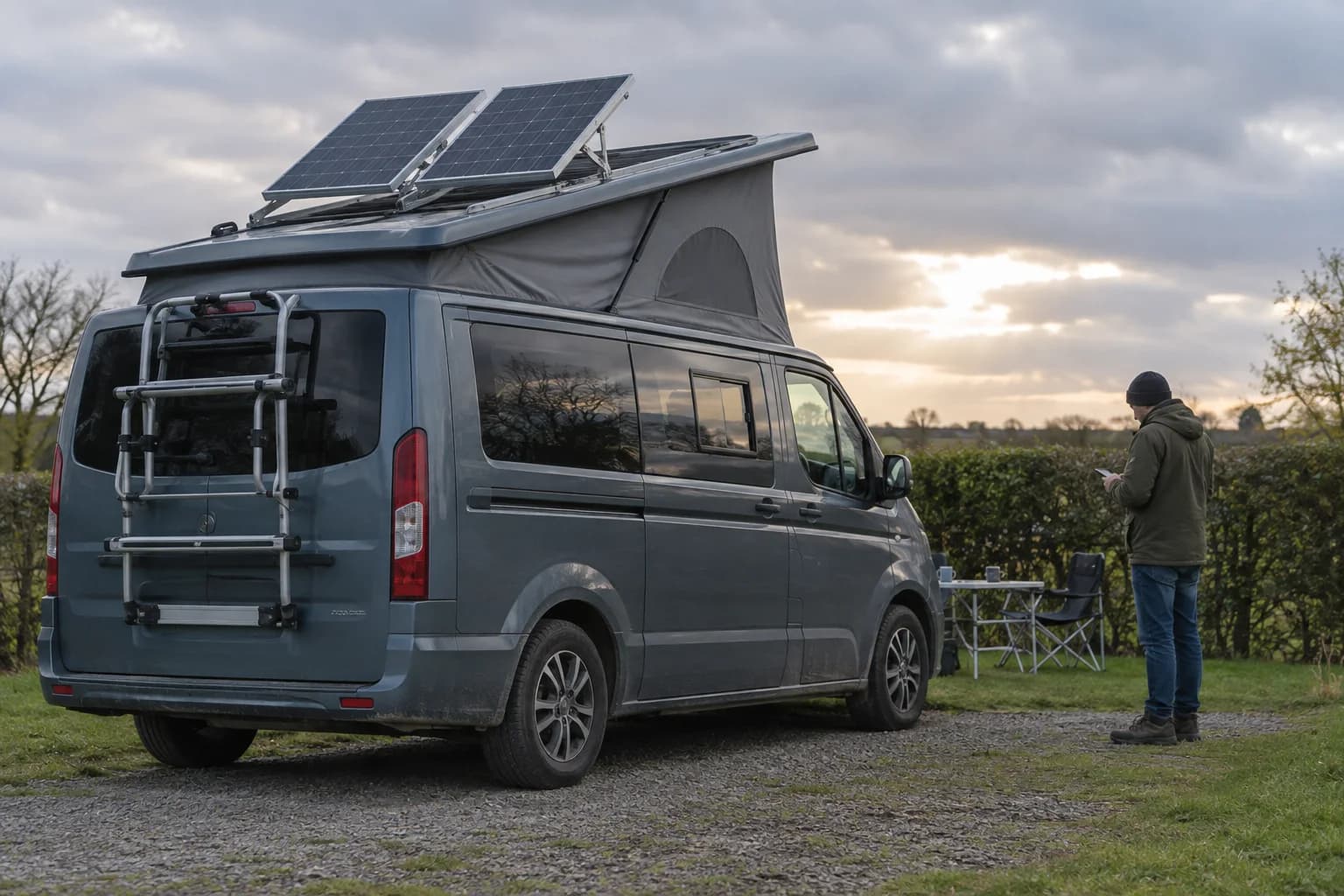
The tilted panels will face the sun better when the van is parked in the right direction. The flat array has 400W more panel capacity and asks nothing of the owner after parking. Which one produces more useful energy?
There is no honest answer based on the two wattages alone. Weather, season, parking direction and the hours you actually need power all matter. This guide shows how to compare them without pretending that one panel angle works everywhere. The calculations are teaching examples rather than promised output. Mounting, wind loading, electrical design and travel safety still need to follow the exact equipment instructions and the qualified parties responsible for the vehicle. Both photographs are illustrative editorial scenes, not customer projects.
First, separate panel watts from daily energy
The large number printed on a solar panel is its rated power under standard test conditions. It does not mean the panel will produce that number from sunrise to sunset.
Power is shown in watts. It tells you what the array is doing at a moment in time. Daily energy is shown in watt-hours or kilowatt-hours. It tells you how much was collected across the day. A camper owner usually needs the second number because the refrigerator, router, lights and laptop keep using energy long after the best sunlight has passed.
A better angle can raise the output of each panel when direct sunlight reaches it. More panel watts give the system a larger collecting area. The comparison is therefore not simply “flat versus tilted.” It is a larger fixed array versus a smaller array that may work better per watt during some hours.
- What changes
- Panel area
- 1,200W flat array
- Uses more of the available roof
- 800W adjustable array
- Gives up roughly one-third of the panel capacity
- What changes
- Sun angle
- 1,200W flat array
- Stays horizontal wherever the van is parked
- 800W adjustable array
- Can improve when the parked vehicle and mount allow useful aiming
- What changes
- Daily routine
- 1,200W flat array
- Set-and-forget after installation
- 800W adjustable array
- Needs parking, weather and stowing decisions
- What changes
- Travel hardware
- 1,200W flat array
- Simple low-profile mounting route
- 800W adjustable array
- Adds hinges, supports and a secure travel position
| What changes | 1,200W flat array | 800W adjustable array |
|---|---|---|
| Panel area | Uses more of the available roof | Gives up roughly one-third of the panel capacity |
| Sun angle | Stays horizontal wherever the van is parked | Can improve when the parked vehicle and mount allow useful aiming |
| Daily routine | Set-and-forget after installation | Needs parking, weather and stowing decisions |
| Travel hardware | Simple low-profile mounting route | Adds hinges, supports and a secure travel position |
The table describes the decision, not a final mounting design. Exact panels and hardware can change the available roof area.
The smaller array has a 50% gap to recover
The difference between 1,200W and 800W is easy to underestimate. The adjustable option has one-third less rated capacity. To produce the same daily energy, every watt in the 800W array must deliver one and a half times as much energy as every watt in the flat array.
Put another way, its angle must improve the energy collected per watt by more than 50% before the smaller array moves ahead. A 10% or 20% improvement would still leave the larger flat array in front in this particular comparison.
That does not prove that 1,200W flat always wins. A well-aimed tilted array can have a much stronger advantage when the sun is low and the sky is clear. It does show why “tilted panels are more efficient” is not enough. The proposed angle has to recover a large loss in collecting area, and it has to do so across the hours and months that matter to the owner.
The 50% figure belongs to this 1,200W-versus-800W example. Change the two array sizes and the break-even point changes too.
Cloudy weather changes the value of aiming
On a clear day, much of the useful sunlight comes from the direction of the sun. Pointing a panel more directly toward it can make a noticeable difference, especially when the sun sits low in the sky.
Under a solid grey sky, more of the light reaching the ground has been scattered by clouds and the atmosphere. It arrives from a wider part of the sky rather than one bright direction. Tilting can still change output, but carefully aiming at the hidden sun may bring a smaller advantage than it does on a clear day. The European Commission's PVGIS documentation separates direct and diffuse sunlight for this reason.
Winter adds another problem. The lower sun can make panel angle more useful on clear days, but shorter days and long cloudy periods reduce the total energy available. A better angle cannot collect sunlight that is not there. If the van must support essential loads through several poor-weather days, alternator charging, shore power or another planned source may matter more than chasing the best midday panel reading.
Do not use a bright summer afternoon to settle a winter decision. Compare monthly energy and look closely at the difficult season.
A movable vehicle rarely keeps a perfect direction
A house roof stays in one place. A campervan may be parked beside a hedge, under trees, between taller vehicles or facing whichever direction fits the pitch. Those ordinary details can outweigh a neat angle calculation.
An adjustable frame also needs to be understood correctly. A simple hinge changes the panel's slope in one direction. It does not automatically let the panel face east in the morning, toward the equator around midday and west in the evening. Doing that may require turning the vehicle, choosing the right parking orientation or using a more complicated mount.
Now add the human part. Will somebody adjust the panels on a cold morning, watch the wind and return them to the documented travel position before leaving? Or will the array usually stay flat because the van moves often? A theoretical advantage has little value when the routine is too awkward to use consistently.
Shade deserves the same attention. One vent, roof box or nearby branch can affect part of the array as the sun moves. Photograph the roof, record the real obstructions and plan around the places where the vehicle is normally used. Do not assume that a clear-looking roof is unshaded all day.
Match the array to the loads and the charging equipment
The useful target is not the highest solar number shown in an app. It is enough daily energy to cover the intended loads and leave the battery in a workable state.
Start with a simple list. A refrigerator cycles on and off. A router or satellite terminal may run for many hours. A laptop can draw more while gaming or rendering than while reading. Electric cooking and space heating can quickly dominate a small mobile system. Record watts where available and the likely hours of use, then separate everyday loads from optional ones.
The solar charger or all-in-one power unit sets another boundary. Its manual should state the allowed panel voltage range, input-current limit and maximum solar input. A larger roof array is not automatically useful if the controller cannot accept the proposed arrangement. A tilted array is not automatically compatible just because its wattage is lower. Exact panel models, grouping, temperature range and controller limits still need to be checked together.
Battery capacity decides how long stored energy can cover the loads; it does not create more solar energy. More storage can help carry energy from a good day into the night, but it will not solve a repeated winter shortfall if the available charging sources cannot refill it.
Compare both layouts with the same weather data
A location-based solar model gives a better starting point than a universal percentage. PVGIS and NREL's PVWatts both allow the user to enter array capacity, tilt, direction and system-loss assumptions.
Run the two options separately. For the flat case, enter 1.2kW and a zero-degree tilt. For the adjustable case, enter 0.8kW and the angle and direction you realistically expect to use. Keep the location, panel type and loss assumptions the same. Then compare monthly energy instead of relying on the annual total.
Treat the result as available solar energy rather than a guarantee of energy stored in the battery. A model does not know where the van will park next week, whether a hedge shades it, whether the battery is already full or whether the controller limits the input. For a vehicle that moves between regions, run more than one representative location.
If the 800W option only wins when perfectly aimed every day, write that assumption beside the result. If the 1,200W option stays ahead during the difficult months even while flat, the larger collecting area is doing more useful work than the adjustment mechanism.
- 1
You move often and want a simple routine
The larger fixed array may be the more useful route when panels would otherwise remain flat most of the time.
- 2
You stay parked for long periods in low sun
Model the adjustable option, provided the vehicle can be oriented well and the approved mount can be used consistently.
- 3
Poor-weather energy is below the daily load
Changing the angle may not close the gap. Reduce optional loads or plan another charging source instead of relying on solar alone.
Keep this short list beside the two quotations
The final choice should still work after the excitement of the first sunny test has passed. Put the following details on one page so the panel layouts, controller and everyday routine can be reviewed together.
- Usable roof dimensions plus vents, aerials, roof boxes and areas that must stay accessible.
- Exact panel models, dimensions and total rated watts for both proposed layouts.
- The months and general locations in which the vehicle will be used most often.
- Daily energy for essential and optional loads, including how use changes in poor weather.
- Exact solar-controller input limits and the proposed panel arrangement from the responsible designer.
- How an adjustable mount is aimed, secured while parked, returned to its travel position and inspected over time.
- Available alternator, shore-power or other charging routes when several weak solar days occur together.
Can 800W of tilted panels produce more than 1,200W of flat panels?
It can happen under some sun angles and operating conditions, but it is not automatic. In this comparison, the 800W array needs more than 50% extra energy per installed watt to recover its smaller size. Compare monthly results for the expected locations, angles and routine.
Does tilting solar panels help on cloudy days?
It may help, but a cloudy sky contains more diffuse light arriving from many directions, so aiming can be less valuable than under clear direct sun. Cloud thickness, season and surroundings change the result. More panel area may still collect more total energy.
Should campervan solar panels be mounted flat?
There is no rule for every vehicle. Flat mounting is simple and uses roof area efficiently. Adjustable mounting can improve the angle when parked, but adds hardware and a daily routine. The better choice depends on the roof, travel pattern, expected weather, loads and measured or modelled energy.
Related Articles

How much should you budget for home solar and battery backup?
Your electricity bill is useful, but it cannot price a solar and battery system by itself. Build the budget around the job, the loads and the complete installed scope.
Read Article→
Can a 3kW inverter work with a 24V 150Ah lithium battery?
The voltage can match while the system still falls short. Check the inverter's real output, battery current limit and expected runtime before buying.
Read Article→
Is there a middle ground between a portable power station and a full DIY solar system?
You can get more choice than a portable power station without building a wall of separate equipment. The catch is knowing what the middle option still requires.
Read Article→