
Can a 24V solar system run a kettle or iron? 24V vs 48V explained
A 24V system can run a large appliance, but the inverter label is only one part of the answer. Compare DC current, battery output, simultaneous loads and the expansion plan.
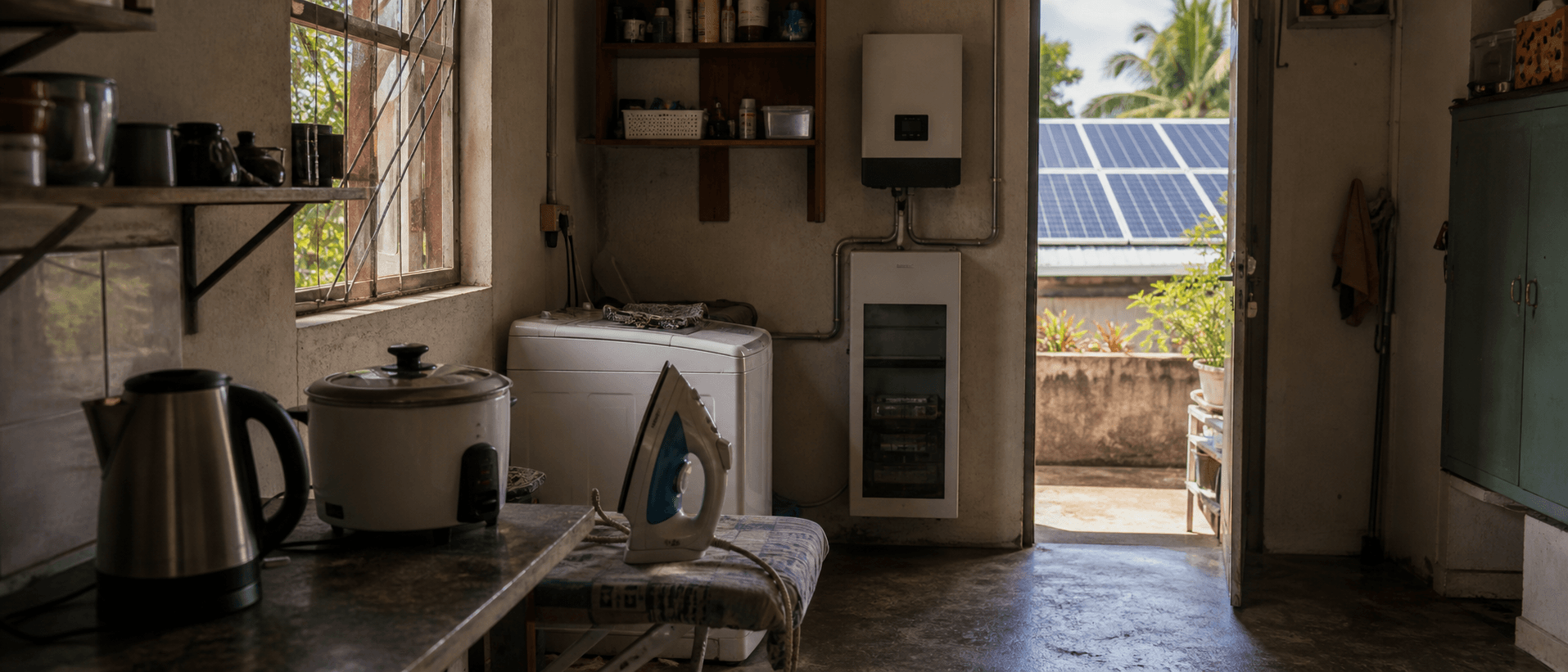
The price gap between 24V and 48V equipment can be large enough to make the decision look easy. Then someone adds a kettle, clothes iron or rice cooker rated around 2,000–2,500W, and the cheaper option becomes harder to judge.
A 24V system is not automatically too small for one of these appliances. The real question is whether the exact battery bank, BMS, inverter and DC-side design can support the load together. A 48V system usually reaches the same AC power with roughly half the DC current, which can make higher sustained loads and later expansion easier to manage.
This guide uses simplified figures to explain that trade-off. They are teaching estimates based on nominal voltage, not final design currents or instructions for choosing cables, protection devices or settings. Those decisions need the equipment manuals, actual operating voltage, installation conditions and a qualified local designer or installer. The two photographs are illustrative editorial images and do not show a Rongkai customer project.
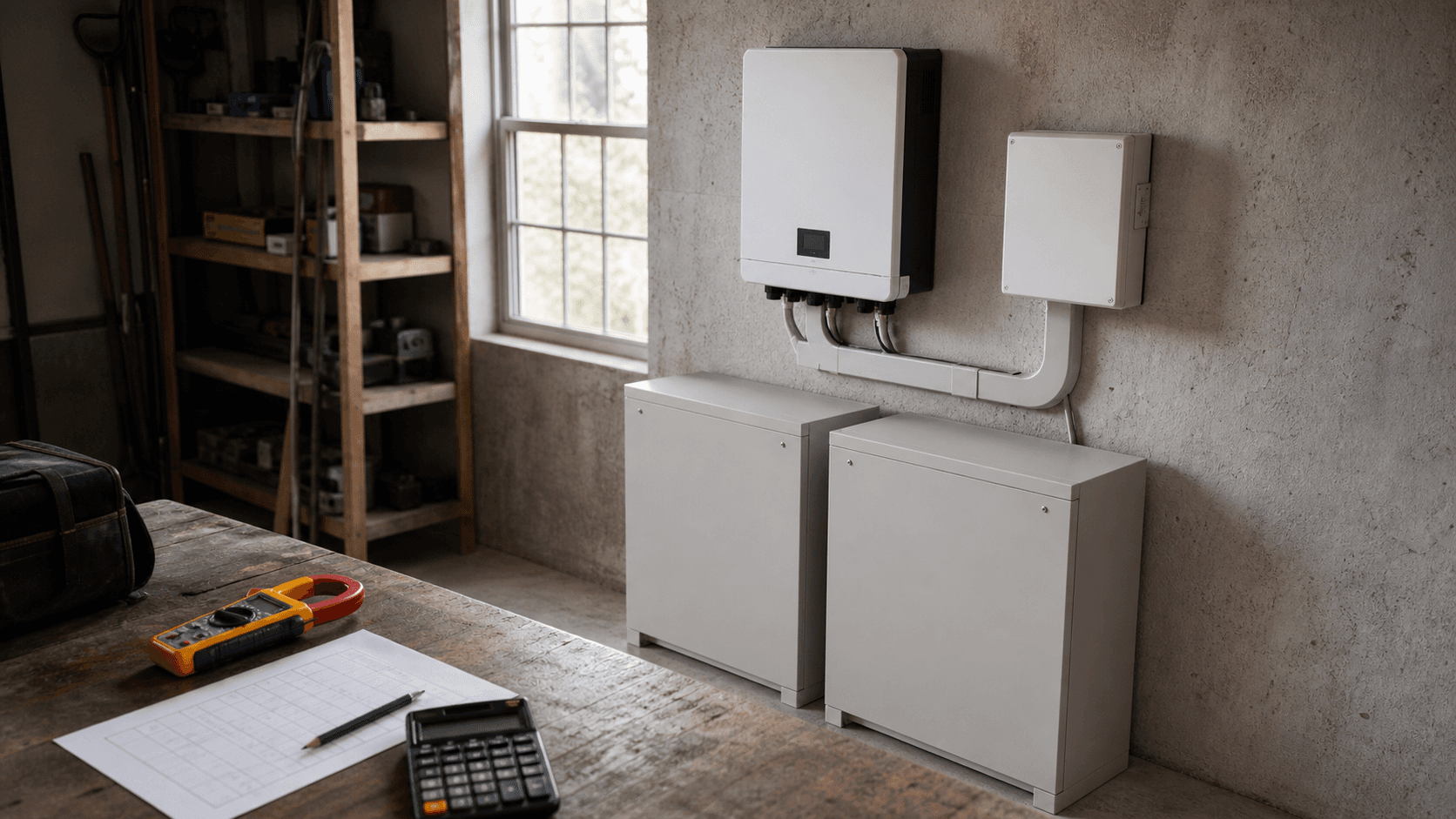
A 2,500W appliance changes the DC-side conversation
A kettle or iron may be connected to the inverter's AC output, but the energy begins on the battery side. If a 2,500W load is supplied through an inverter operating at an illustrative 90% efficiency, the simplified DC current is about 116A at 24V: 2,500 ÷ 24 ÷ 0.90. At 48V, the same calculation is about 58A.
That comparison explains why system voltage matters. Higher current increases the effect of connection resistance and voltage drop, and it places more demand on the battery, BMS, conductors, terminations and DC protection. The 116A and 58A figures are not equipment settings. Actual current changes with battery voltage under load, inverter efficiency, temperature, cable losses and the behaviour of the specific appliance.
Solar-array wattage does not remove this check. At night, the battery and inverter carry the appliance load. In daylight, PV may reduce the battery contribution, but cloud, other household loads and the charge-controller or inverter operating limits still matter. The system should be assessed for the operating condition the owner actually expects, not only for the best solar hour.
- Record the rated power of each large appliance and which ones may operate at the same time.
- Check the inverter's continuous output at the relevant ambient conditions, not only the model name or peak figure.
- Confirm the battery and BMS continuous-discharge limit for the exact proposed bank.
- Have the DC cable route, terminations, isolation and protection reviewed as one design by the responsible qualified party.
Can a 24V inverter run a 2,500W kettle?
It can be possible, but the 24V label alone cannot confirm it. The exact inverter must support the continuous AC load, while the battery bank, BMS and complete DC design must safely deliver the corresponding current under real operating conditions.
24V 200Ah and 48V 100Ah can store similar energy
Amp-hours are easy to compare and easy to misuse. At nominal values, a 24V 200Ah bank and a 48V 100Ah bank each contain about 4.8kWh: voltage multiplied by amp-hours. That does not make their high-load performance identical.
Usable energy depends on the battery chemistry, permitted depth of discharge, reserve setting, temperature, age and conversion losses. Power delivery is another question. The battery datasheet and BMS must show whether the proposed configuration can sustain the required current and how short-duration limits are defined. If several modules are combined, current sharing, communication and permitted series or parallel arrangements remain product-specific; a familiar-looking battery case is not evidence that any bank arrangement is allowed.
A quotation that gives only voltage and amp-hours is therefore incomplete. Ask for the exact battery model, nominal and usable energy, continuous charge and discharge limits, short-duration limits where relevant, and the approved inverter pairing. Those details are more useful than assuming that a larger Ah number means a stronger system.
- Exact battery model and datasheet revision, including the battery voltage operating range.
- Nominal energy, stated usable energy and any reserve assumed in the proposal.
- BMS continuous and short-duration discharge limits for the intended battery-bank configuration.
- Manufacturer rules for communications, accessories and permitted module combinations.
- Compatibility evidence for the exact inverter, battery and firmware route being offered.
Is 24V 200Ah the same as 48V 100Ah?
Their nominal stored energy is similar at about 4.8kWh, but usable energy and power capability can differ. Chemistry, BMS limits, operating voltage, temperature, losses and the exact battery configuration still need to be compared.
The inverter must cover the whole load moment
A single kettle or iron is often a fairly predictable resistive load. A home rarely runs in isolation from everything else. A refrigerator may restart while the kettle is boiling; a pump, compressor or power tool may add a short starting demand; lighting, fans and electronics continue in the background. The useful number is the highest credible simultaneous load, not the rating of one appliance.
Read the exact inverter manual for continuous output, peak or surge behaviour, duration, temperature derating, battery-voltage range and any limit on the backup or secondary output. Peak power printed on a product page is not permission to operate continuously at that level. VA and W also should not be treated as interchangeable without understanding the connected loads and the manufacturer's rating basis.
Daily energy and instantaneous power answer different questions. A short kettle cycle may use relatively little energy, yet demand high power for several minutes. A modest overnight load may draw more total kWh while never approaching the same peak. Battery capacity helps estimate runtime; inverter and battery power limits decide whether the load can start and continue.
- Base household loads that remain on while a large appliance is used.
- Appliances likely to overlap during morning, evening or outage operation.
- Motor or compressor loads whose starting behaviour must be checked from real equipment information.
- The inverter's continuous output, short-duration capability and temperature-dependent limits.
- Any load-management rule the owner is genuinely willing to follow.
When 24V is reasonable—and when 48V earns its place
A 24V route may be reasonable for a modest system when large appliances are used one at a time, cable runs can be kept within a professionally designed layout, compatible equipment is well supported locally and future power growth is limited. It still needs model-level verification. A low purchase price does not compensate for a battery or BMS that cannot sustain the load.
A 48V route often makes more sense when 2,000–2,500W loads will run regularly, several appliances may overlap, the inverter rating is moving upward or expansion is likely. Halving the current for the same simplified power example gives the designer more room to manage DC-side losses and equipment limits. It may also align better with the available battery and inverter families at higher power.
This is not a rule that every 48V proposal is superior. Product quality, local service, replacement availability, DC appliance requirements, battery compatibility and total system scope can outweigh the voltage label. Compare the complete bill of materials and operating limits. If one quote is cheaper because it omits required accessories, protection scope or compatible battery hardware, it is not a like-for-like saving.
Should I choose 48V if I may expand the system later?
Expansion is a strong reason to evaluate 48V early, especially if future loads or inverter power may rise. It is not automatic approval for a particular product; the final battery, inverter, charging and protection design still needs to support the planned expansion.
Prepare a voltage decision brief before requesting a quote
The first inquiry does not need a finished single-line diagram. It does need enough information to stop the supplier from guessing. List the appliances, their nameplate ratings, expected overlap and typical run time. Add the operating goal: occasional backup, nightly off-grid use, solar self-consumption or a system expected to grow.
If equipment has already been shortlisted, share the full inverter and battery model codes rather than a screenshot of headline ratings. Ask the supplier to return the compatibility basis, continuous power limits, battery-bank assumptions and named exclusions. Site-specific conductor sizing, protection coordination, earthing, installation and code compliance should remain with the appropriately qualified local parties.
Rongkai can use this brief to discuss compatible inverter and battery product routes and prepare a clearer equipment and shipping quotation. The result is an initial supply proposal, not a final electrical design.
- Appliance list, nameplate power, expected simultaneous use and approximate operating duration.
- Required operating mode: backup, off-grid, self-consumption or a defined combination.
- Existing PV, charger, inverter or battery details, including exact model codes where available.
- Preferred 24V or 48V route, the reason for that preference and any firm local availability constraint.
- Planned expansion, installation environment, destination and the party responsible for final electrical design.
Related Articles

Do solar panels cause roof leaks or damage your roof?
Solar panels do not normally make a sound roof leak. Problems are more often linked to roof condition, unsuitable mounting, damaged materials or poor workmanship.
Read Article→
How to size solar panels, a home battery and an EV charger for a villa
Size the panels for energy, the inverter for loads that run together, the battery for evening use and backup, and the charger for the car's daily refill.
Read Article→
Solar only vs solar plus battery: which pays back faster?
Solar alone often pays back sooner on bill savings. A battery can change the calculation, but the extra cost and extra savings need their own line.
Read Article→