
Can you install battery backup now and add solar panels later?
Yes, a home energy project can often be built in stages. The safest way to protect that option is to plan the finished system before buying the first inverter or battery.

A power outage is happening now. The budget for a full rooftop solar and battery system may not be. That leaves many homeowners with a reasonable question: can I install battery backup first and add solar panels later?
In many homes, the answer is yes. A suitable battery system can charge from the grid where the equipment, tariff and local rules allow it, then supply the circuits chosen for backup when the grid fails. Solar panels can be added in a later phase. A smaller solar array can also be installed first and expanded later.
The difficult part is preserving that option. A product described as "expandable" may only accept more of one battery model. It may have no spare solar input, or the future array may require a second inverter and another approval. This guide explains the questions to settle before phase one. It is planning information for homeowners and buyers, not an electrical installation guide. The photographs are illustrative editorial scenes rather than customer project records.
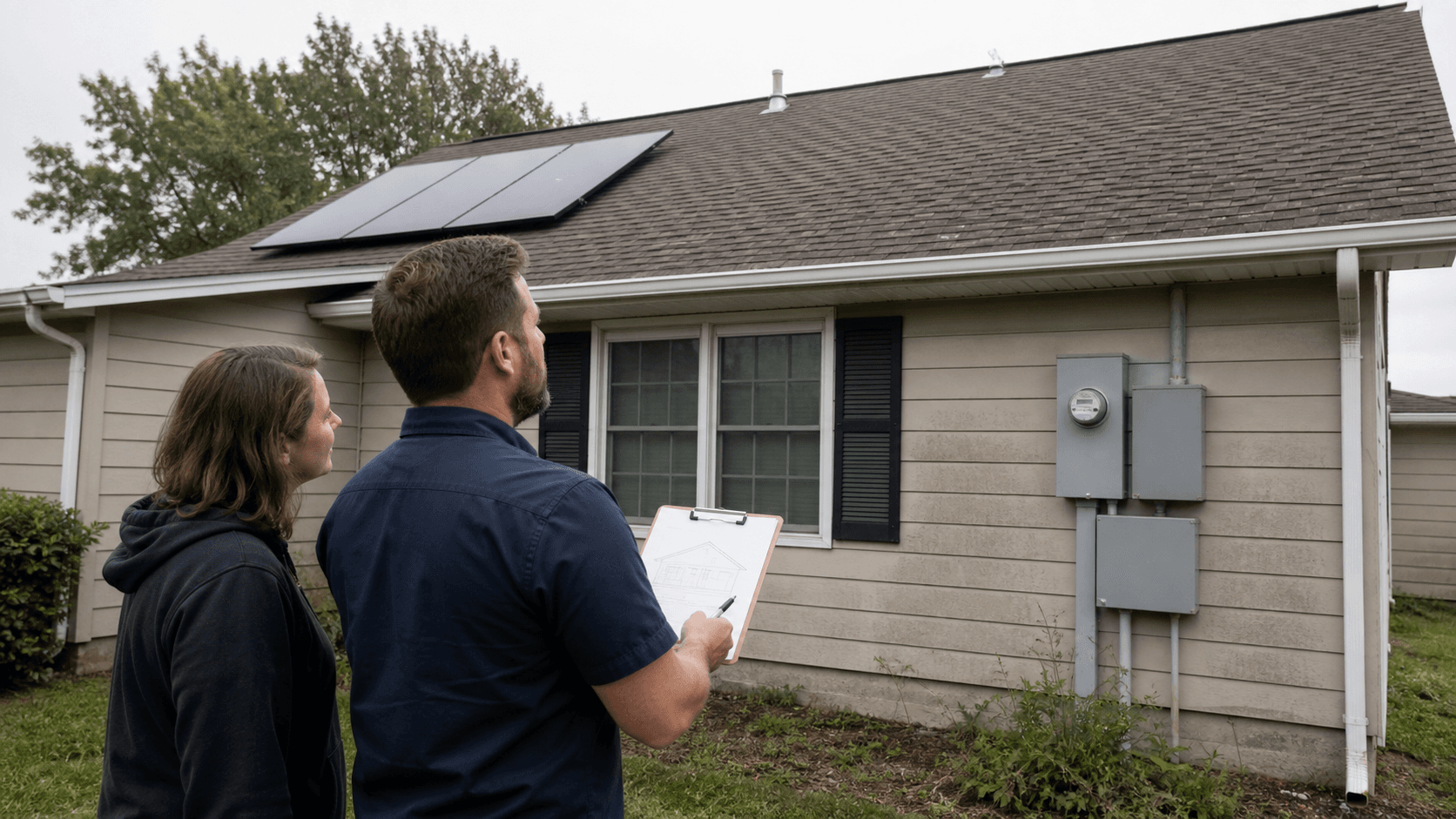
Plan the finished home system before buying phase one
Start at the end. Write down what you eventually want the home to do, even if you will not buy all of it this year. The final plan can change, but it gives the first installer something real to allow for.
Think in household terms. Which rooms or appliances should stay on in an outage? How long does the longest normal outage last? Will an electric vehicle, another air conditioner, a heat pump or a larger workshop load arrive in the next few years? Is the goal a few essential circuits, or a much wider part of the home?
Two measurements will appear in quotations. Kilowatts, written as kW, describe how much power the system can supply at one time. Kilowatt-hours, written as kWh, describe how much energy is available over time. A large battery may offer more hours, but it does not automatically let the home run more high-power appliances together. More solar panels can collect more energy, but they do not automatically increase the backup inverter's output.
Use recent electricity bills and, where available, hourly or half-hourly usage data. A load calculator can help turn appliance labels and operating hours into a first estimate. Keep normal daily use and outage use as two separate lists; most homes do not need the washing machine, oven and every air conditioner on the emergency list.
- 1
Choose the backup loads
List the appliances that truly need power during an outage and note which may run together.
- 2
Describe the later home
Add planned electric vehicles, cooling, heating, pumps or other loads that may change the final system.
- 3
Set a phase-two solar range
Use roof space, electricity use and a location-based solar estimate to frame the later array.
- 4
Ask for both stages on one drawing
The quote should show what is installed now, what is reserved and what may still need replacement later.
Three ways to split the project
There is no single correct order. The useful choice depends on the problem that needs attention first.
Battery first can make sense when outages are the immediate concern or when the solar roof work must wait. Ask how the battery charges before solar is added, which circuits it can support and how the later array will connect. Grid charging and time-of-use operation depend on the equipment, electricity plan and local rules.
A small solar-and-battery system can deliver some generation and backup in phase one. It needs a clear route for the additional panels: spare input on the first inverter, a supported second inverter, or another documented design. A solar-first route may suit a home focused on reducing daytime grid use. If storage comes later, the first quotation should still explain whether the existing solar inverter stays, whether another unit will be added and what is needed for outage operation.
Do not choose the order from a slogan such as "battery ready." Ask what the phrase means for the exact models on the quotation.
- First phase
- Battery backup first
- What it solves now
- Keeps the selected backup loads running for the planned period, subject to the final design.
- What must be clear for later
- Future solar connection, available PV input, supported charging route and any new approval.
- First phase
- Small solar plus battery
- What it solves now
- Provides some solar generation and a defined level of outage support.
- What must be clear for later
- Unused solar-input capacity or a documented second-inverter route, plus roof and connection space.
- First phase
- Solar first
- What it solves now
- Offsets some grid electricity while sunlight is available.
- What must be clear for later
- Battery compatibility, backup switching, backed-up circuits and whether the first inverter remains.
| First phase | What it solves now | What must be clear for later |
|---|---|---|
| Battery backup first | Keeps the selected backup loads running for the planned period, subject to the final design. | Future solar connection, available PV input, supported charging route and any new approval. |
| Small solar plus battery | Provides some solar generation and a defined level of outage support. | Unused solar-input capacity or a documented second-inverter route, plus roof and connection space. |
| Solar first | Offsets some grid electricity while sunlight is available. | Battery compatibility, backup switching, backed-up circuits and whether the first inverter remains. |
What ‘expandable’ should mean on a quotation
An expandable battery label is only one piece of the system. Ask the supplier or installer to turn each claim into a model number, a limit and a drawing.
The inverter is the equipment that manages power between the solar panels, battery, grid and household. Some units include solar input channels, often called MPPTs. A future array needs a suitable place to connect within the voltage, current and power limits of the exact inverter. A spare-looking socket is not proof of usable capacity.
Battery expansion needs the same care. The later module may need to be the same model or part of a supported product family. The battery's built-in control system, commonly called the BMS, must communicate correctly with the inverter and with the other batteries. Age, software version and the manufacturer's expansion rules may also matter. Ask for the current compatibility document and the permitted module count instead of accepting "48V lithium compatible" as the full answer.
The house itself needs room to grow. Include roof area, equipment location, wall clearance, cable routes, distribution-board space and the planned backup circuits. Local fire, building, electrical and utility requirements can change the practical layout. These decisions belong with the responsible local professionals.
- Sales phrase
- Expandable battery
- The useful follow-up question
- Which exact modules can be added, how many, and are there age or software limits?
- Evidence to keep
- Battery manual, inverter compatibility list and the quoted module arrangement.
- Sales phrase
- Solar ready
- The useful follow-up question
- Where will the future panels connect, and how much input remains after phase one?
- Evidence to keep
- Inverter model, input limits and a phase-one/phase-two system drawing.
- Sales phrase
- Whole-home backup
- The useful follow-up question
- Which appliances can run together, and for how long under the stated assumptions?
- Evidence to keep
- Load list, backed-up circuit schedule, power limits and usable-energy assumptions.
- Sales phrase
- Easy future upgrade
- The useful follow-up question
- What work, equipment and approvals will be repeated in phase two?
- Evidence to keep
- A separate second-stage scope with included work and exclusions.
| Sales phrase | The useful follow-up question | Evidence to keep |
|---|---|---|
| Expandable battery | Which exact modules can be added, how many, and are there age or software limits? | Battery manual, inverter compatibility list and the quoted module arrangement. |
| Solar ready | Where will the future panels connect, and how much input remains after phase one? | Inverter model, input limits and a phase-one/phase-two system drawing. |
| Whole-home backup | Which appliances can run together, and for how long under the stated assumptions? | Load list, backed-up circuit schedule, power limits and usable-energy assumptions. |
| Easy future upgrade | What work, equipment and approvals will be repeated in phase two? | A separate second-stage scope with included work and exclusions. |
Why 5kW now and 10kW later may need more than five extra kilowatts
Suppose the first idea is a 5kW rooftop array, with a later target of about 10kW. The open roof area is encouraging, but the roof is not the only limit.
The first inverter may already be using every suitable solar input. The approved connection or export setting may also limit the later system. New panels bought several years later may have different electrical and physical characteristics from the first group. They may need a separate input or another inverter rather than being placed into the original group. That can be a perfectly workable design, but it should appear in the phase-two plan and budget.
There may also be a second round of roof access, labour, protection work, monitoring changes, paperwork and commissioning. In some locations the expanded system needs a new permit or utility review. The U.S. Department of Energy uses the idea of a "solar-ready" home for a reason: planning the route, electrical space and site layout early can make panels easier to add later. The exact rules still come from the local authority and utility.
A staged installation is not automatically a bad financial choice. It can solve an urgent backup problem and spread the spending over time. Compare the total two-stage scope rather than the phase-one equipment price alone. Ask each bidder to show which first-stage items remain useful and which might be replaced when the final array is installed.
A simple quote comparison
The example below is invented to show how to compare two approaches. It is not a price comparison, a product recommendation or a customer project.
Both quotations can run the agreed phase-one loads. Quote A stops there. Its solar inputs are already spoken for, and it gives no supported route for adding the planned battery module. Quote B includes a drawing for the finished system, names the supported later battery and reserves a clear solar-expansion route.
Quote B is easier to plan around, but that does not prove it is the better purchase. The final decision still depends on the equipment quality, actual limits, local support, warranty, phase-two costs and whether the homeowner is likely to complete the expansion. The point is that the difference is visible before the order is placed.
- Planning item
- Phase-one backup
- Illustrative Quote A
- Lists the battery and inverter only.
- Illustrative Quote B
- Lists the equipment, backed-up circuits and agreed operating assumptions.
- Planning item
- Later solar
- Illustrative Quote A
- Says panels can be added, without showing where.
- Illustrative Quote B
- Shows the reserved input or supported second-inverter route and its limits.
- Planning item
- Later battery
- Illustrative Quote A
- Described as expandable.
- Illustrative Quote B
- Names the compatible module family, allowed quantity and evidence to recheck before purchase.
- Planning item
- Second-stage work
- Illustrative Quote A
- Not listed.
- Illustrative Quote B
- Separates likely equipment, labour, approval and commissioning work, with exclusions.
| Planning item | Illustrative Quote A | Illustrative Quote B |
|---|---|---|
| Phase-one backup | Lists the battery and inverter only. | Lists the equipment, backed-up circuits and agreed operating assumptions. |
| Later solar | Says panels can be added, without showing where. | Shows the reserved input or supported second-inverter route and its limits. |
| Later battery | Described as expandable. | Names the compatible module family, allowed quantity and evidence to recheck before purchase. |
| Second-stage work | Not listed. | Separates likely equipment, labour, approval and commissioning work, with exclusions. |
Illustrative procurement example only. It contains no real prices, customer results or guaranteed expansion route.
Keep a phase-two folder
Several years can pass between the two installations. The salesperson may move, an app may change and a product page may disappear. Keep the information needed to understand the first system without guessing.
Save the final quotation, full model codes, datasheets, manuals, system drawing, panel layout, battery compatibility evidence, commissioning record, settings record where it can be safely provided, permits, utility approval and warranty terms. Add clear photographs of equipment labels and the finished installation. Do not rely on an app screenshot as the only record.
When phase two begins, have the current installer inspect the site and check the latest manufacturer documents. The old drawing records the intention; it does not override updated product instructions, equipment condition or local requirements. NREL's PVWatts can help compare location-based production estimates for the first and final PV sizes, but it does not choose the battery, confirm backup runtime or approve an electrical design.
- The first-stage system drawing and a second-stage concept drawing.
- Exact model codes, manuals, datasheets and current compatibility documents.
- Installed quantities, panel layout, equipment labels and commissioning records.
- The backed-up circuit list and the household loads used for the original estimate.
- Permits, utility or programme approval, export limits and warranty conditions.
- A phase-two cost scope showing equipment that stays, equipment that may change and work that may be repeated.
Common questions about installing in stages
Can I install a home battery before solar panels?
Often, yes. A suitable system may charge from the grid and provide the designed backup function before solar is added. Confirm that the exact inverter supports the future PV route, that grid charging is allowed under the local tariff and rules, and that the phase-one installation includes the required backup equipment.
Can a 5kW solar system be expanded to 10kW later?
Sometimes, but the open roof area does not answer the whole question. The installer must check the exact inverter inputs, panel arrangement, connection capacity, export limit, structure, protection and local approval. The expansion may use the first inverter, a second inverter or a redesigned system.
Should I buy a much larger inverter now?
Not automatically. A larger inverter may create useful headroom, or it may add cost without solving the real input, battery, grid or backup limit. Ask for the phase-one and final load calculations, the proposed array arrangement and the model-specific operating limits before deciding.
Does an expandable system accept any battery later?
No. Expansion is usually limited to supported battery models and arrangements. Voltage alone is not enough. Check the inverter compatibility list, battery control communication, allowed module count, software requirements and the manufacturer's rules again when the later battery is ordered.
Related Articles
How do solar panels perform in clouds, heat, salt air and dust?
A panel's watt rating cannot describe every site. Learn what changes in cloudy, hot, coastal and dusty locations, and which details belong in a supply quote.
Read Article→
How to compare solar battery specifications before buying
Two batteries with the same kWh label can do different jobs. Here is how to read the numbers, check the missing details and compare like-for-like quotes.
Read Article→
Solar self-consumption and grid export: what equipment do you need?
For project buyers, installers and distributors: what to source as an equipment package, what to arrange locally, and what a useful supply quote should include.
Read Article→