
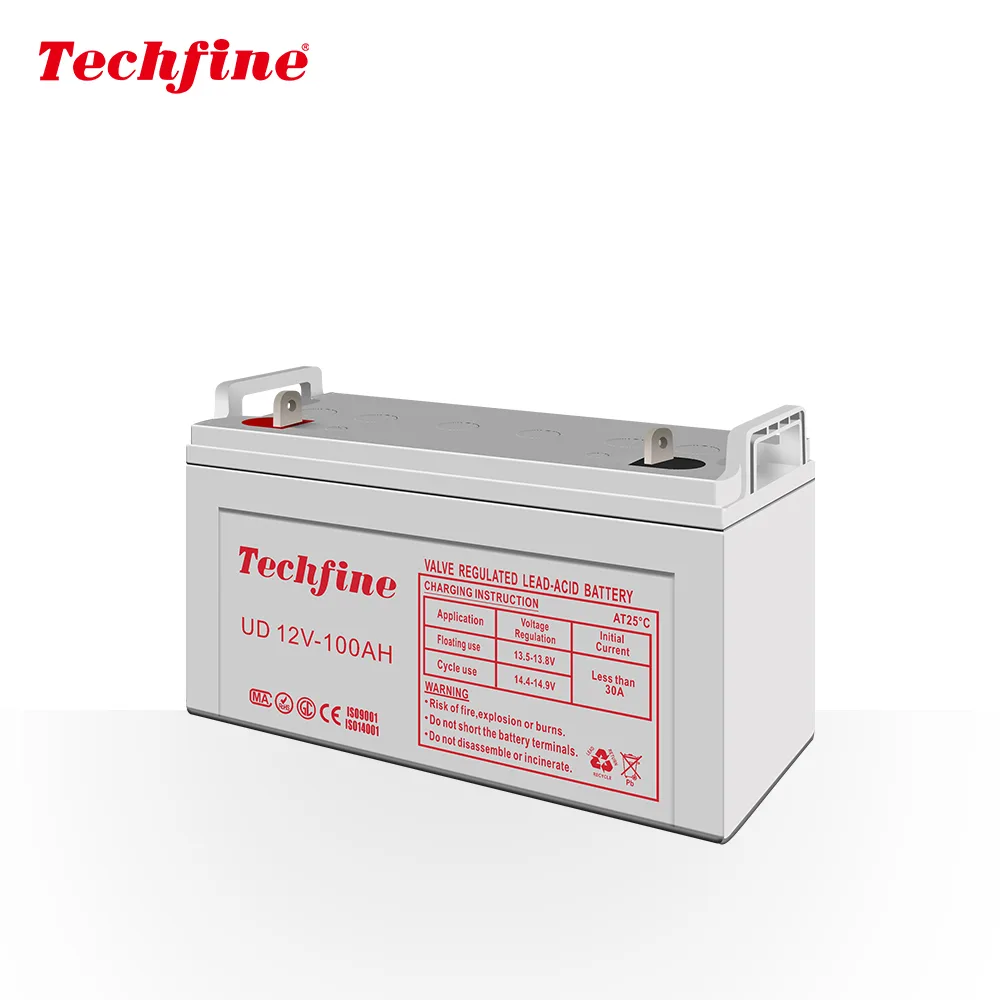
Techfine 12 V 100 Ah short lead-acid battery: Verify Capacity, Case and Duty
This page preserves the current source record for the Techfine 12 V 100 Ah short lead-acid battery. 100 Ah at 10-hour rate; 406 × 174 × 215 mm container; about 28.6 kg. Capacity depends on its stated rate, cutoff and temperature; it must not be converted into a universal runtime or bank-design claim.
Current source route: 12 V 100 Ah short lead-acid battery.
Current source parameter table
This table is preserved from the current source record. Read it with the identity, compatibility and document boundaries below; unresolved conflicts are not corrected by assumption.
| Nominal Voltage | 12V | |
|---|---|---|
| Nominal Capacity(20HR) | 100AH | |
| Dimension | Length | 406±3mm (15.98 inches) |
| Width | 174±2mm (6.85 inches) | |
| Container Height | 215±2mm (8.46inches) | |
| Total Height (with Terminal) | 233±2mm (9.17inches) | |
| Approx Weight | Approx 28.6 kg(63.05lbs) | |
| Terminal | T11 / T10 | |
| Container Material | ABS | |
| Rated Capacity | 104.0AH/5.20A | (20hr,1.80V/cell,25°C/77°F) |
| 100.0 AH/10.0A | (10hr,1.80V/cell,25°C/77°F) | |
| 86.0 AH/17.2A | (5hr,1.75V/cell,25°C/77°F) | |
| 78.0 AH/26.9A | (3hr,1.75V/cell,25°C/77°F) | |
| 61.0 AH/61.0A | (1hr,1.60V/cell,25°C/77°F) | |
| Max. Discharge Current | 1200A (5s) | |
| Internal Resistance | Approx 4.8mΩ | |
| Operating Temp.Range | Discharge:-15~50℃ (5~122°F) | |
| Charge: 0~40°C(32~104°F) | ||
| Storage:-15~40°C(5~104°F) | ||
| Nominal Operating Temp. Range | 25 ±3°C(77±5°F) | |
| Cycle Use | lnitial Charging Current less than 30.0 A.Voltage | |
| 14.4V~15.0V at 25℃(77°F)Temp.Coefficient -30mV/℃ | ||
| StandbyUse | No limit on Initial Charging Current Voltage | |
| 13.5V~13.8V at 25℃(77F)Temp.Coefficient -20mV/℃ | ||
| Capacity affectedby Temperature | 40°C (104°F) | 103% |
| 25℃(77°F) | 100% | |
| 0℃(32°F) | 86% | |
| Self Discharge | Techfine batteries may be stored for up to 6monthsat 25°C(77°F)and then a freshening charge is required. Forhigher temperatures the time interval will be shorter. | |
Current document status
Request the current exact-model datasheet, charge/float limits, discharge table, terminal drawing, production revision and transport files before order release.
Current battery evidence
Keep capacity rate and physical format together
Battery bank design needs the exact cell construction, rate, temperature, case, terminals and charging limits.
Current record
100 Ah at 10-hour rate; 406 × 174 × 215 mm container; about 28.6 kg
Capacity boundary
Ah is rate- and cutoff-dependent. Confirm the exact discharge table, temperature and end voltage before calculating usable energy or runtime.
Construction and charging
Lead-acid, gel and AGM labels are not interchangeable. Confirm exact construction, cyclic/standby duty, charge/float/equalize limits and temperature compensation.
Bank integration
Confirm series/parallel count, charger/controller settings, BMS if applicable, fuse/cable, ventilation, enclosure, terminals and maintenance access.
Battery RFQ checks
Six checks before finalizing the battery bank
A battery page is one component of a defined DC system and operating duty.
Exact model
Request model, nameplate, construction and current datasheet.
Energy and runtime
State load watts, discharge rate, cutoff, reserve, temperature and target autonomy.
Charge settings
Confirm charger/controller voltage, current, float/equalize rules and temperature compensation.
Mechanical fit
Confirm case, terminal, dimensions, mass, clearance, rack/cabinet, cable and service access.
Duty and environment
Confirm cyclic or standby profile, ambient temperature, ventilation, installation orientation and maintenance.
Evidence and supply
Request test basis, safety/transport files, packing, warranty, sample, lead time and substitution controls.
Battery boundaries
A 12 V Ah headline is not a runtime or compatibility guarantee
Final bank performance depends on rate, temperature, charging, age, wiring and exact battery construction.
Capacity is conditional
Do not use an Ah headline without its discharge rate, cutoff, temperature and test basis.
Construction needs confirmation
Gel, AGM and lead-acid terminology needs an exact model document; do not infer electrolyte, valve regulation or maintenance requirement.
Runtime requires system inputs
Actual load, inverter losses, cable losses, reserve, battery condition and temperature determine runtime.
Documents control the order
Packing, transport, warranty, production revision, terminal and installation data must match the quoted exact model.
Continue the battery review
Define bank energy and export evidence
Use existing guidance to prepare the actual system inputs and document request.
Lead-acid battery FAQ
Questions to close before quotation
The exact model document and bank design remain decisive.
What capacity applies to this 12 V 100 Ah short lead-acid battery?
The current source record is 100 Ah at 10-hour rate; 406 × 174 × 215 mm container; about 28.6 kg. Confirm the exact discharge-rate table, cutoff and temperature before sizing.
Can capacity be used as a runtime value?
No. Runtime needs load, discharge rate, inverter losses, cutoff, reserve, temperature, battery condition and bank wiring.
Are gel, AGM and lead-acid labels interchangeable?
No. Confirm exact construction, charge/float/equalize settings, duty cycle, terminals and maintenance requirements from the current model document.
Which documents should the RFQ include?
Request exact datasheet, nameplate, discharge table, charge settings, dimensions/terminal drawing, test/transport files, warranty and packing.
Prepare a verified 12 V 100 Ah short lead-acid battery RFQ
Send load and autonomy target, charge source/settings, environment, bank layout, case/terminal constraints and required documents.
Verify Battery ConfigurationRelated products
 Lead Acid Battery
 Lead Acid Battery
 Lead Acid Battery
Techfine Gel Battery 12v 250ah Lead Acid AGM Batteries For Solar Home System
Minimum order quantity (MOQ) ≥5 Pieces;
View Details