
How to size battery storage for backup, self-consumption, and peak shaving
The same battery capacity does not answer three different operating questions.
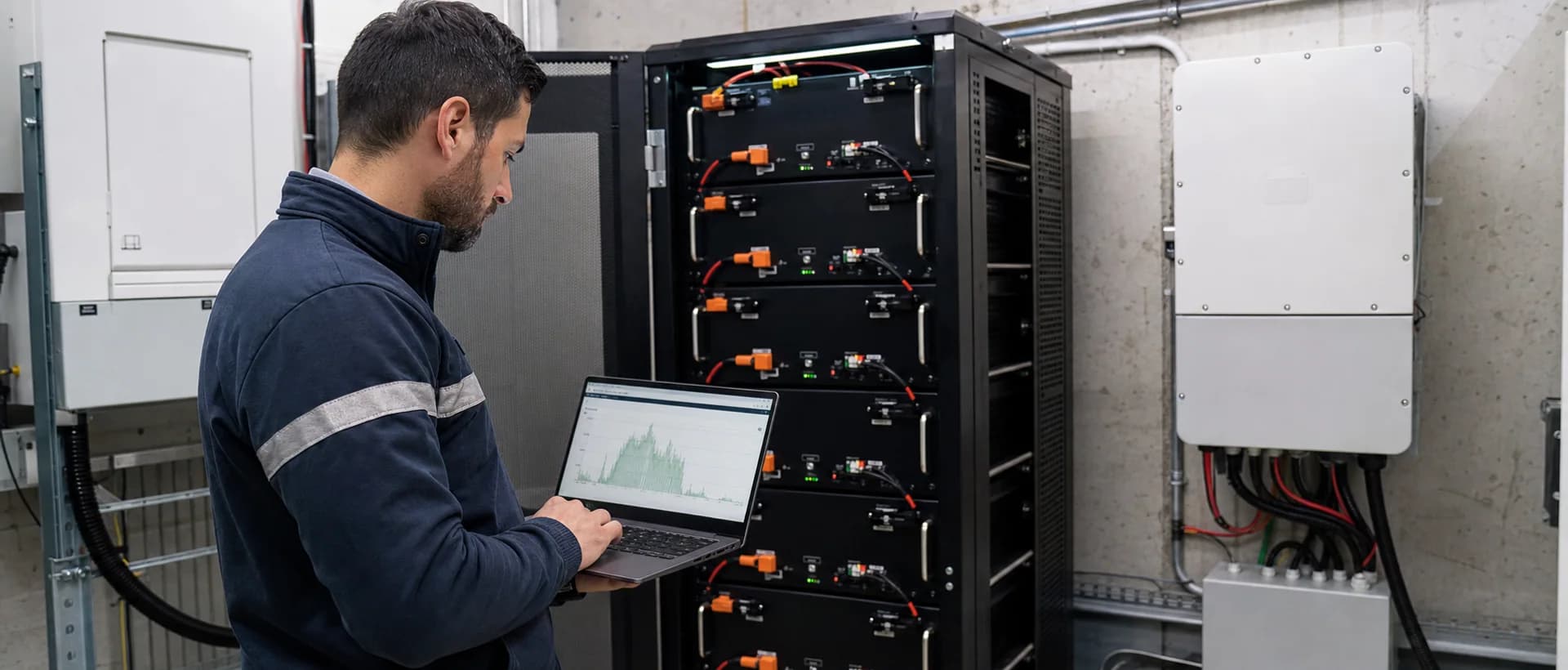
Start with the operating objective. Backup requires a documented critical-load list and target autonomy. Self-consumption requires an interval view of generation and demand. Peak shaving requires demand data, the target peak, the expected discharge window, and the site's tariff logic. Do not quote a battery only from a headline kWh figure.
For every option, record usable energy assumptions, charge and discharge power, inverter limits, BMS pairing, ambient conditions, expansion plan, and the exact control strategy. Ask the responsible engineer or manufacturer channel to confirm the intended configuration. IEC 62619 addresses safety requirements for industrial lithium cells and batteries; it does not size a system for a particular site.
Build the sizing brief before comparing products
Use measured interval data where it is available. If it is not, state that the load profile is estimated and show the assumptions. A battery proposal should distinguish energy (how long a defined load can be supported) from power (how much load can be served at one moment). It should also say whether the quoted capacity is nominal or usable, and under which operating conditions.
For backup, agree which circuits are critical and what happens when the battery reaches its reserve. For self-consumption, agree whether the objective is energy shifting, export limitation, or both. For peak shaving, confirm the tariff measurement interval and whether the controller can respond to the actual peak pattern. These are project questions, so final design and protection decisions belong with the responsible qualified designer.
- Operating objective and the decision metric: outage duration, self-consumption rate, demand peak, or another stated target.
- Load evidence: interval data, critical-load schedule, starting currents, and expected future loads.
- Usable-energy basis, reserve setting, charge/discharge power, and the inverter's backup-output limit.
- Exact battery and inverter models, supported BMS communication, firmware requirement, and expansion limit.
- Ambient temperature, installation location, ventilation, and local safety or fire requirements for the site.
Can kWh alone tell us the backup time?
No. Backup time depends on usable energy, the actual critical load, discharge limits, reserve setting, temperature, and inverter capability. Quote a load assumption alongside any autonomy estimate.
Avoid three sizing shortcuts
Do not translate a household's monthly electricity bill directly into battery capacity. It does not reveal the time of use, the critical-load share, short peaks, or what solar production is available at the time of discharge. Likewise, do not use nominal battery capacity as if it were delivered energy at every temperature and power level.
A final shortcut is to size only the battery and overlook the inverter's backup output and surge capability. A large energy figure cannot make a small backup circuit carry a larger instantaneous load. Ask the responsible designer to review the actual load and protection arrangement before committing to a backup promise.
What should a buyer compare between two battery proposals?
Compare the stated objective, load basis, usable-energy assumption, charge/discharge power, inverter pairing, control strategy, installation conditions, warranty terms, and what remains to be confirmed—not only the nominal kWh figure.
Related Articles
How do solar panels perform in clouds, heat, salt air and dust?
A panel's watt rating cannot describe every site. Learn what changes in cloudy, hot, coastal and dusty locations, and which details belong in a supply quote.
Read Article→
How to compare solar battery specifications before buying
Two batteries with the same kWh label can do different jobs. Here is how to read the numbers, check the missing details and compare like-for-like quotes.
Read Article→
Solar self-consumption and grid export: what equipment do you need?
For project buyers, installers and distributors: what to source as an equipment package, what to arrange locally, and what a useful supply quote should include.
Read Article→