
UN 38.3, SDS, and battery export documents: what to check
Transport paperwork must identify the actual cell or battery type being shipped.
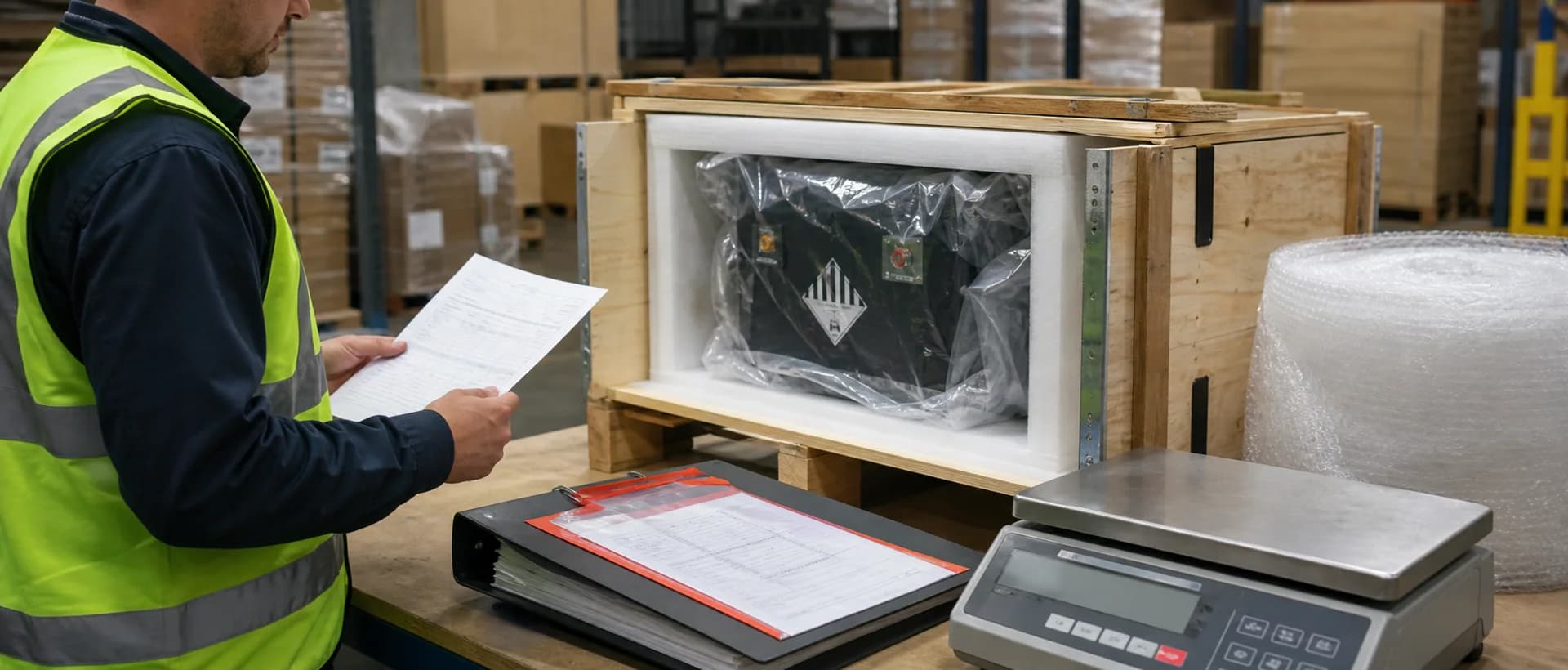
For a battery shipment, begin with the exact product and configuration: chemistry, battery type, nominal voltage, capacity or watt-hours, whether it is standalone or packed with equipment, and the transport mode. The carrier or forwarder then determines the applicable booking, declaration, packaging, marking, and documentation requirements.
Keep the battery test summary, safety data sheet where required, product specification, packing data, and commercial documents aligned to that exact product. The UN framework requires manufacturers and subsequent distributors to make the lithium battery test summary accessible so parties in the supply chain can confirm compliance. Do not use a test summary from a different model as a substitute.
Use a model-matched transport file
A battery test summary, SDS, and transport acceptance are related but different records. The test summary relates to the applicable UN Manual of Tests and Criteria test information; an SDS communicates hazard information in contexts where it is required; the carrier or forwarder confirms how the planned shipment must be booked and presented. None should be copied from a similar-looking product family without checking the exact model and configuration.
Send the forwarder an early product-data sheet rather than waiting until cargo is packed. Include the product model, cell chemistry, nominal voltage, watt-hours, gross and net weights, package count, whether equipment is included, origin and destination, and requested transport mode. Their instructions should govern the final shipping file and packing approach.
- Exact battery model, chemistry, nominal voltage, capacity or watt-hours, and configuration.
- Current test summary that covers the shipped product; retain the source and revision in the order file.
- SDS if requested for the transaction or transport process, checked against the same model.
- Packing specification, package count, weights, marks, and any carrier-required labels or declarations.
- Written forwarder or carrier confirmation for the intended mode, route, and booking.
Can one UN 38.3 file cover a different battery model?
Do not assume so. Ask the responsible manufacturer channel to confirm the scope. The shipping file must be traceable to the product actually booked.
Keep the carrier decision separate from a product document
A test summary is not a booking approval, and an SDS is not a substitute for carrier instructions. Transport acceptance depends on the actual product, quantity, packaging, mode, route, and the carrier or forwarder’s current process. Send the details early enough to change the plan before production is packed.
If the forwarder requests a revision, record the request and resolve it against the exact shipped model. Do not silently edit values on a shipping document to fit a template; that creates a mismatch between the product, test evidence, and commercial file.
When should the forwarder receive battery details?
At quotation or pre-booking stage, before final packing and vessel/flight booking. Early review is the practical way to identify route, packaging, declaration, or timing constraints.
Related Articles

How do solar panels perform in clouds, heat, salt air and dust?
A panel's watt rating cannot describe every site. Learn what changes in cloudy, hot, coastal and dusty locations, and which details belong in a supply quote.
Read Article→
How to compare solar battery specifications before buying
Two batteries with the same kWh label can do different jobs. Here is how to read the numbers, check the missing details and compare like-for-like quotes.
Read Article→
Solar self-consumption and grid export: what equipment do you need?
For project buyers, installers and distributors: what to source as an equipment package, what to arrange locally, and what a useful supply quote should include.
Read Article→