
How to size solar panels, a home battery and an EV charger for a villa
Size the panels for energy, the inverter for loads that run together, the battery for evening use and backup, and the charger for the car's daily refill.
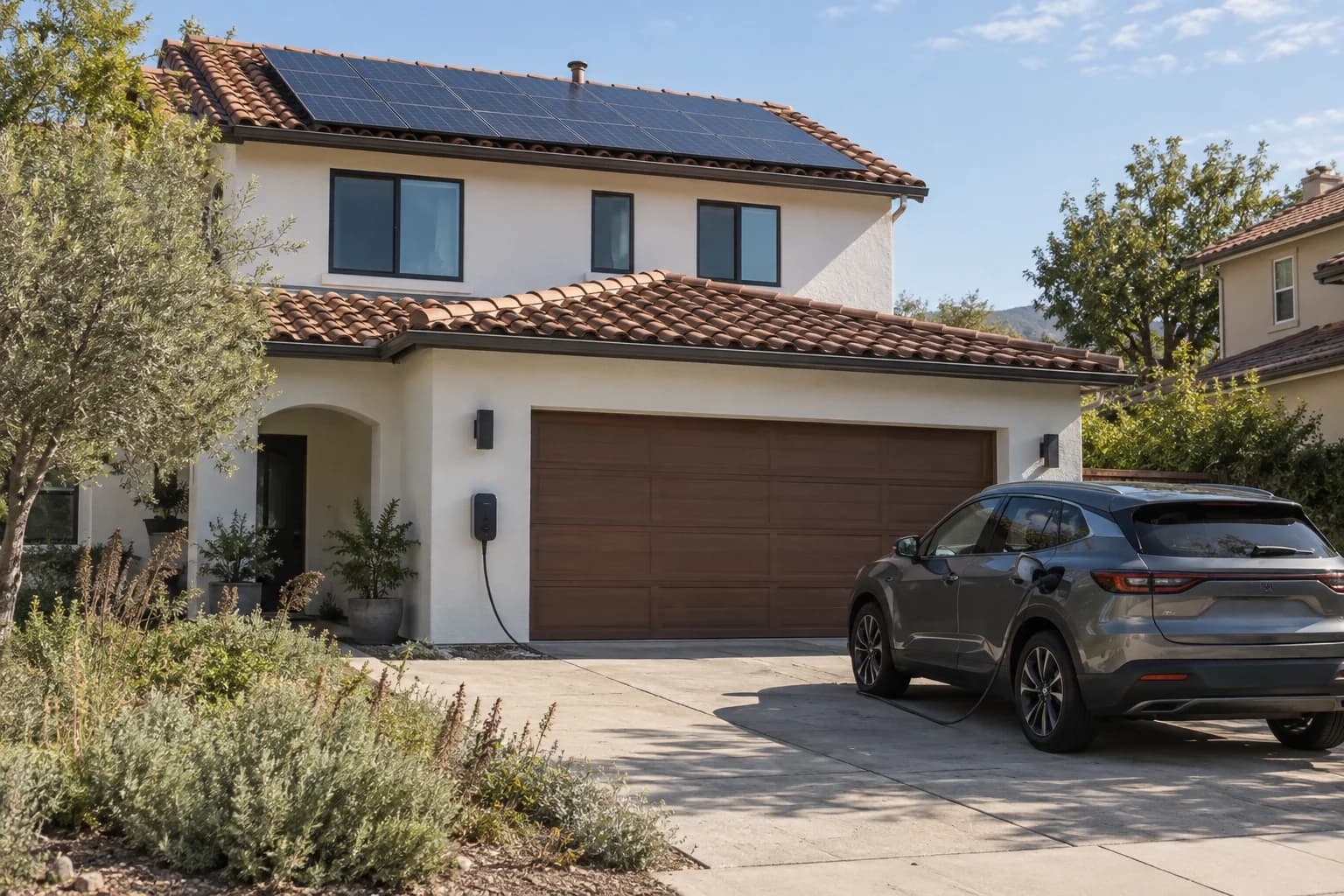
A villa with solar panels, battery storage and an EV charger should not be designed by choosing the same number for every product. A 10kW solar array, a 10kW inverter, a 10kWh battery and a 10kW charger describe four different things. They do not automatically make a balanced system.
The useful starting point is simple. Size the solar array for the energy used by the home and car. Size the inverter for appliances and charging that may happen at the same time. Size the stationary battery for evening use and the loads that need backup. Choose the EV charger around the car's daily refill, parking time and the power available at the property.
This guide shows that process without turning it into an electrical design. The worked figures are made-up teaching examples, not a recommended package or a customer result. A qualified local professional still needs to check the roof, electrical supply, equipment limits, protection and approval requirements. The photographs are illustrative editorial scenes rather than project records.
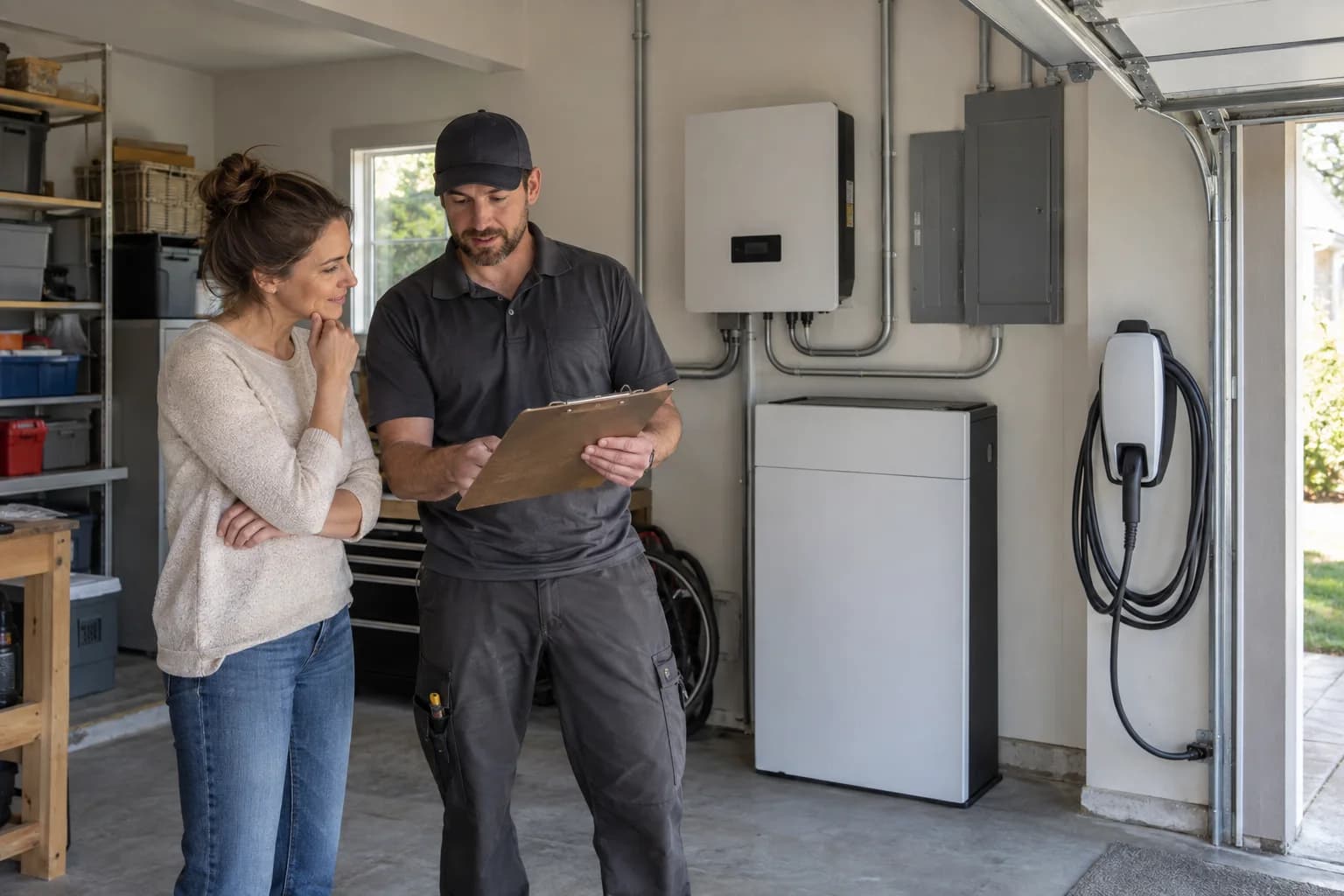
Four parts of the system, four different jobs
Start with the question each item has to answer. Solar-panel capacity is shown in kW, but the owner's real concern is how much energy the array can produce over a day or year. The inverter's kW rating is about how much power it can move at one moment. Battery kWh indicates stored energy, while its kW limit indicates how quickly that energy can be delivered. The EV charger rating is the fastest power it may offer; the car, property supply and control settings can all reduce the actual rate.
This is why a product bundle can look impressive and still be poorly matched. A large charger may sit below its maximum most nights because the car has many hours to charge. A large battery may add little value if it is already full before midday and the home uses very little after sunset. A large inverter does not create more sunlight or battery energy.
Keep these four jobs on separate lines when comparing quotations. They come together in the final system, but they should not be justified by one headline number.
- System part
- Solar array
- Main question
- How much energy should it produce?
- Useful input
- Home use, EV charging and local solar yield
- System part
- Hybrid inverter
- Main question
- What may need power at the same time?
- Useful input
- Likely overlapping loads, phase and operating mode
- System part
- Home battery
- Main question
- What should run after sunset or during an outage?
- Useful input
- Usable energy, load power, hours and reserve
- System part
- EV charger
- Main question
- How much energy must reach the car before it leaves?
- Useful input
- Daily driving, parking time and vehicle charge limit
| System part | Main question | Useful input |
|---|---|---|
| Solar array | How much energy should it produce? | Home use, EV charging and local solar yield |
| Hybrid inverter | What may need power at the same time? | Likely overlapping loads, phase and operating mode |
| Home battery | What should run after sunset or during an outage? | Usable energy, load power, hours and reserve |
| EV charger | How much energy must reach the car before it leaves? | Daily driving, parking time and vehicle charge limit |
kW describes power at a moment; kWh describes energy used or stored over time. A quotation needs both where they apply.
Add the car's daily refill, not its full battery size
An electric car may have a large traction battery, but most owners do not empty it every day. Planning the home around one full charge can make the solar array, stationary battery and inverter much larger than the daily routine requires.
Use recent driving instead. Find the distance normally travelled in a day and the car's energy use for that distance. The vehicle or charger app may already show how many kWh are added during a normal week. Divide that weekly figure by the number of charging days, then allow for the difference between energy drawn from the wall and energy stored in the car where suitable data is available.
Suppose the charger records 55kWh drawn across five ordinary charging nights. The planning figure is about 11kWh per charging day, not the car's full battery capacity. If the car is parked for eight hours, that 11kWh represents an average of about 1.4kW across the whole window. It may still make sense to install a faster charger, but the example shows why maximum charging speed and daily energy need are different questions.
Occasional long trips can be handled separately. The owner may accept a longer home charging session, use grid power, or use public fast charging rather than building the entire household system around a rare journey.
Estimate the solar array from the home and EV together
Add the home's normal daily electricity use to the energy usually drawn by the car. Then compare that total with realistic solar production for the roof and location. Roof direction, shade, temperature, panel layout and seasonal weather all affect the result. One generic “hours of sun” number is not enough for a final proposal.
Here is a simple teaching example. Assume the home uses 20kWh a day and the charger draws another 11kWh. The combined target is 31kWh a day. If an early estimate uses four equivalent full-sun hours and an overall production factor of 80%, the arithmetic is 31 ÷ (4 × 0.8), or roughly 9.7kW of panels. This is not a recommendation for a 9.7kW system. It only shows how the inputs connect.
A proper estimate needs local monthly production data and the actual roof. The winter result may matter more than the annual average if the owner expects a high share of home charging all year. The available roof may also set a hard limit. When the array cannot cover every kWh, the design can still be useful: solar supplies part of the home and car demand, while the grid covers the balance.
Choose the inverter and charger around busy periods
The inverter has to deal with what happens at the same time, not the total energy used across a day. Air conditioning, cooking, water heating, a pool pump and EV charging can overlap even when the daily kWh figure looks reasonable.
Write down one believable busy period. For example, the air conditioning and ordinary house loads may be using 4kW, cooking adds 2kW, a pump adds 1kW and the car begins charging at 7kW. The total is 14kW in this simplified example. That does not automatically mean the home needs a 14kW or larger hybrid inverter. With the grid present, the system may be allowed to import the difference. A smart charger may also slow or pause the car while cooking and the pump are running.
Charging control can be more useful than buying extra capacity for an overlap that lasts twenty minutes. Ask whether the charger can follow surplus solar, use a schedule, respect a whole-property power limit and restart sensibly after an interruption. Also check the car's own AC charging limit: a charger cannot force the vehicle to accept more power than it supports.
The property's supply and phase arrangement still matter. A single-phase and three-phase home can use the same total energy but need different equipment and load planning. The quotation should state the exact inverter and charger models, phase, continuous limits and what happens when the grid is available versus unavailable.
Size the home battery for a clear job
A home battery can move daytime solar into the evening, reduce purchases during expensive hours or keep selected loads running during a power cut. These goals can overlap, but the owner should say which one comes first.
For evening use, list what normally runs after solar production falls. For backup, make a shorter list of what must stay on. If selected loads average 1kW and the owner wants them for eight hours, they need roughly 8kWh delivered to those loads before allowing for reserve, conversion losses and equipment limits. That is a clearer starting point than choosing a battery because its brochure says “whole home.”
Do not assume the stationary battery must be large enough to fill the EV battery. Sending stored energy from one battery into another uses a lot of capacity and passes through conversion equipment. It may be a deliberate choice for a particular owner, but it should be priced and modelled as such. Many homes get more value by charging the car from daytime solar when it is parked, scheduling it for a suitable grid period, and keeping the stationary battery for household evening use or outages.
Battery power matters as well as battery energy. The exact battery and inverter pairing must support the intended charge and discharge rate. A large kWh number does not prove that air conditioning, pumps and vehicle charging can all run from the battery at once.
Decide how the system should behave before choosing models
There is no single best order for using solar energy. A home focused on bill savings may let flexible EV charging follow midday surplus. A home focused on backup may protect part of the stationary battery instead of using every available kWh overnight. Someone who needs the car ready early may allow grid charging even when stored solar is available for the house.
Write the priority in plain language. For example: “Keep 30% of the home battery for outages, charge the car from spare solar when it is parked, and use the grid if the car still needs energy by 11 p.m.” That sentence tells the system designer far more than asking for a “smart solar package.”
Before comparing equipment, collect the information below. It is enough for a useful first discussion without pretending that the final electrical design is complete.
- Twelve months of electricity use, or the best available daily and seasonal figures.
- EV model, normal driving distance, energy added during a typical week and usual parking hours.
- Large household loads that may overlap with charging, including air conditioning, pumps and water heating.
- The appliances that must run during an outage and the required backup time.
- Roof area, shade, existing electrical supply and whether the property is single-phase or three-phase.
- Current electricity prices, export arrangement and any time periods that change the value of charging or storage.
- Likely changes such as a second EV, more air conditioning, a heat pump or a larger pool pump.
Can solar panels charge the home battery and EV at the same time?
Yes, if solar production is high enough and the inverter, battery, charger, vehicle and site limits allow both paths. When production is lower, the controls can split the available power, slow the car, use the grid or give one load priority.
Will the EV charger work during a power outage?
Not automatically. The charger must be on a supported backup path, and the inverter and battery must be able to supply it alongside the protected household loads. Many owners exclude or limit EV charging during an outage to preserve energy for the home.
Do I need a larger home battery because I own an EV?
Only if the plan is for the stationary battery to supply some of the car's charging or if the EV changes when household solar is available. If the car charges directly from daytime solar or the grid, its full traction-battery capacity does not need to be copied into the home battery.
Related Articles

Solar only vs solar plus battery: which pays back faster?
Solar alone often pays back sooner on bill savings. A battery can change the calculation, but the extra cost and extra savings need their own line.
Read Article→
Best solar panels for a tiny house: start with the work, not the panel
A tiny roof and a three-hour work session can make solar look simple. The missing loads, battery reserve and poor-sun days usually decide whether it really is.
Read Article→
Hybrid inverter or separate solar and battery inverters: which is better for power cuts?
A separate battery inverter can be simple and independent. A hybrid system can make better use of solar during an outage. The right choice depends on the backup job and what is already installed.
Read Article→