
Solar only vs solar plus battery: which pays back faster?
Solar alone often pays back sooner on bill savings. A battery can change the calculation, but the extra cost and extra savings need their own line.

If you are choosing between solar panels alone and solar plus a battery, solar alone often pays back faster from electricity-bill savings. It costs less to install. The battery has to save enough extra money to earn back its extra price.
That is a starting answer, not a rule for every home. A battery may save more where exported solar earns little, electricity bought later costs much more, and the household regularly has both midday surplus and evening demand. Where exports receive nearly the same value as later imports, the bill-saving case for a battery can be weak. Some owners still choose one for backup power; that is a separate benefit.
Below, we compare two new installations for the same home. If solar is already installed, the question is different: compare the full cost of a battery retrofit against the bills and export data from the existing system. The figures in this article are invented to teach the method. They are not market prices, savings promises or customer results. The photographs are illustrative editorial scenes, not project records.

Put the two quotes on the same footing
Ask for a solar-only quote and a solar-plus-battery quote based on the same roof, solar-panel capacity, household use and electricity plan. Otherwise a larger solar array in one quote may look like a benefit of the battery. Keep equipment and installation scope visible too: a battery may change the inverter choice and add controls, metering, electrical work or backup hardware.
Start with the annual bill the home would pay without either system. For each quote, estimate the bill after installation, including any payment or credit for solar sent to the grid. The difference is that option's annual bill saving. Check whether fixed supply charges remain in all three bills; do not claim they disappear unless the applicable plan actually removes them.
For a first look, simple payback is installed cash cost divided by annual bill saving. It is easy to understand, but it assumes the same saving every year and ignores financing, future prices, maintenance, performance changes and replacements. A fuller decision uses year-by-year cash flow. Keep those two methods clearly labelled rather than presenting one simple figure as a guaranteed return.
One made-up example, with the battery shown separately
Suppose the home's current electricity bill is $2,400 a year. Both proposed systems use the same solar array and the same electricity plan. The figures below are a fictional teaching example, in an arbitrary dollar currency. The quoted installed prices are assumed to be paid in cash, with no incentives, loan interest, maintenance or future bill changes in this simplified illustration.
Solar alone costs $12,000 and leaves an annual bill of $800, so it saves $1,600 a year: $12,000 ÷ $1,600 = 7.5 years of simple payback. Solar plus battery costs $18,000 and leaves an annual bill of $400, so it saves $2,000 a year: $18,000 ÷ $2,000 = 9 years. Here, solar alone pays back sooner, even though the battery option produces the lower bill.
Now ask the more useful battery question. Adding the battery costs $6,000 more and saves an additional $400 per year compared with solar alone. The battery's incremental simple payback is $6,000 ÷ $400 = 15 years. That number is not the payback of the whole solar-plus-battery system. It is the simplified time needed for the extra battery spending to come back through extra bill savings.
- Same home, fictional inputs
- Installed cash cost
- Solar only
- $12,000
- Solar plus battery
- $18,000
- Same home, fictional inputs
- Annual bill after installation
- Solar only
- $800
- Solar plus battery
- $400
- Same home, fictional inputs
- Annual saving against $2,400 baseline
- Solar only
- $1,600
- Solar plus battery
- $2,000
- Same home, fictional inputs
- Whole-system simple payback
- Solar only
- 7.5 years
- Solar plus battery
- 9 years
- Same home, fictional inputs
- Extra battery cost / extra annual saving
- Solar only
- —
- Solar plus battery
- $6,000 / $400 = 15 years
| Same home, fictional inputs | Solar only | Solar plus battery |
|---|---|---|
| Installed cash cost | $12,000 | $18,000 |
| Annual bill after installation | $800 | $400 |
| Annual saving against $2,400 baseline | $1,600 | $2,000 |
| Whole-system simple payback | 7.5 years | 9 years |
| Extra battery cost / extra annual saving | — | $6,000 / $400 = 15 years |
These prices and savings are invented solely to show the arithmetic. They exclude financing, incentives, operating costs and changes over time; they do not establish an expected payback for a real site.
What makes the battery's extra savings larger or smaller?
The battery usually charges when solar production exceeds what the home is using. In the evening it can supply some of the electricity the home would otherwise buy. The value of that shift depends on what the owner would have received for exporting the charging energy, the purchase price avoided later, and how much energy reaches the appliances after losses.
If exported solar is credited at or near the value of later grid purchases, storing it may add little bill value. If the export credit is low and the later purchase price is high, the gap can be more attractive. Even then, the home needs enough midday surplus to charge and enough later demand to discharge. A battery that sits full with no evening load, or empty through a cloudy season, does not earn the same saving as a model that assumes one useful cycle every day.
Keep kWh and kW apart. Usable kWh describes roughly how much energy can be delivered; kW describes how quickly the battery and inverter can deliver or absorb it. Reserve settings, operating limits, standby use and conversion losses reduce the energy actually shifted. They cannot be recovered by multiplying the nameplate battery capacity by 365 and calling it annual savings.
Electricity plans also differ. Some have flat prices, some charge more at certain hours, some add demand charges, and some treat exported energy differently. Current local tariff and export rules—not a generic national average—must be used for a real estimate.
A short payback can still hide a weak comparison
Check the full installed price. One battery quote may include an inverter, switching equipment and labour while the other omits them. A backup-capable system can cost more than a storage system that only shifts energy for bill savings. A quote that compares these as if they were identical is not ready for a payback claim.
Ask what each annual saving actually represents. Has the estimate deducted lost export credits? Does it include the same solar array and shade assumptions? Are fixed charges still there? If battery savings rely on exporting stored energy or special tariff payments, are those uses permitted and reflected in the current plan? An attractive spreadsheet result can disappear when one assumption changes.
Simple payback also ignores when costs occur. Battery performance can change with use and age; the warranty may have time, energy-throughput and capacity conditions. Repairs, replacements, financing and incentives belong in a year-by-year cash-flow comparison if they are material. Do not assume a future incentive or tariff will remain available for the equipment's full life. A long incremental payback especially deserves a check against the documented warranty and plausible operating period; a warranty itself is not a promise that a device stops working on its last day.
Backup power is a different reason to buy a battery
During an outage, keeping a refrigerator, lights or communications running may matter much more to an owner than a few years of bill payback. That preference is real. It does not need a made-up monetary value in the electricity-savings column.
Put a second line beside the financial comparison: which circuits must stay on, for how long, and whether the exact solar, inverter, battery and transfer arrangement can do that during an outage. Solar panels alone normally do not provide ordinary grid-tied households with backup when the grid fails. A solar-plus-battery quote must still include a supported backup design; the presence of a battery does not guarantee whole-home backup.
Someone who wants only the fastest bill-savings payback may choose solar alone. Someone who needs reliable selected-load backup may choose solar and storage even with a longer simple payback. Both decisions can be sensible when the reason is stated honestly.
What to request before comparing real quotes
The useful first step is a pair of quotes with the same solar size and a short explanation of how each estimated bill was calculated. You do not need a perfect forecast. You do need to see the assumptions that could change the answer.
- The same roof, PV capacity, expected production and household-use profile for both options.
- The complete installed cash price and included inverter, battery, backup and electrical work for each quote.
- Current import prices, export-credit rules, fixed charges and any time-of-use periods used in the model.
- Estimated annual grid imports, solar exports, direct solar use and useful battery energy delivered to the home.
- Battery usable energy, power, reserve, losses, warranty terms and an explicit replacement assumption if modelled.
- Bill savings, backup value, incentives and financing shown as separate lines rather than one unexplained payback number.
Which usually pays back faster: solar panels alone or solar with a battery?
Solar alone often has the shorter simple payback on electricity-bill savings because it costs less upfront. Storage can improve the result when the additional value from shifting energy is large enough relative to its full additional installed cost. Compare two quotes using the same home, solar array and tariff.
Can a battery lower my bill but still have a slower payback?
Yes. A lower bill does not automatically pay for a higher purchase price quickly. Divide the battery's extra installed cost by the extra annual bill saving to see its simplified incremental payback, then check financing, operating life and other costs separately.
Should I install solar first and add a battery later?
That can be reasonable if payback and current budget come first, but later storage is a retrofit with its own installed cost and compatibility checks. If you already have solar, use measured import and export data rather than this new-installation example to assess it.
Related Articles

Best solar panels for a tiny house: start with the work, not the panel
A tiny roof and a three-hour work session can make solar look simple. The missing loads, battery reserve and poor-sun days usually decide whether it really is.
Read Article→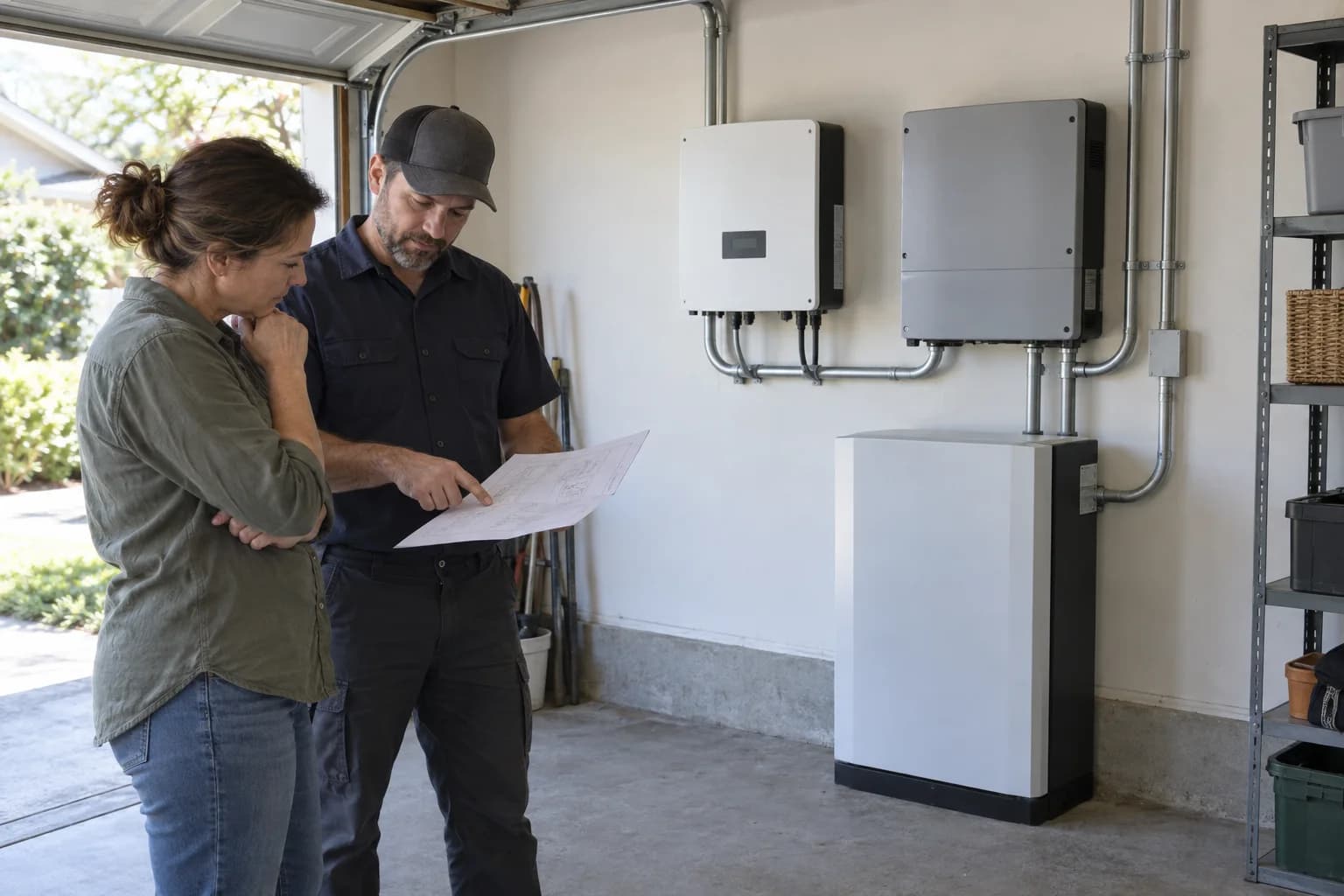
Hybrid inverter or separate solar and battery inverters: which is better for power cuts?
A separate battery inverter can be simple and independent. A hybrid system can make better use of solar during an outage. The right choice depends on the backup job and what is already installed.
Read Article→
Is 15 kWh of home battery enough, or is the next module worth it?
A bigger battery can cover more hours, but the last module may do very little work. Judge it by the expensive electricity it actually avoids, the backup you need and the limits of the full system.
Read Article→