
Hybrid inverter or separate solar and battery inverters: which is better for power cuts?
A separate battery inverter can be simple and independent. A hybrid system can make better use of solar during an outage. The right choice depends on the backup job and what is already installed.
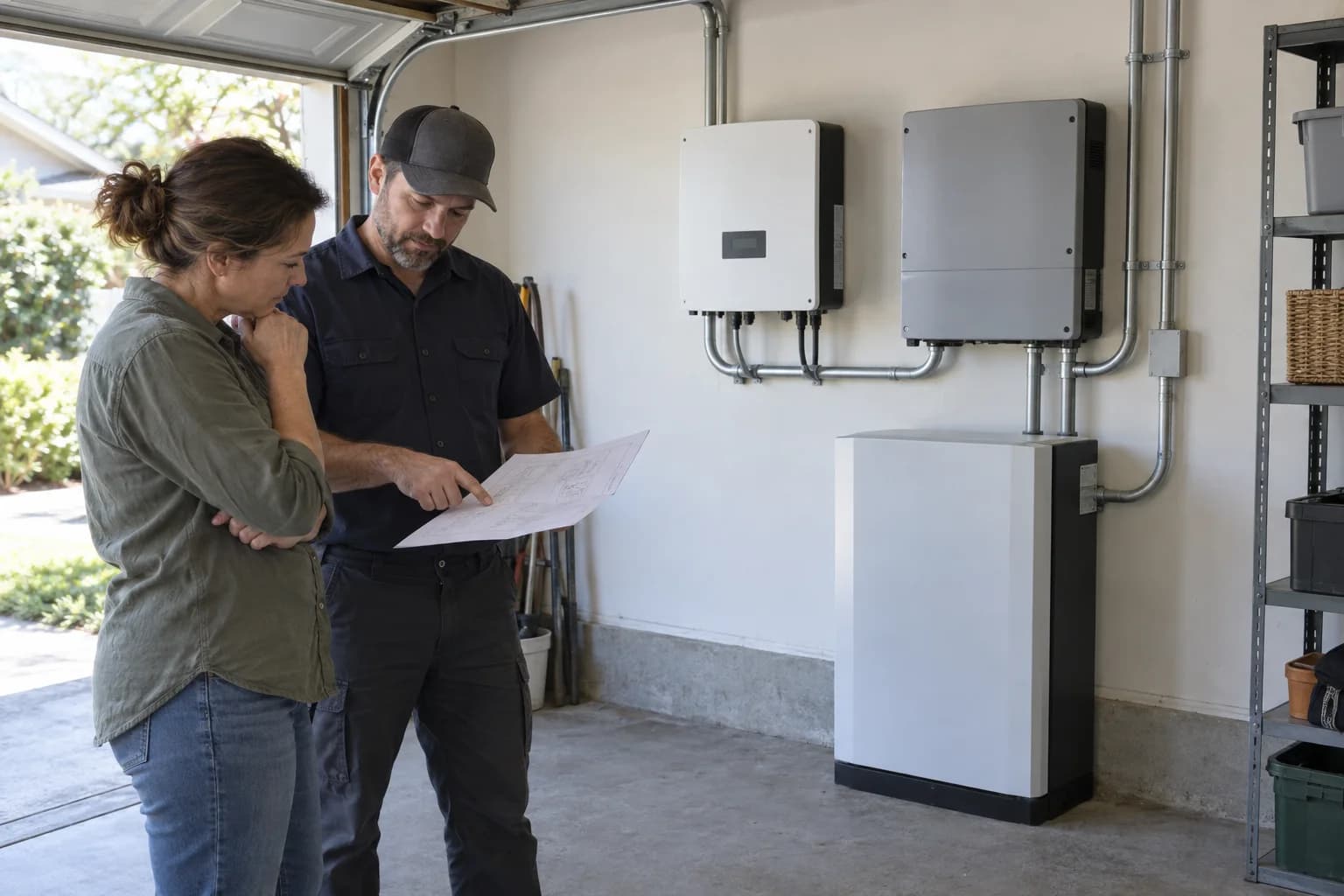
A normal grid-tied solar system can cut the electricity bill every sunny day and still leave the house without power during an outage. That surprises many first-time buyers. The panels may be in full sun, but the solar inverter normally has to stop when the grid disappears.
A separate home inverter and battery can keep selected appliances running. In the simplest version, though, that battery charges from the grid and does not make the stopped solar inverter come back to life. A properly designed hybrid system can coordinate the panels, battery and backup loads, but only within the limits of the exact equipment and system design.
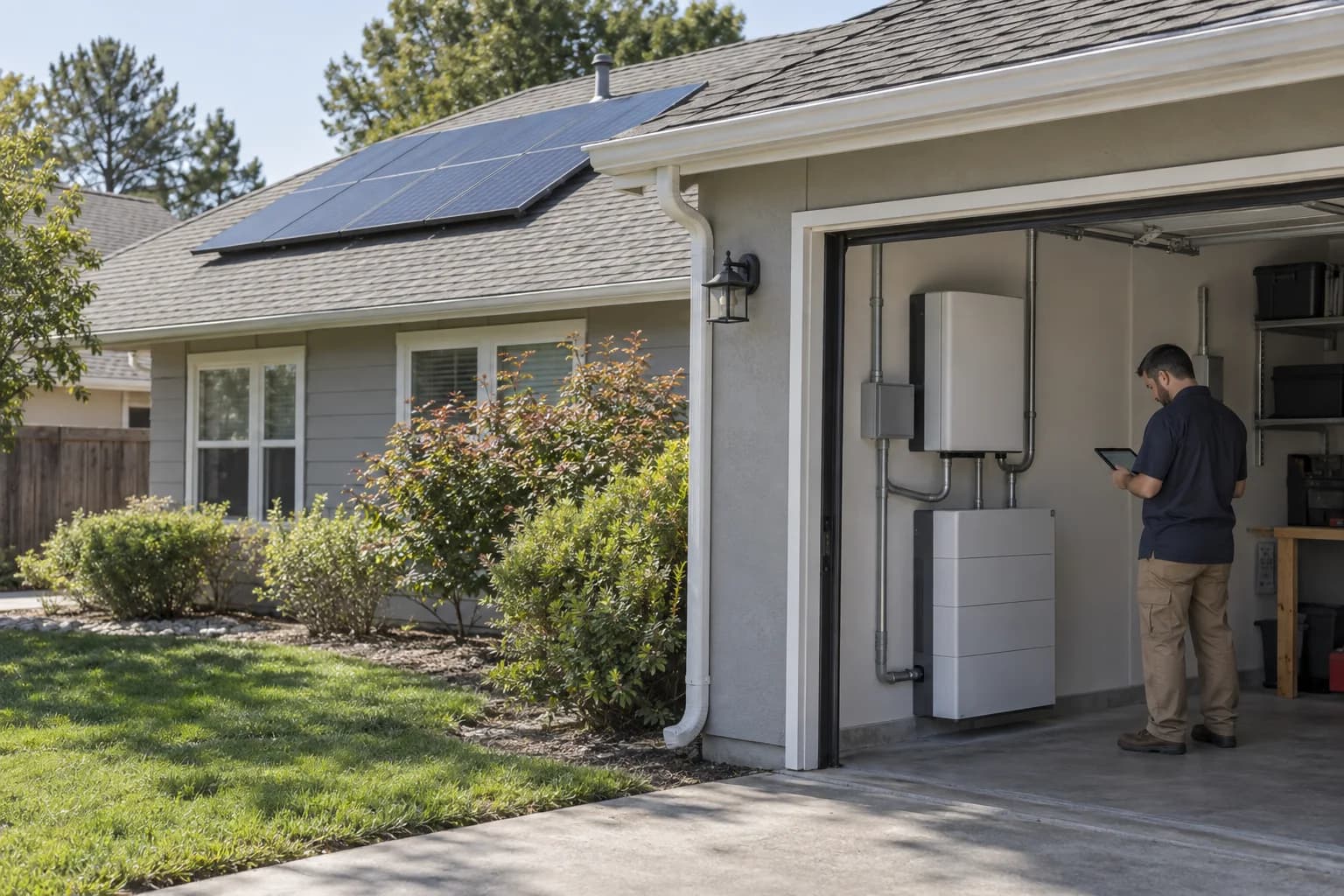
There is also a third choice that is often missed: keep an existing grid-tied solar inverter and add an AC-coupled battery system designed to work with it. This guide compares all three routes in plain language. The photographs are illustrative editorial scenes rather than customer projects.
The short answer
For a new solar installation in a home with frequent power cuts, one compatible hybrid system is often the cleanest route. It can use solar, a battery and the grid under one control system, and a suitable backup design may let the panels support the home and recharge the battery while the grid is down.
A separate solar inverter plus a small home inverter and battery can still be sensible when cuts are rare, only a few basic loads need backup, or a good backup unit is already installed. The two systems are easier to treat as separate assets, but they may not share energy or information during an outage.
If the roof already has a working grid-tied system, replacing it is not the only option. An AC-coupled battery retrofit may preserve that investment. It needs a documented control and backup plan; simply connecting two independent AC devices does not create a safe, coordinated backup system.
- 1
New system and frequent outages
Start by comparing a complete hybrid backup design, including the battery, transfer equipment and supported circuits.
- 2
Existing grid-tied solar
Price an AC-coupled battery retrofit before removing a sound solar inverter.
- 3
Rare, short cuts and basic loads
A smaller separate backup system may do the job without rebuilding the solar side.
- 4
Long cuts or several large appliances
Choose from a measured load list and required running time, not from the word “hybrid” on a catalogue.
Why ordinary on-grid solar stops in a power cut
A grid-tied inverter follows the grid's voltage and frequency. When the grid fails, it shuts down so it cannot send power onto a line that utility workers may expect to be dead. This protection is commonly called anti-islanding.
Nothing is necessarily wrong with the panels. The normal grid reference has gone, and the inverter is doing what it was designed to do. To keep part of the house running, a backup system must first separate those circuits from the failed grid and then create a stable local supply for them.
That local supply may come from a battery inverter or from the backup side of a hybrid inverter. Whether the solar array can restart and contribute during the outage depends on the complete design. It should be confirmed in the manuals for the exact inverter, battery, transfer equipment and controls rather than guessed from the product category.
The three system layouts worth comparing
These are planning descriptions, not wiring instructions. The final protection, changeover, earthing, circuit selection and local approval belong with a qualified designer or installer.
- Layout
- Grid-tied solar plus a separate home inverter and battery
- When the grid is available
- Solar serves the home or exports normally. The backup battery is often charged from the mains.
- During an outage
- The battery supplies its selected loads. The basic grid-tied solar system normally remains off.
- Main trade-off
- Independent and familiar, but the solar and backup sides may not cooperate.
- Layout
- Hybrid inverter with a compatible battery
- When the grid is available
- One control system manages solar, battery and grid energy.
- During an outage
- Supported circuits can stay on, and solar may run or recharge the battery if the complete system supports it.
- Main trade-off
- Better coordination, but compatibility and backup limits are tied to the chosen system.
- Layout
- Existing grid-tied solar plus an AC-coupled battery inverter
- When the grid is available
- The existing solar inverter keeps doing its normal job while the battery system is added on the AC side.
- During an outage
- A purpose-designed system may coordinate both in backup mode; this must be documented for the exact products.
- Main trade-off
- Useful for retrofits, with extra controls and possible conversion losses to check.
| Layout | When the grid is available | During an outage | Main trade-off |
|---|---|---|---|
| Grid-tied solar plus a separate home inverter and battery | Solar serves the home or exports normally. The backup battery is often charged from the mains. | The battery supplies its selected loads. The basic grid-tied solar system normally remains off. | Independent and familiar, but the solar and backup sides may not cooperate. |
| Hybrid inverter with a compatible battery | One control system manages solar, battery and grid energy. | Supported circuits can stay on, and solar may run or recharge the battery if the complete system supports it. | Better coordination, but compatibility and backup limits are tied to the chosen system. |
| Existing grid-tied solar plus an AC-coupled battery inverter | The existing solar inverter keeps doing its normal job while the battery system is added on the AC side. | A purpose-designed system may coordinate both in backup mode; this must be documented for the exact products. | Useful for retrofits, with extra controls and possible conversion losses to check. |
Ask every supplier to describe the same two moments: what happens one second after the grid fails, and what happens the next sunny morning if the battery became empty overnight.
When separate solar and backup systems make sense
Independence has real value. If a home already has a reliable inverter and battery for lights, fans, a refrigerator and internet equipment, a new grid-tied solar array does not always need to replace it. Each side can be serviced without automatically changing the other, and the owner can improve the solar side in one stage and the backup side in another.
This route also fits homes where outages are brief and the goal is modest. A small battery that keeps a few essential loads comfortable for an hour or two is a different purchase from a system expected to run pumps, cooking appliances, air conditioning and the rest of the house.
The limitation is coordination. In the basic arrangement, the home inverter sees a power cut and takes over its selected circuits, while the grid-tied solar inverter sees the same cut and shuts down. Sunlight on the roof does not automatically reach the backup battery. The owner may also end up with two monitoring systems, two conversion stages and more equipment than a new integrated design would need.
Separate equipment can simplify one repair, but it does not guarantee a simpler whole installation. The quotation still needs to show which circuits are backed up, how the changeover works and which party is responsible for the complete result.
Where a hybrid system earns its extra cost
A hybrid system becomes useful when outages happen often enough that solar energy during the cut matters. If the system is designed for that operating mode, daytime solar can help carry the backup loads and may recharge the battery. That can extend useful running time without buying a battery large enough to cover the entire outage on its own.
One control platform can also make daily operation easier. It can decide when to use solar directly, when to charge the battery and when to import from the grid. This does not mean every hybrid inverter behaves the same way. Some products have a limited backup output, some support only selected circuits, and some require extra switching equipment before backup is available.
Compatibility is part of the purchase. The exact battery model, communication method, software version and permitted operating modes need to match the inverter documentation. A battery with the right voltage is not automatically a supported battery.
“Hybrid” does not automatically mean whole-home backup
The word describes a product family, not the result at the house. A hybrid inverter may be able to work with a battery and still provide only a limited backup circuit. Another may carry a larger set of loads but not every phase or every appliance.
Power and energy answer different questions. Backup output in kilowatts decides what can run at the same time. Usable battery energy in kilowatt-hours helps decide how long those loads can run. A battery can contain plenty of energy and still trip when several high-power appliances start together.
One less obvious question is what happens after a long night. If the battery reaches its minimum level before sunrise, can the system start again from solar without the grid? This is often called black-start capability. Do not assume it is included. The same applies to transfer time: a system described as backup power is not automatically an uninterrupted supply for sensitive equipment.
- Which household circuits will be connected to the backup output?
- What is the continuous backup power, and how are short starting loads handled?
- How much battery energy is usable after reserve and operating limits?
- Can the solar array run and charge the battery while the grid is down?
- Can the system restart from solar after the battery reaches its minimum level?
- Are extra transfer, backup-panel or control components included in the quotation?
The retrofit option many owners miss
A working grid-tied solar inverter does not always need to be removed when storage is added. An AC-coupled battery inverter can be installed as a separate energy-storage system while the existing solar equipment stays in place.
This route can make sense when the solar installation is recent, performs well or has warranty and approval reasons to remain unchanged. It also lets the battery project be planned around the actual backup loads rather than around a complete replacement of the PV side.
The details matter during an outage. The battery inverter has to create the local supply, and the existing solar inverter must be able to operate safely within that backed-up system. The controls may need to reduce solar production when the battery is full and the household load is small. Only a documented, supported combination should be treated as outage-capable.
AC coupling can involve more energy conversions than a direct battery connection, and monitoring may remain split between platforms. Those are comparison points, not automatic reasons to reject it. For an existing system, avoiding an unnecessary inverter replacement can matter more.
Do not assume a solar-only backup inverter will work
It sounds appealing to add a second inverter that runs straight from the panels whenever the grid fails, with no battery. In practice, sunshine changes by the second while household appliances expect steady power. Clouds, motor starts and sudden load changes can make a solar-only supply difficult to hold stable.
Some purpose-built products support limited daytime backup without a battery. Others need a battery or another grid-forming source before they can operate. This is an exact-model feature, not a safe general assumption. If daytime backup is part of the plan, ask the supplier to show the supported operating mode and its load limits in the product documentation.
Compare both quotes against the same outage
A fair comparison starts with one ordinary outage scenario. List the appliances that must remain on, note which ones may run together and choose the number of hours that matters. A refrigerator, several lights, a fan and a router produce a very different system from electric cooking, water pumping and air conditioning.
Then ask each supplier to describe that same event in simple steps. Which circuits stay on? Does solar keep working? Can the battery recharge? What happens when a large appliance starts? What happens if the battery becomes empty before morning? A quote that cannot answer these questions is not yet a backup plan.
Avoid comparing only the inverter's headline kilowatt rating. The battery's discharge limit, backup-output rating, solar availability, transfer equipment and selected circuits can all become the real limit. A short load schedule gives suppliers a much clearer basis than a request for “a hybrid inverter for the whole house.”
- Frequency and typical duration of power cuts, plus the longest outage worth planning for.
- Essential appliances, their running time and which high-power loads may overlap.
- Existing solar inverter, battery or home-backup equipment that should be retained.
- Required behaviour during an outage: battery only, solar support, daytime recharge or overnight restart.
- Exact proposed inverter and battery models, backup accessories and documented compatibility.
- Who owns final design, circuit selection, installation, commissioning and local approval.
Can normal on-grid solar work during a power cut?
Usually not. A standard grid-tied inverter normally shuts down when the grid fails. Solar can support outage loads only when the complete system is designed to isolate safely from the grid and create a stable local supply.
Is a separate inverter and battery always cheaper or easier to repair?
No. It may be a practical low-cost route for a few essential loads or when the equipment already exists. A new two-system installation can also duplicate controls, conversion equipment and service responsibility, so compare the full installed scope.
Can a battery be added to an existing on-grid solar system?
Often yes. The main routes are an AC-coupled battery retrofit or replacement with a compatible hybrid inverter. The better choice depends on the existing equipment, required backup behaviour, warranty position and the supported product combinations.
Related Articles

Is 15 kWh of home battery enough, or is the next module worth it?
A bigger battery can cover more hours, but the last module may do very little work. Judge it by the expensive electricity it actually avoids, the backup you need and the limits of the full system.
Read Article→
Roof or ground-mount solar in a snowy area: how to choose
A steep roof may shed snow and shorten the cable run. A ground array is easier to reach but may use valuable land or sit in tree shade. Compare the whole site before choosing.
Read Article→
Can a solar lease cost more than grid power? Check the real numbers
A solar lease can lower one part of the electricity bill and still cost more overall. Put the lease payment, remaining grid bill and export credits on the same page.
Read Article→