
15kW vs 20kW hybrid inverter: which size does your home need?
A larger inverter adds headroom, but the useful choice comes from real appliance input, phase loading, backup plans and battery power—not one large number on a quote.

Two solar-and-battery quotes can look almost identical until the inverter line says 15kW on one and 20kW on the other. The usual sales answer is simple: buy the larger unit for more headroom. That may be sensible, but it does not show whether the extra 5kW solves a problem in this home.
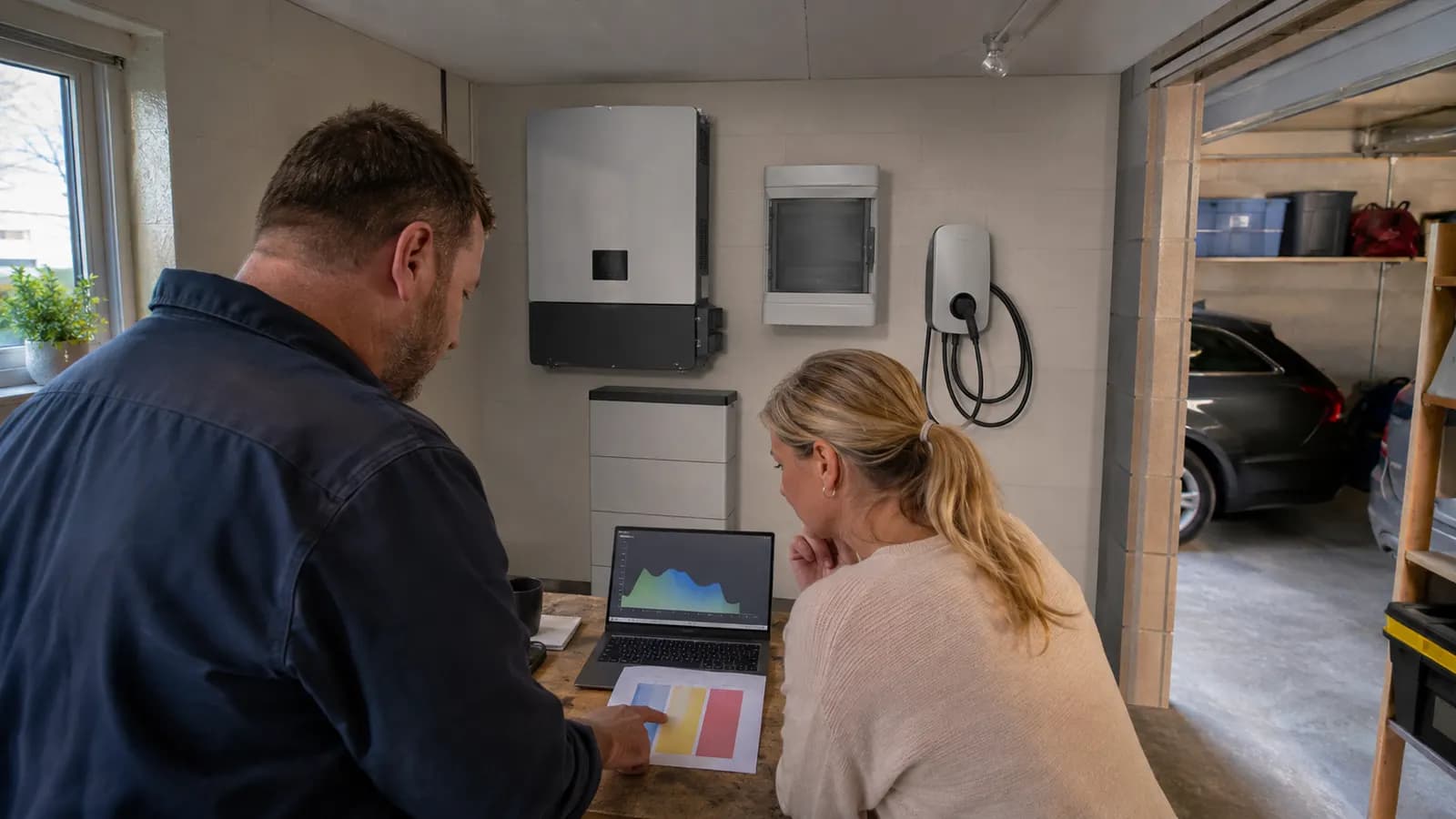
Start with the appliances that may run together. Then check how those loads are spread across the phases, what must keep working during an outage and how quickly the battery or an electric vehicle needs to charge. These questions often matter more than the solar-array size or the battery's headline capacity.
This guide explains that comparison in plain language. The figures are teaching examples rather than a design for a particular home, and the photographs are illustrative editorial scenes rather than customer installations. Exact equipment limits, wiring, protection and local approval still belong with the responsible qualified parties.
First, find out what the air-conditioner number means
A ducted air conditioner may be sold as a 12kW, 16kW or 20kW unit. That number often describes how much heating or cooling the machine can deliver. It is not automatically the electricity drawn from the switchboard. A current manufacturer's specification for one 16kW ducted model, for example, lists 16kW of rated cooling capacity and 4.95kW of rated electrical input. That example does not predict another model; it shows why the full model code matters.
Look for rated input power, maximum input power and current in the technical sheet for the complete indoor-and-outdoor combination. A variable-speed system will not consume one fixed amount all day. Weather, thermostat setting, zoning and the condition of the building all change how hard it works. Starting behaviour also varies by model.
If the quotation simply says “16kW air conditioner,” ask the supplier to add the electrical input data. Until that is known, neither a 15kW nor a 20kW inverter can be judged properly.
- Number on the proposal
- Air-conditioner capacity in kW or BTU/h
- What it helps answer
- How much heating or cooling the unit is designed to provide
- What it does not prove
- Its actual electrical input or starting demand
- Number on the proposal
- Battery capacity in kWh
- What it helps answer
- How much energy can be stored before reserve and losses
- What it does not prove
- How much power the battery can deliver at one moment
- Number on the proposal
- Solar-array capacity in kW
- What it helps answer
- The panels' rated DC power under specified conditions
- What it does not prove
- The home's peak load or guaranteed daily generation
- Number on the proposal
- Inverter rating in kW
- What it helps answer
- A starting point for continuous AC output
- What it does not prove
- Per-phase capability, backup scope or battery support
| Number on the proposal | What it helps answer | What it does not prove |
|---|---|---|
| Air-conditioner capacity in kW or BTU/h | How much heating or cooling the unit is designed to provide | Its actual electrical input or starting demand |
| Battery capacity in kWh | How much energy can be stored before reserve and losses | How much power the battery can deliver at one moment |
| Solar-array capacity in kW | The panels' rated DC power under specified conditions | The home's peak load or guaranteed daily generation |
| Inverter rating in kW | A starting point for continuous AC output | Per-phase capability, backup scope or battery support |
The labels answer different questions. Keep power, stored energy and heating or cooling capacity on separate lines.
List the appliances that may run at the same time
An inverter does not see the annual electricity bill. It sees what is switched on right now. A house may use modest energy over a full day but still have a busy half hour when the air conditioner, cooking equipment, water pump and general household loads overlap.
Consider a deliberately simple example. Assume the air conditioner is drawing 5.5kW, cooking equipment 3kW, a pump 1.2kW and the rest of the home 1kW. The simultaneous load is 10.7kW before starting demand, conversion losses or any output reduction in hot conditions are considered. On total power alone, a 15kW inverter appears to have room.
Now add a 7kW AC vehicle charger. The total becomes 17.7kW. A 20kW inverter may cover that steady figure if the battery, phase loading and exact equipment ratings also allow it. Another practical answer is to slow or pause vehicle charging while the other large loads are running. If the car is normally connected for eight hours, buying 5kW of extra inverter solely to protect one short overlap may offer less value than simple load management.
Build the list around real routines. Include the loads that are likely to overlap, not every appliance the home owns. Where possible, use manufacturer data or suitable measured demand rather than internet estimates.
A three-phase total can hide one busy phase
Think of a three-phase supply as three lanes carrying the home's electrical traffic. The inverter's headline figure describes the combined road, while many household appliances occupy only one lane. A balanced 15kW total would split into about 5kW per phase as a simple arithmetic example. Real products differ in how unevenly they can load those three phases and how they handle a short peak, so that calculation is not a universal model limit.
This matters when several large single-phase loads share the same phase. An oven, pump and EV charger could make one phase busy while the other two remain lightly loaded. The home might then draw some power from the grid even though the combined demand looks lower than the inverter's total rating. During an outage, there may be no grid available to fill that gap.
Ask for the continuous output current, allowed phase imbalance and backup output for the exact inverter. The installer should also review which phase serves each important appliance. Moving or controlling a load may solve a phase problem that a larger headline rating does not fully explain.
Normal operation and backup need separate answers
When the grid is available, a hybrid inverter can supply part of the household demand while the grid supplies the rest, subject to the approved design and operating settings. A brief grid import during a busy period does not necessarily mean the inverter has failed.
An outage removes that safety net. Only the circuits connected to the supported backup path can remain available, and their power must come through the permitted inverter-and-battery route. A gateway, transfer equipment, phase arrangement and protection design may impose additional limits. Some homes back up refrigeration, lights, communications and selected outlets. Others ask for ducted air conditioning, cooking and pumps as well. Those are very different jobs.
Write the outage load list separately from the everyday load list. If air conditioning must run during a blackout, record which zones are required and what other equipment may start at the same time. “Whole-home backup” is too vague for comparing two inverter quotations.
Battery capacity tells you how long, not how much at once
A 36kWh battery does not automatically require a 20kW inverter, and it does not automatically support 20kW of discharge. Kilowatt-hours describe stored energy. Kilowatts describe the rate at which energy is moving.
The usable power may depend on the exact battery module, the number of modules, their temperature, the battery-management system and the approved pairing with the inverter. Adding battery modules often increases stored energy and may increase available charge or discharge power, but the change must come from the manufacturer's documentation for that configuration.
Charging speed is another reason buyers consider a larger inverter. A narrow low-price grid window may reward faster charging, while a home that normally charges from solar across several hours may gain little from the higher rate. Check the allowed AC charging power, the battery's accepted charge power, the site connection and the household demand during that same window. The smallest active limit sets the result.
Does a 36kWh battery need a 20kW inverter?
No fixed ratio decides this. The inverter is chosen around the required power and operating modes, while the battery is checked for usable energy, charge and discharge power, module quantity and compatibility. A 36kWh battery can be paired only with models and power limits approved for that exact configuration.
Treat EV charging as its own power path
An AC wall charger behaves like another AC load in the home. Its demand may overlap with the air conditioner and cooking, or it can be reduced and scheduled for quieter hours. A three-phase charger and a single-phase charger also affect the phase discussion differently.
Some integrated energy systems offer a DC-coupled vehicle-charging module. Current manufacturer material for one such product describes direct access to DC power from compatible solar and battery equipment. That does not mean every DC charger bypasses every inverter limit. Power coming from the grid may follow a different conversion route, and the battery, vehicle, charger, controller and software can each set a lower limit.
Put the actual energy path on the proposal: solar to vehicle, battery to vehicle and grid to vehicle. Name the charger and controller models for each path. If the explanation is only “the charger is DC,” there is not enough information to predict charging speed or decide between 15kW and 20kW.
When 15kW may be enough—and when 20kW earns its place
A 15kW model can be a sensible choice when documented simultaneous demand stays comfortably below its limits, large flexible loads can be scheduled and the planned backup scope is modest. A 20kW model deserves consideration when the home repeatedly approaches 15kW, wants broader backup, needs faster supported battery charging or is adding a high-power load soon.
Price is part of the decision, but compare the complete change. A larger inverter could affect the approved connection, protection, gateway, battery configuration, cabling, installation scope or future expansion route. If the rest of the system becomes the bottleneck, paying for a larger label does not release its full value.
Ask both suppliers to answer the same questions below. Their responses will be more useful than two bare model numbers, and they make any remaining assumptions easy to spot.
- Full model codes and current datasheets for both inverter options and the air conditioner, including its rated and maximum electrical input, supply phase and starting behaviour.
- A short list of likely simultaneous loads, including which phase supplies each important single-phase appliance.
- Separate normal-grid and outage load lists, with the expected backup circuits and operating priorities.
- Exact battery models and quantities, usable energy, continuous charge and discharge power, and supported inverter pairing.
- EV charger type and model, expected charging schedule, adjustable power range and energy path from solar, battery and grid.
- Site import or export limits, required approval route and any changes to protection, gateway or installation scope.
Can a 15kW inverter run a 16kW air conditioner?
Possibly, because the 16kW label may describe cooling capacity rather than electrical input. Check the exact air-conditioner's rated and maximum input, its phase arrangement and starting behaviour, then add the other loads that may run with it. The inverter's model-specific backup and per-phase limits still apply.
Is a 20kW inverter always better for a three-phase home?
No. It provides more potential headroom, but that headroom may be limited by phase loading, the battery, the site connection, backup equipment or operating controls. If measured demand is lower and flexible loads are managed, a correctly chosen 15kW system may be the more balanced purchase.
Related Articles

What does a one-stop solar system supplier actually provide?
Need panels, an inverter, batteries and the parts to put them together? Here is how Rongkai helps turn a project requirement into a coordinated supply package.
Read Article→
How do solar panels perform in clouds, heat, salt air and dust?
A panel's watt rating cannot describe every site. Learn what changes in cloudy, hot, coastal and dusty locations, and which details belong in a supply quote.
Read Article→
How to compare solar battery specifications before buying
Two batteries with the same kWh label can do different jobs. Here is how to read the numbers, check the missing details and compare like-for-like quotes.
Read Article→