
One large solar inverter or two smaller inverters: which is better?
Two inverter nameplates may add up to the same power as one larger unit, but that does not make the two system designs equal—or automatically redundant.

At first glance, this looks like simple arithmetic. One 20kW inverter and two 10kW inverters both add up to 20kW. Why not choose whichever option costs less?
Because the number of boxes changes more than the total on the label. It can change how the solar panels are divided, how the battery supplies power, what happens during a fault, how much energy the equipment uses while waiting and how difficult the system is to expand or service.
This guide is for someone comparing equipment for a home, workshop or small commercial property. It does not assume that one arrangement always wins. The right answer comes from the exact models and the way the site needs to operate. The photographs are illustrative editorial scenes rather than customer installations, and final electrical design, protection, installation and approval remain with the responsible qualified parties.
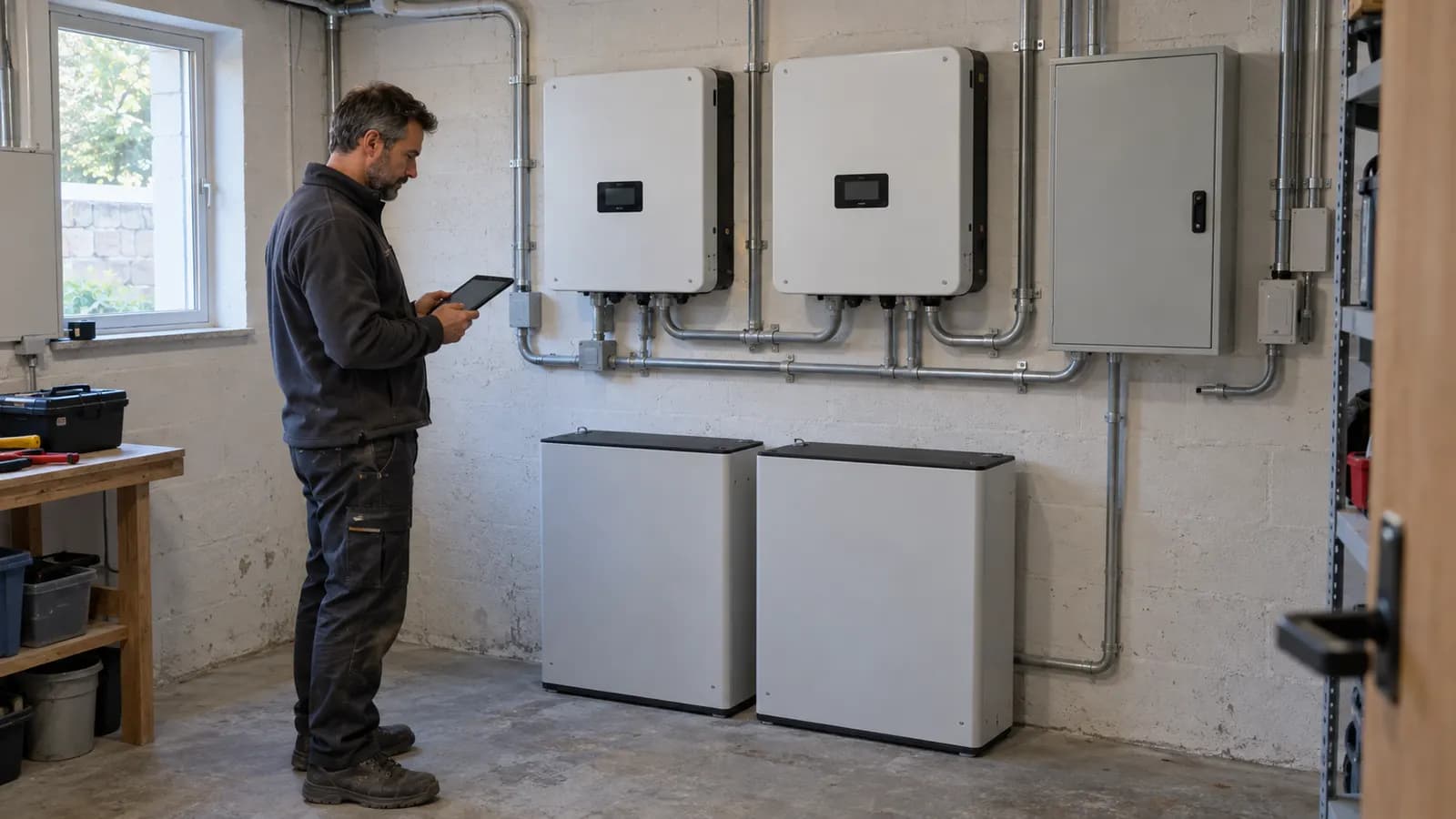
Start with the job, not the inverter count
Before comparing one inverter with two, decide what the system is expected to do. A normal grid-connected solar inverter, a hybrid system with a battery and a system expected to run without the grid are different products and different projects.
The property layout matters too. A house and a nearby workshop could share one electrical supply, or they could have separate distribution boards and very different working hours. Two inverters connected in parallel to one set of loads are not the same as two independent inverters, each serving its own group of circuits. The parallel pair behaves as one coordinated power system. Independent units create two power paths, along with two sets of design decisions and interfaces.
Write down the operating mode, voltage and phase arrangement, the loads that may run together and what must remain available during an outage. That short description is more useful than beginning with “one or two?”
- Arrangement
- One larger inverter
- What it means
- One device manages the supported solar, battery and AC power paths
- Question to settle
- Does this exact model have enough output and PV inputs for the site?
- Arrangement
- Two inverters in parallel
- What it means
- Two supported units are configured to work as one coordinated system
- Question to settle
- What happens to the whole system if one unit or its communication link stops?
- Arrangement
- Two independent inverters
- What it means
- Each unit supplies a separate, clearly defined group of loads
- Question to settle
- Which circuits, solar inputs and batteries belong to each system?
| Arrangement | What it means | Question to settle |
|---|---|---|
| One larger inverter | One device manages the supported solar, battery and AC power paths | Does this exact model have enough output and PV inputs for the site? |
| Two inverters in parallel | Two supported units are configured to work as one coordinated system | What happens to the whole system if one unit or its communication link stops? |
| Two independent inverters | Each unit supplies a separate, clearly defined group of loads | Which circuits, solar inputs and batteries belong to each system? |
Do not use the words dual inverter until the quotation states whether the units are parallel or independent.
Two 10kW units do not always behave like one 20kW unit
If a manufacturer allows two units to operate in parallel, their supported AC output may combine. That is only the beginning of the comparison. The system may still have separate limits for normal grid-connected operation, backup output, battery charging, short starting loads and power on each phase.
Imagine a property with a pump, compressor or large workshop tool. The steady load may fit comfortably below 20kW, yet the equipment can ask for more power briefly while starting. The useful question is not whether the two labels add up. It is whether the exact parallel combination can carry that start in the required operating mode, with the proposed battery and at the expected temperature.
The grid connection may set another boundary. A larger inverter does not grant permission to import or export more power, and two smaller units do not bypass a site limit. Ask for the model-specific continuous output, short-duration capability, backup rating, phase limits and approved parallel quantity. Keep the solar-array rating on a separate line; panel capacity does not reveal the property's highest simultaneous AC load.
Two boxes do not automatically provide redundancy
This is the point most likely to be misunderstood. Buying two inverters can look safer because one appears able to take over if the other fails. Some systems can do that under defined conditions. Others cannot do it automatically.
In a parallel arrangement, the units exchange timing, load and status information so that they can act as one system. Depending on the product, a missing unit or communication fault may stop the full group, reduce the available output, or require a trained person to reconfigure the remaining unit. The remaining inverter also needs enough capacity to carry the loads that stay connected. None of this can be confirmed from the word parallel alone.
Official manufacturer documents show why the answer must be model-specific. Victron's VE.Bus parallel guidance requires matching device type, system voltage, feature set, firmware and compatibility information. Its Inverter RS family has separate settings that control whether a system may continue when a unit is missing. EG4 documentation, as another example, lists CAN communication and missing-master faults for a parallel system. These are not universal verdicts on either brand; they show the questions that any supplier should answer.
If continued operation during a failure is essential, ask for a written fault-response plan. It should say which loads remain available, whether recovery is automatic, what manual work is required and who is qualified to perform it. A second box without that plan is additional equipment, not proven redundancy.
The roof layout may decide before the load does
An MPPT is the part of an inverter that manages a group of solar panels operating under a similar set of conditions. You do not need to understand its electronics to use the idea: panels facing different directions, sitting under different shade or installed on separate roofs may need more independent solar inputs.
Two smaller inverters sometimes provide more MPPT channels than one larger unit. That can be useful for a house and workshop with different roof directions, or for an array split across several surfaces. It is not automatically better. A single large inverter may already have enough suitable inputs, while two smaller models can add equipment without solving a real panel-layout problem.
Count the planned panel groups and record their orientation, shade and module quantity. Then compare that layout with the MPPT count, voltage window, current limit and connector arrangement of the exact inverter models. The responsible designer should prepare the final string plan. For a buyer, the goal is simply to make sure the quotation has somewhere appropriate for every planned group of panels.
Compare battery power and standby use on the same page
A battery has to support the inverter arrangement, not just store enough energy for the night. Two inverters asking for high output at the same time can place a large demand on the battery bank. Check the battery's permitted continuous power, short-duration power, module quantity, communication method and approved inverter combination.
Keep power and energy separate. Kilowatts describe how much power the system can deliver at one moment. Kilowatt-hours describe how long stored energy may last. Adding a second inverter may increase possible output without adding one extra minute of battery runtime. Adding battery capacity may extend runtime without increasing the inverter output available to the loads.
Self-consumption also deserves a line in the comparison. Every inverter uses some energy for its controls, conversion and communications. Two smaller units may consume more in total at light load, but the answer belongs in their datasheets rather than a rule of thumb. Do not assume one unit in a parallel pair can simply be switched off at night; some systems require every configured unit to remain available. Compare published standby or no-load consumption for the complete arrangement and check whether any power-saving mode is supported in that configuration.
Choose the architecture you can operate and maintain
One larger inverter usually creates a simpler equipment list: fewer communication links, fewer devices to configure and one main set of operating data. Its obvious weakness is concentration. If that one device is unavailable and no approved bypass or alternative supply is present, its functions are unavailable too.
Two smaller units can provide more PV inputs, a supported expansion path and easier handling of individual replacement units. They also add cables, protection, communications, wall space, settings and possible failure points. A parallel pair may still behave as one logical system during a fault. Two independent systems can offer more separation, but the loads and energy sources must be divided deliberately; they do not combine their spare capacity whenever convenient.
There is no useful winner without exact models. Lean toward one larger inverter when it covers the real load, panel layout and backup need with a simpler supported design. Consider two smaller units when the manufacturer documents the parallel combination, the site genuinely benefits from additional PV inputs or staged expansion, and the fault behaviour meets the owner's expectations. Compare the full installed scope rather than the inverter prices alone.
- Operating goal: grid-connected solar, hybrid self-use, outage backup or operation without a normal grid supply.
- Measured or documented simultaneous loads, important motor starts, voltage, phase and required backup circuits.
- Panel groups by roof or ground area, including direction, shade and the planned module quantities.
- Exact inverter models, supported parallel quantity, MPPT limits, backup output, self-consumption and required controllers or meters.
- Exact battery models and module count, usable energy, permitted charge and discharge power, BMS communication and approved inverter pairing.
- Written fault response, maintenance access, expansion route, warranty process and the party responsible for final design and commissioning.
Do two 10kW solar inverters equal one 20kW inverter?
Only in a limited sense. Their nameplate power adds to 20kW, but usable system output still depends on whether the exact units support parallel operation, their backup and phase limits, the battery's power capability, site limits and the connected loads. Compare the complete supported configuration rather than the sum alone.
Will one inverter keep running if the other parallel inverter fails?
Do not assume it will. Some products stop the coordinated system, some can continue with reduced capacity under specific settings, and others need manual reconfiguration. Ask the supplier to document the behaviour for the exact models, firmware and operating mode, including which loads remain supported.
Is one large inverter usually simpler than two smaller inverters?
Usually, because it reduces the number of devices and communication links. Two smaller units may still be the better fit when the solar layout needs more independent inputs, the project will expand in planned stages or a documented fault strategy benefits from multiple units. The complete equipment and maintenance scope decides the trade-off.
Related Articles
Solar solutions for telecom towers, schools and clinics with unreliable grids
A classroom, a telecom station and a clinic need different backup plans. Start with the equipment that must keep working, then build the solar supply around it.
Read Article→
What does a one-stop solar system supplier actually provide?
Need panels, an inverter, batteries and the parts to put them together? Here is how Rongkai helps turn a project requirement into a coordinated supply package.
Read Article→
How do solar panels perform in clouds, heat, salt air and dust?
A panel's watt rating cannot describe every site. Learn what changes in cloudy, hot, coastal and dusty locations, and which details belong in a supply quote.
Read Article→