
What is the hardest part of off-grid solar? Getting through the worst week
A system that works on normal days can still run short after several dull days. The useful question is how the home will reduce the deficit and recover afterward.
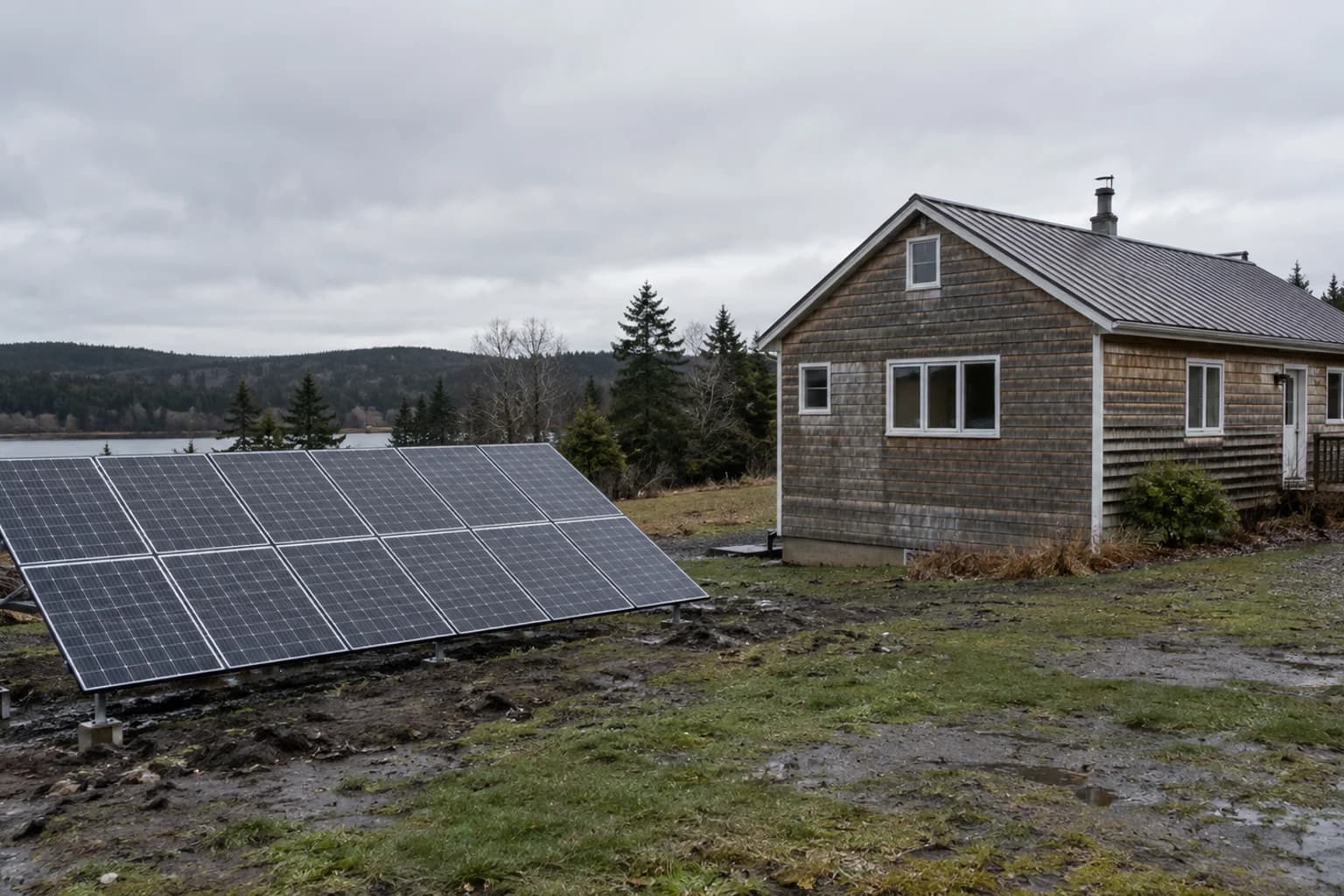
An off-grid solar system can look generous on a bright afternoon. The battery is full, the panels are carrying the house and there is spare energy for laundry or tools. Three dull days later, the same system can feel much smaller.
That difficult stretch is where off-grid solar system sizing becomes real. Night-time use is usually predictable. A run of weak solar days is harder because the battery starts each morning lower, while the panels may produce only enough to cover part of that day's load.
This guide explains the problem in everyday terms. It shows how to compare more panels, more battery capacity, lower energy use and a secondary charging source. It does not give one battery size for every home, and the worked numbers are teaching examples rather than a quotation or performance promise. Both photographs are illustrative editorial scenes, not customer projects.

An average day can hide the week that causes trouble
Annual and monthly solar estimates are useful, but a household does not live on an annual average. The battery has to deal with what happens hour by hour. A sunny weekend cannot send energy backward to cover a dark week that arrived earlier in the month.
Start with the difficult season. Shorter days, a lower sun angle, cloud, shade and weather-related use can all arrive together. Heating, cooling, water pumping or longer lighting hours may also change the household load at the same time that solar production falls.
The European Commission's PVGIS off-grid tool models this relationship with hourly solar data, an hourly use pattern and a battery. Its results include the share of days when the battery becomes empty and the energy the system could not supply. That is a more useful reliability question than looking only at the array's yearly production.
No model can promise the weather. It can show whether a proposal has been tested against several years of local conditions instead of one attractive daily average.
The last part of off-grid reliability is usually the expensive part
Covering most ordinary days can be quite different from covering every day without changing how the home is used. The final stretch of reliability may require equipment that is needed only during a few poor-weather periods each year.
This is sometimes described as the difference between 90% and 100% solar coverage. Those percentages should not be treated as a universal cost rule. They simply describe a common shape: ordinary days are covered first, while rare difficult days ask for a much larger reserve or another source of energy.
A household that can postpone laundry, electric water heating or vehicle charging has an easier job. A remote site with medical equipment, refrigeration, communications or a water system may need a firmer reserve. Reliability is therefore a decision about loads and operating choices as well as hardware.
Before paying for the last few difficult days, decide what must continue and what can wait. That one conversation can change the array, battery and backup plan more than choosing between two panel brands.
Four figures give you a useful starting point
A long list of product specifications is not the first thing to collect. Begin with four figures that describe the job.
Daily energy use tells you how quickly stored energy is spent. Peak power tells you what the inverter and battery may have to supply at one moment. Low-season solar production shows what the array can put back during the difficult part of the year. The chosen reserve says how far the battery is allowed to fall before optional loads are stopped or another approved source is used.
Keep the units separate. Kilowatts, written as kW, describe power at a moment. Kilowatt-hours, written as kWh, describe energy used or stored over time. A large battery does not make an undersized inverter start a difficult load, and a powerful inverter does not give a small battery a long runtime.
- Figure
- Daily energy, kWh
- What it tells you
- How much energy the selected loads use in 24 hours
- A practical way to find it
- Meter history, monitoring data or appliance power multiplied by realistic operating time
- Figure
- Peak power, kW
- What it tells you
- What may run together, including reasonable motor or compressor starts
- A practical way to find it
- Exact appliance labels, manuals and measured operating patterns
- Figure
- Low-season solar, kWh/day
- What it tells you
- What the array may replace during the difficult season
- A practical way to find it
- A location-based solar model using the proposed array direction, angle and losses
- Figure
- Reserve and fallback point
- What it tells you
- When the household changes loads or starts another charging plan
- A practical way to find it
- A written operating rule agreed before the battery is low
| Figure | What it tells you | A practical way to find it |
|---|---|---|
| Daily energy, kWh | How much energy the selected loads use in 24 hours | Meter history, monitoring data or appliance power multiplied by realistic operating time |
| Peak power, kW | What may run together, including reasonable motor or compressor starts | Exact appliance labels, manuals and measured operating patterns |
| Low-season solar, kWh/day | What the array may replace during the difficult season | A location-based solar model using the proposed array direction, angle and losses |
| Reserve and fallback point | When the household changes loads or starts another charging plan | A written operating rule agreed before the battery is low |
All four figures need a time context. A summer daily average should not be used as the low-season production figure.
A larger battery cannot refill itself
Imagine a home that uses 12kWh per day. During three heavily overcast days, its solar array produces 2kWh per day after the system's ordinary losses. The daily shortfall is 10kWh, so the three-day energy deficit reaches about 30kWh.
That is a simplified teaching example. It leaves out battery reserve, conversion loss, temperature, changing weather and limits on charge or discharge power. Its purpose is to show the direction of the problem: the battery is covering the difference between use and new solar energy.
Now suppose the household has already separated essential and flexible loads. Laundry, workshop equipment, electric water heating and vehicle charging are delayed, reducing daily use to 7kWh. With the same 2kWh of solar production, the daily deficit becomes 5kWh and the three-day deficit becomes about 15kWh.
The second plan has not created more sunshine. It has cut the amount that must come from storage in half. This is why energy efficiency and a simple low-power routine can sometimes do more for a difficult week than another battery cabinet.
Extra storage still has value when the array regularly produces enough surplus to refill it. If the array cannot replace the energy taken out, a larger battery mainly delays the point when another decision is needed.
Should you add panels, batteries, or a secondary source?
There is no single upgrade that fixes every off-grid shortage. Look at the pattern in the monitoring data.
If the battery starts the night low even after a clear day, the project may have a production problem, a daytime-load problem or an equipment limit. If the battery reaches full on good days but runs out before morning, usable storage or night-time consumption deserves attention. If several poor days create the problem, the answer may combine extra solar collection, a reduced-load mode and a planned secondary charging source.
Available roof or ground area, solar-controller limits, battery compatibility and site rules can change what is practical. Exact models should be checked together rather than treating each component as an independent upgrade.
- Possible change
- Add solar panels
- It can help when
- The battery often begins the evening below its target or recovers too slowly after weak weather
- Check before choosing it
- Space, shade, string design, controller input limits and low-season production
- Possible change
- Add battery capacity
- It can help when
- There is regular surplus generation, but the stored energy does not last through the required hours
- Check before choosing it
- Usable energy, charge and discharge limits, expansion rules and time needed to refill
- Possible change
- Reduce or move flexible loads
- It can help when
- Large optional appliances are draining the battery during low-production periods
- Check before choosing it
- Which tasks can safely wait for strong solar hours and whether everyone can follow the plan
- Possible change
- Use a secondary charging source
- It can help when
- Rare long low-sun periods would otherwise require a much larger array and battery bank
- Check before choosing it
- Fuel or energy access, approved equipment compatibility, maintenance, noise and safe local installation
| Possible change | It can help when | Check before choosing it |
|---|---|---|
| Add solar panels | The battery often begins the evening below its target or recovers too slowly after weak weather | Space, shade, string design, controller input limits and low-season production |
| Add battery capacity | There is regular surplus generation, but the stored energy does not last through the required hours | Usable energy, charge and discharge limits, expansion rules and time needed to refill |
| Reduce or move flexible loads | Large optional appliances are draining the battery during low-production periods | Which tasks can safely wait for strong solar hours and whether everyone can follow the plan |
| Use a secondary charging source | Rare long low-sun periods would otherwise require a much larger array and battery bank | Fuel or energy access, approved equipment compatibility, maintenance, noise and safe local installation |
Write a low-power plan that the household can actually follow
A useful plan should make sense without opening an engineering drawing. Put the loads into three short groups.
The first group contains items that need to stay on: perhaps refrigeration, essential lighting, communications, a water pump or necessary medical equipment. The second group contains loads that can run when solar production is strong. The third contains loads that can be paused during a poor-weather spell.
Do not guess from the appliance name alone. A small well pump can create a demanding start. An electric heater may use far more daily energy than its short operating time suggests. A refrigerator cycles instead of drawing one fixed amount all day. Use the exact model information and measurements where suitable data is available.
Then choose simple household rules, such as delaying laundry below a stated battery level or running a flexible load only after the battery has reached its daytime target. The final controls, protection and equipment settings belong with the responsible designer and installer; the household still needs to understand the operating plan.
Recovery matters as much as runtime
Battery runtime answers only half the question. After the difficult weather passes, the array has to supply the live household and refill the energy that was used earlier.
Suppose the home returns to its normal 12kWh daily use and the array produces 14kWh on the next day. Only about 2kWh remains before allowing for real system behaviour. A 20kWh deficit would take many such days to recover. A larger battery does not shorten that recovery unless more charging energy is available.
Ask a supplier or designer to show the recovery assumption alongside the autonomy figure. How much energy remains for charging after the daytime loads? What happens if the next day is only partly sunny? At what battery level are flexible loads restored? These questions reveal whether the system has a workable routine rather than a headline number.
Monitoring should make the trend easy to see. If the battery ends each day lower than the day before, the system is running an energy deficit. The household then follows the planned response before the reserve is exhausted.
A short brief for an off-grid solar proposal
A supplier can compare options more honestly when the brief describes the hard week as well as the normal day. Gather the information below before asking for a final configuration. Unknown items can stay marked for measurement or local review; filling them with a guess only makes the quotation look more certain than it is.
- Daily energy use for normal days and the reduced-load plan, preferably supported by meter or monitoring history.
- The essential appliances, their exact models, operating hours and the loads that may run or start together.
- The site's difficult season, shading, proposed panel area and a location-based low-season solar estimate.
- Target reserve, acceptable low-power days and the point when a secondary charging source may be used.
- Proposed panel, controller, inverter and battery model codes, including usable energy and expansion limits.
- A recovery estimate showing how the system serves daily loads while rebuilding battery charge.
How many days of battery storage does an off-grid home need?
There is no fixed number for every home. The answer depends on the essential daily load, low-season solar production, usable battery capacity, reserve, acceptable load changes and whether another approved charging source is available. Compare the probability and consequence of running short instead of applying a universal three-day rule.
Is it better to add more solar panels or more batteries?
Add production when the battery regularly fails to recharge or starts the evening low. Add storage when good days produce usable surplus but the battery still cannot carry the required night or low-sun period. Monitoring data and exact equipment limits should support the choice.
Can an off-grid solar system work without a generator?
It can be possible where the load is modest, the solar resource and site are suitable, the system has enough reserve, and the user accepts a clear low-power plan. Sites that cannot tolerate an energy shortage may choose another approved source for rare long low-sun periods. The decision is specific to the load, weather, reliability target and local requirements.
Related Articles

How much should you budget for home solar and battery backup?
Your electricity bill is useful, but it cannot price a solar and battery system by itself. Build the budget around the job, the loads and the complete installed scope.
Read Article→
More solar panels or a better angle? Flat vs tilted solar for a campervan
A smaller array pointed at the sun can work harder per panel, but it first has to recover the watts lost from the roof. Here is a practical way to compare both layouts.
Read Article→
Can a 3kW inverter work with a 24V 150Ah lithium battery?
The voltage can match while the system still falls short. Check the inverter's real output, battery current limit and expected runtime before buying.
Read Article→