
Will adding battery modules make EV charging faster?
More battery capacity gives a system a larger energy store. It does not automatically make the inverter, charger or grid connection deliver energy any faster.
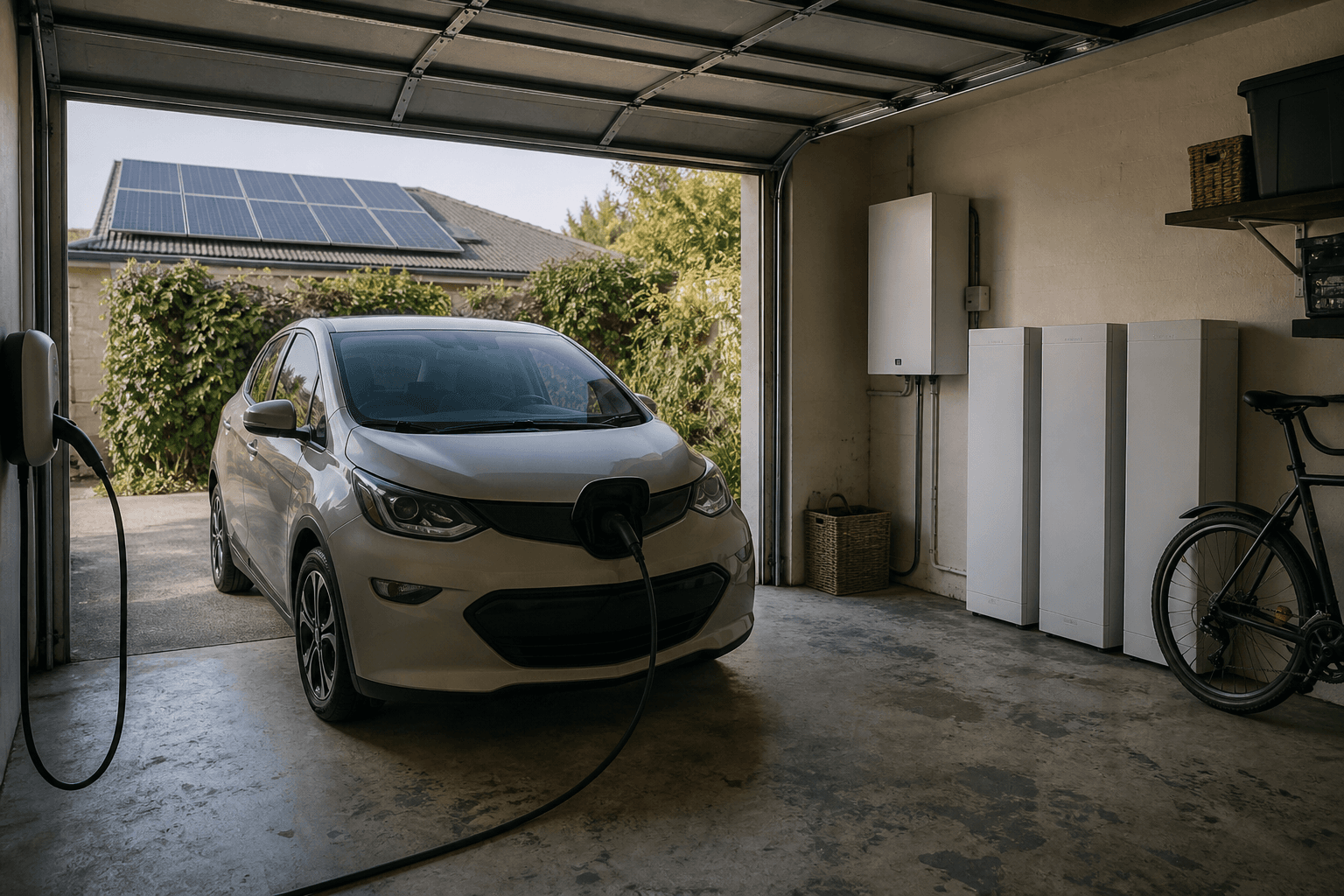
A battery expansion quote can solve the wrong problem. The owner needs an electric vehicle ready by a certain time, so the proposal adds another 10 or 20kWh of home storage. The stored-energy figure becomes larger, but the charge and discharge path may still be limited to the same number of kilowatts. The battery can hold more without filling or emptying any faster.
That distinction matters when an EV has to receive a substantial amount of energy inside a short solar or low-price tariff window. The car, charger, battery modules, energy controller or inverter, grid connection, PV system and household loads all share the result. Adding modules can raise the available energy and, in some product families, may raise battery-side power. It cannot be assumed to remove a limit elsewhere in the system.
This guide shows how to review a modular home battery upgrade before comparing prices. All figures are teaching examples rather than household averages, equipment settings or Rongkai project results. Exact models, site limits, installation design, tariff eligibility and local compliance must be confirmed by the relevant manufacturer channel and appropriately qualified local parties. The two photographs are illustrative editorial images, not customer installations.

Start with the energy target and the clock
Write down how much energy the vehicle needs and when it will be connected. A target in kWh describes the amount to be added to the car; the available hours turn that target into an average power requirement. The result should then be adjusted for charging losses, household demand during the same period and the actual power accepted by the vehicle.
Consider a deliberately simplified example. An EV needs 30kWh before departure and is available for four hours. Delivering that energy requires an average of 7.5kW at the vehicle before losses are considered. If the relevant home-battery path is limited to 5kW, four hours represents a theoretical maximum of 20kWh from that path before conversion losses, reserve settings or other loads. Increasing stored capacity alone does not close the gap.
The same arithmetic can expose an oversized power proposal. If a car usually needs 8kWh overnight and remains connected for ten hours, a high-power charging route may save little time that the owner actually values. Use several normal days rather than the largest trip of the year, and keep an occasional exceptional journey visible as an exception rather than designing every operating assumption around it.
- Energy required at the vehicle on an ordinary workday and after a longer journey.
- Arrival, departure and parking times for each relevant work or travel pattern.
- The vehicle's documented AC or DC charging capability for the exact model and market.
- Household loads likely to operate during the same solar, free-electricity or off-peak window.
- The minimum battery reserve or backup objective that should remain available after EV charging.
Does a larger home battery automatically charge an EV faster?
No. A larger battery normally adds energy capacity. Charging becomes faster only if the exact battery configuration supports more power and no lower limit remains in the controller or inverter, EV charger, vehicle, grid connection, energy-management settings or site design.
The slowest component sets the charging rate
Follow the energy path from its source to the vehicle. Grid energy may pass through the site connection, meter or gateway and an energy controller before reaching the charger. Solar may enter through the same hybrid system or through a separate PV inverter on the AC side. Battery energy has its own continuous power, BMS and controller limits. The vehicle then applies its own voltage, current, temperature and state-of-charge restrictions.
The usable charging rate is no higher than the lowest active limit along that route. A charger with a 12.5kW nameplate does not promise 12.5kW from every source at every moment. If the battery path supplies 5kW, the remaining power would need to come from another permitted source for the charger to deliver more. If grid import is constrained or household demand rises, the energy-management system may reduce vehicle charging again.
Existing PV topology changes the review. Panels connected directly to a compatible hybrid controller follow a different conversion path from a third-party solar inverter connected through the home's AC system or gateway. One online description of 'solar-first charging' cannot be transferred to both arrangements. Record the actual models and a current single-line representation for technical review, but leave wiring, protection and commissioning decisions to the qualified installer or designer.
- Exact EV, charging equipment, battery-module, controller or inverter, gateway and existing PV-inverter model codes.
- Continuous power limits for each operating route, kept separate from short-duration peak ratings.
- Grid import or export limits and any site-level demand-control setting confirmed for the actual account.
- PV connection route and measured generation during the intended charging window.
- Simultaneous home loads and the control rule used when total requested power exceeds an active limit.
Can a 5kW battery system be used with a 12.5kW EV charger?
The labels alone cannot answer that. The charger may be able to draw from solar, grid and battery under an approved system design, while the battery contributes only within its permitted power. Confirm the exact product pairing, source priorities, vehicle support and site limits rather than assuming the battery supplies the charger's full nameplate power.
What an added battery module can actually change
An additional module normally increases nominal and usable energy. Whether it also increases charge or discharge power depends on the architecture. Some modular systems give each battery module its own conversion capability and allow aggregate battery power to rise as modules are added. The increase stops when the energy controller, inverter, battery interface, thermal limit, grid setting or another system boundary becomes the constraint. Other systems keep essentially the same power limit across several capacity options.
Current manufacturer documents illustrate why family names are not enough. One Sigenergy battery document lists 6.0 and 10.0 product routes with different usable-energy and per-module power values, while its separate EV DC charging document lists 12.5 and 25kW variants. Those figures apply to the stated products and revisions; they are not a rule for another Sigenergy generation or another brand, and they do not establish a compatible complete system by themselves.
Expansion also has a time dimension. Ask whether the existing and new module generations may be combined, whether the permitted module count changes with the controller, and whether firmware, commissioning, warranty or state-of-health conditions apply. A physically stackable module is not automatically an approved addition to an older system. The quotation should name the existing and proposed modules separately and attach the current evidence used to approve the combination.
- Existing battery model, quantity, installation date, firmware and available state-of-health information.
- Proposed module model and revision, including nominal energy, usable energy and continuous power.
- Manufacturer-supported mixed-module and maximum-module combinations for the exact controller and market.
- Resulting system-level energy and power after every controller, inverter and operating limit is applied.
- Warranty, commissioning, monitoring and service consequences of adding modules to the installed system.
Direct charging and battery buffering are different jobs
There are three common scheduling routes to compare. When the vehicle is home during strong solar production, direct solar charging may avoid moving the same energy through the stationary battery first. When the vehicle is present during a low-price grid window, direct scheduled charging may be simpler than buying extra home storage. A stationary battery becomes a time buffer when cheap or surplus energy is available while the vehicle is away and must be held until it returns.
The buffer can solve a genuine timing problem, but the energy is converted and stored before it reaches the car. Storage and power conversion are not perfectly efficient, and the extra throughput may use part of the home battery's warranted energy and leave less reserve for household backup. Compare those effects with the value of moving the charging time; do not assume that free or inexpensive input energy makes every additional battery cycle costless.
Build a short schedule for each recurring shift or travel pattern. Show when PV is available, when the tariff window opens, when the car is connected, how the home battery is expected to charge and discharge, and what reserve remains. This is more useful than selecting the largest battery that fits because it reveals which days actually need buffering and which can use direct charging.
Is it worthwhile to charge a home battery first and then charge the EV?
It can be useful when the car is absent during the available solar or low-price window. Compare that scheduling benefit with conversion losses, battery throughput, reserve requirements and the installed upgrade cost. If the car can charge directly during the same window, extra stationary storage may add little value for that task.
Build the upgrade RFQ before asking for a module price
A current module price is not enough to compare two upgrades. One offer may include only the battery block, while another includes a controller or inverter change, EV charging equipment, gateway work, commissioning, monitoring changes, local electrical work and updated warranty records. Ask each supplier to return the same installed-scope table, with assumptions and exclusions visible.
Treat tariffs and incentives as dated inputs. In Australia, the Clean Energy Regulator's current guidance allows additional modules in some existing stackable battery systems only when stated conditions are met. These include the original battery not having previously claimed STCs, at least 5kWh of additional nominal capacity and a total nominal system capacity no greater than 100kWh; STCs are limited to the first 50kWh of usable capacity. This reflects the guidance reviewed on 11 August 2026 and should be checked again for the installation date, product listing and project circumstances.
Rongkai can help organize a model-specific equipment and shipping inquiry from the completed brief. The manufacturer or authorised technical channel must confirm the expansion combination, and qualified local parties remain responsible for site design, electrical capacity, installation, commissioning, incentive eligibility and utility requirements.
- Exact installed PV, inverter or controller, gateway, battery, EV charger and vehicle models, with current documents where available.
- Required EV energy, connection windows, tariff periods, household loads and backup reserve for the recurring schedules.
- Existing measured PV, grid, battery and EV charging data rather than capacity labels alone.
- Written expansion approval showing the proposed module count, power result, firmware, accessories and warranty treatment.
- A complete supply and installation scope with equipment, local work, commissioning, exclusions and responsibilities separated.
- Current incentive and tariff eligibility verified for the account, installation date, product list and responsible accredited parties.
Can an existing Australian battery expansion receive STCs?
Some expansions may qualify under the current CER conditions, but not when the original battery has already claimed STCs. Additional-capacity, total-capacity, usable-capacity, approved-product, installer and program requirements also apply. Confirm the current official rules and project eligibility before treating a discount as part of the quotation.
Related Articles

Do solar panels cause roof leaks or damage your roof?
Solar panels do not normally make a sound roof leak. Problems are more often linked to roof condition, unsuitable mounting, damaged materials or poor workmanship.
Read Article→
How to size solar panels, a home battery and an EV charger for a villa
Size the panels for energy, the inverter for loads that run together, the battery for evening use and backup, and the charger for the car's daily refill.
Read Article→
Solar only vs solar plus battery: which pays back faster?
Solar alone often pays back sooner on bill savings. A battery can change the calculation, but the extra cost and extra savings need their own line.
Read Article→