
Solar battery sizing when an EV changes your home energy use
An EV changes when a home uses energy. Size the battery from interval data, charging behaviour, power demand and backup scope—not a kWh figure alone.
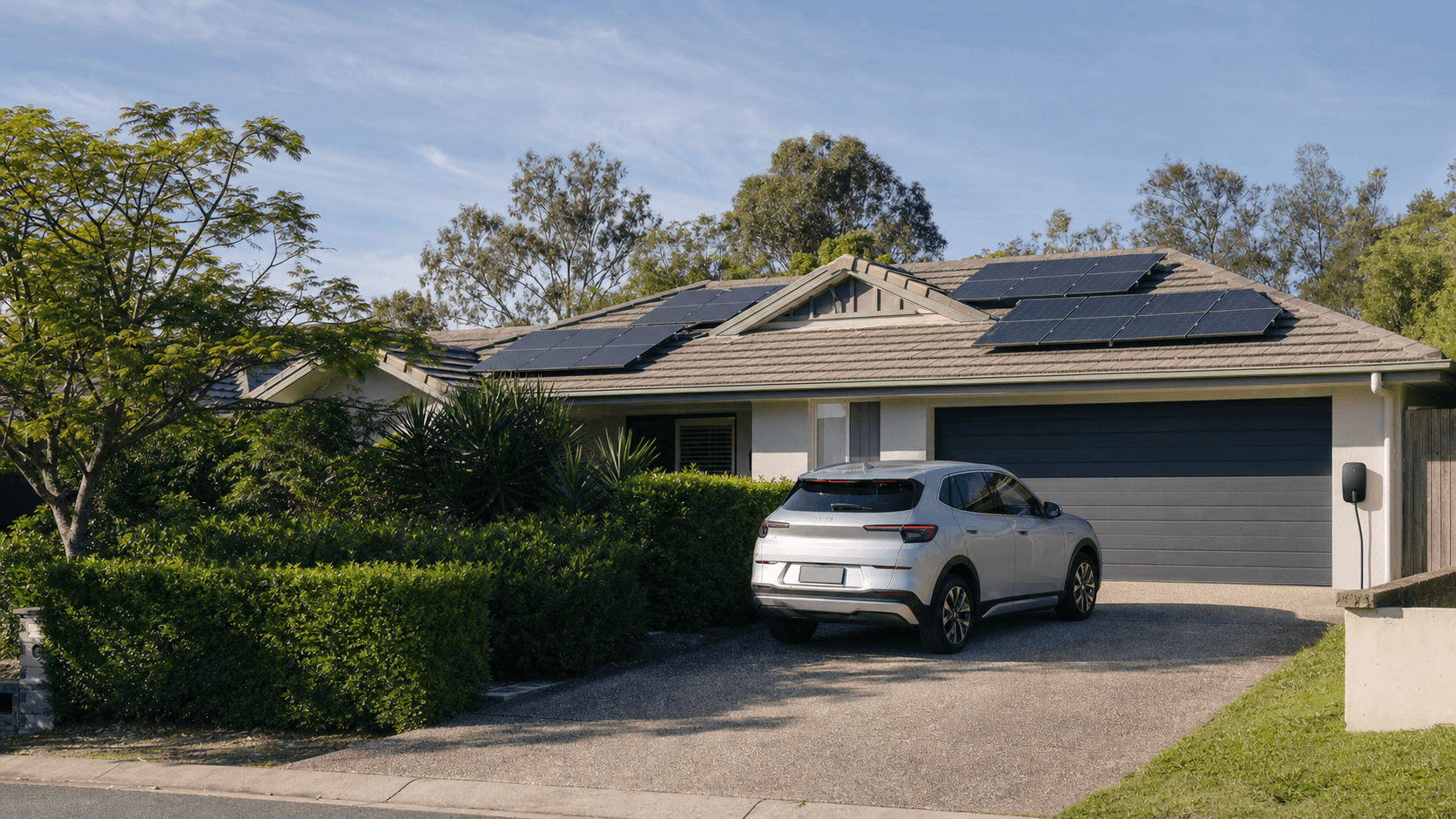
A battery quote can look sensible until an EV arrives. Many homes with solar have a familiar pattern: surplus generation around midday, then household demand after work. An EV does not automatically make a larger battery the answer. Its charging time is the first thing to understand.
That matters in Australia because solar exports are often worth less than electricity bought from the grid. Charging a car while the roof is producing can use some of that surplus directly. Charging it after dinner can move a large new load into the same period the battery was expected to cover. The two habits can lead to very different equipment choices even for the same house.
This article uses a simplified worked scenario to show the questions worth asking. It is not a performance promise or an installation design. Real equipment, tariffs, solar output, household behaviour and electrical work all need to be checked for the specific site.
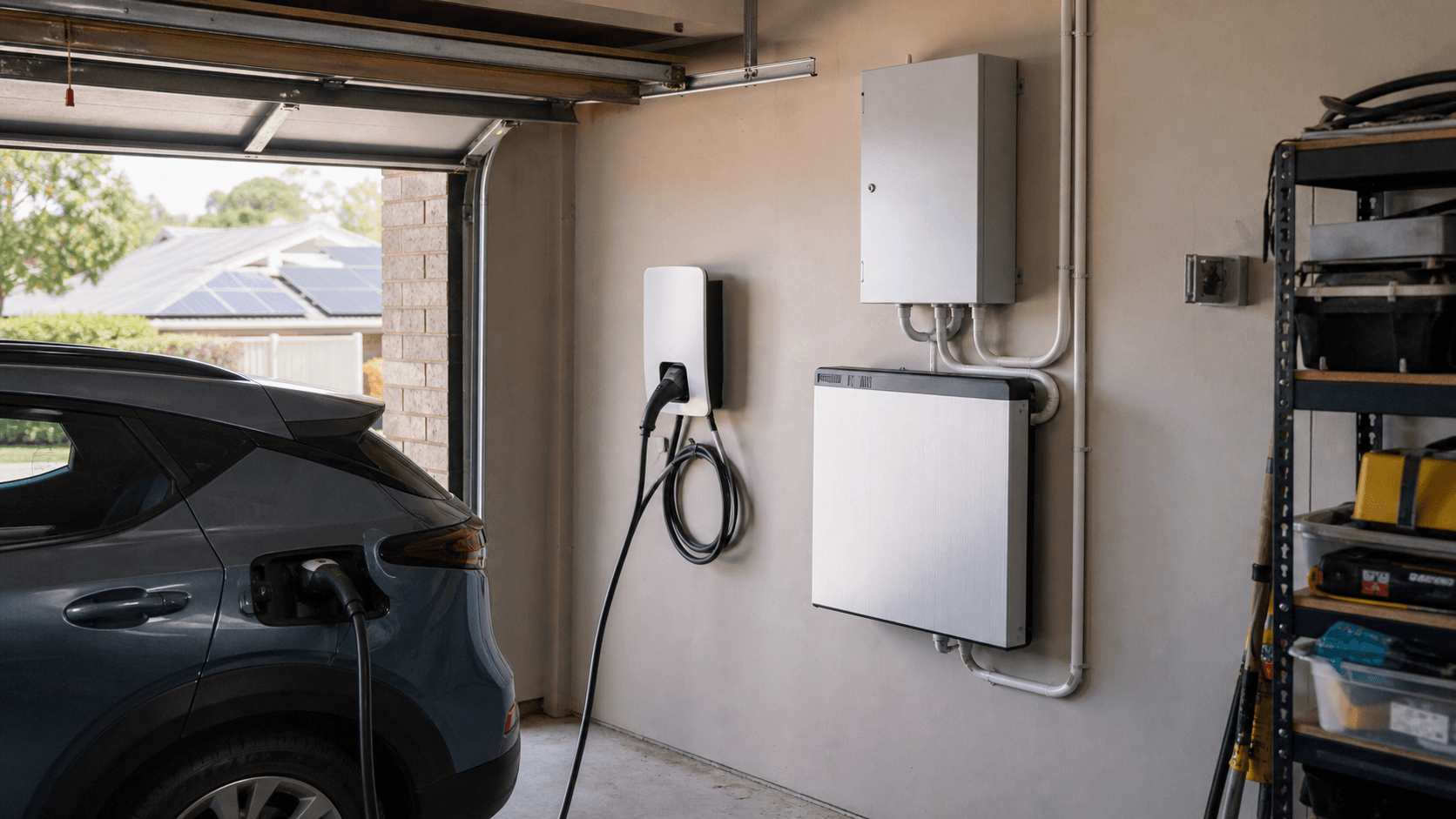
Start with the EV charging pattern—not the battery number
An existing solar array and a low current bill are useful inputs, but neither tells you the right battery capacity. First map when the home imports and exports energy. Then add the expected EV kilometres, the vehicle's energy use, the preferred charging window, charger power and the days the vehicle is normally at home. A vehicle that charges at midday can absorb solar that would otherwise be exported; a vehicle that arrives in the evening can add to the same demand window the battery is intended to cover.
A capacity figure such as 42 kWh is therefore not a conclusion. It may be reasonable for a particular load profile, backup objective and solar resource, but it does not prove that the system can recharge as intended in winter, deliver the required power, or create a suitable financial outcome. Use interval data where possible. If only bills are available, make the missing timing assumptions explicit and validate them before a final design.
- Recent interval data or bills, with daytime imports, evening demand and solar exports separated where available.
- Existing PV capacity, inverter model, roof orientation and seasonal generation pattern—not only the headline array size.
- Expected EV travel, charging location, preferred charging window and charger power; distinguish a future assumption from current measured use.
- Other changing loads, including electric hot water, HVAC, pool equipment, induction cooking and planned electrification.
- The primary objective: increase self-consumption, manage time-of-use costs, support selected backup loads, or combine several defined goals.
Does a 13 kW solar array determine the battery size?
No. Array size helps estimate generation, but battery sizing also depends on usable energy, export profile, home demand by time of day, EV charging behaviour, tariff conditions, inverter power and the requested backup scope.
Separate capacity, power and backup scope
A useful way to test a quote is to sketch one ordinary weekday. Take a deliberately simplified home with 6.6 kW of rooftop solar that imports 9 kWh from sunset to breakfast and often exports around midday. Assume the driver expects about 40 km on a typical weekday. At 17.5 kWh per 100 km, that is roughly 7 kWh delivered to the vehicle before charging losses. These numbers are a teaching example, not an Australian average.
If the car is at home and scheduled to charge during a sunny window, it can use some available PV directly. The battery can then be assessed mostly against the evening household load and an agreed outage reserve. If the same car arrives at 6 pm and starts charging from a 7 kW wall charger, that driving energy joins the evening demand instead. The battery, inverter, grid and charging schedule each have a different job in those two versions of the same home.
That is why a low bill, a 6.6 kW array or a proposed 10 kWh battery is not enough on its own. Interval data is valuable because it shows whether solar is available when the car needs energy and when the home reaches its highest power demand.
Capacity is only one part of the decision
Battery capacity describes stored energy, usually in kWh. It is only one part of a working configuration. Usable energy may differ from nominal capacity; charge and discharge power determine how much load can be supported at one time; and the inverter or backup output determines what can operate during an outage. A proposal should state each assumption rather than allowing a large kWh figure to imply whole-home backup or unrestricted EV charging.
This distinction matters when several loads run together. An EV charger, cooking appliance, air-conditioner, pump and general household demand can create a higher simultaneous load than the battery or backup system is designed to supply. Equally, a system with substantial storage may not have enough spare PV generation to recharge fully on every low-solar day. The final electrical design must confirm the exact equipment, wiring arrangement, protection and supported circuits.
- Nominal and usable battery energy, together with the reserve retained for outages or other operating rules.
- Continuous and short-duration battery/inverter power, including the intended simultaneous household loads.
- PV charging capability and the realistic seasonal generation available after daytime household use.
- Backup scope: selected essential circuits or a wider home supply, plus any loads deliberately excluded.
- Exact battery, inverter, communication and firmware compatibility basis for the proposed route.
Can a home battery be sized only from overnight electricity use?
Not reliably. Overnight use is important, but the review should also include daytime PV surplus, EV charging behaviour, power demand, tariff periods, reserve settings, seasonal generation and the backup objective.
Review the retrofit architecture and tariff before quoting
For an existing solar home, the battery route may involve an AC-coupled system, a compatible hybrid-inverter route, or another site-specific arrangement. The appropriate path depends on the installed inverter, its age and capability, switchboard and backup design, PV configuration, local requirements and the desired controls. It should be confirmed against exact models and the responsible installation design—not inferred from a generic product category.
Tariff conditions can materially change how a configuration is operated. Time-of-use pricing, feed-in credits, export limits, smart-meter eligibility and virtual-power-plant terms may affect when a battery charges or discharges and how much stored energy is held in reserve. Australian Government guidance recommends comparing the relevant electricity plan and tariff information. Do not carry a retailer offer, VPP payment or rebate assumption into a long-term result without checking its current terms and site eligibility.
- Record the exact existing inverter and PV-system details before choosing an AC-coupled or hybrid route.
- Confirm whether the requested backup outcome is technically supported by the proposed equipment and electrical design.
- Check the current retailer plan, meter status, controlled-load arrangements, export limit and any VPP conditions.
- Make charging and reserve rules visible in the proposal: solar priority, off-peak charging, EV schedule and outage reserve are operating choices, not generic promises.
- Keep financial illustrations separate from equipment performance statements, with all tariff, weather, finance and household-use assumptions named.
Does a hybrid inverter automatically mean whole-home backup?
No. Backup capability depends on the exact inverter and battery models, output rating, site wiring, protection design, reserve setting and the selected circuits. Confirm it at site and model level.
Build a free EV and battery solution brief
A useful first request does not need to be a technical report. Start with the suburb, the existing solar and inverter details, a recent bill or interval data, the likely EV charging routine and the loads that matter in an outage. That is enough to begin comparing viable routes.
The quote should then make the remaining decisions visible: exact model codes, usable energy, charge and discharge power, compatibility basis, backup inclusions, installation scope and any tariff assumptions. If those details are missing, a large capacity number can sound more complete than it is.
- Share the location, existing system details, interval data or bills, and a short description of likely EV charging behaviour.
- List the loads that matter during an outage and whether the objective is essential-load backup or a broader home supply.
- Ask for model-level compatibility, usable-energy and power information—not a capacity figure in isolation.
- Request a clear statement of inclusions, exclusions, operating assumptions and the party responsible for the final electrical design.
- Use the initial brief to compare viable routes; obtain local technical, electrical and tariff confirmation before order or installation.
Can a first solution brief provide a final battery quotation?
It can define a suitable starting configuration and the information needed for a quotation. Final equipment selection, installation scope, eligibility and financial outcomes still require the exact site, models, local requirements and current commercial terms to be checked.
Related Articles

Do solar panels cause roof leaks or damage your roof?
Solar panels do not normally make a sound roof leak. Problems are more often linked to roof condition, unsuitable mounting, damaged materials or poor workmanship.
Read Article→
How to size solar panels, a home battery and an EV charger for a villa
Size the panels for energy, the inverter for loads that run together, the battery for evening use and backup, and the charger for the car's daily refill.
Read Article→
Solar only vs solar plus battery: which pays back faster?
Solar alone often pays back sooner on bill savings. A battery can change the calculation, but the extra cost and extra savings need their own line.
Read Article→