
Can one backup power system run 120V and 240V loads at the same time?
A 240V socket and a large wattage number do not settle the question. Start with the pump, the output mode and what each 120V leg can actually supply.
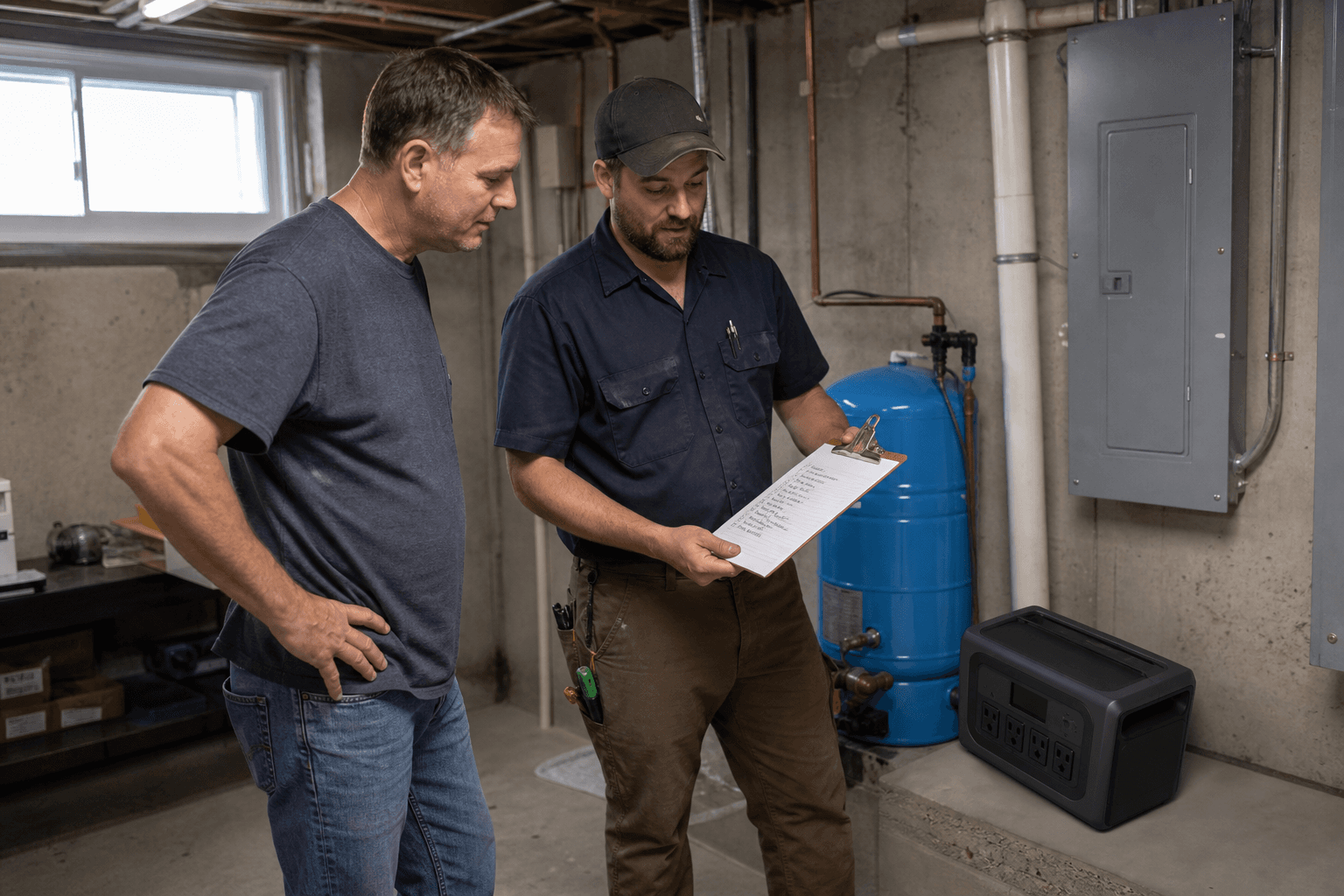
A refrigerator is easy to picture. A well pump is where a backup-power plan gets awkward. The breaker may say 240V and 20A, but that does not tell you what the pump normally draws or what it asks for during the first second of a start. It also does not tell you whether a portable power station can keep its 120V outlets alive while supplying 240V.
These details matter when a home needs water and a few basic appliances during an outage. Some products provide native 120/240V split-phase output in battery mode. Some switch between a 120V mode and a 240V mode. Others can pass 240V from an incoming source but cannot create it while inverting from the battery. Similar product names can hide very different behavior.
This guide shows what to check before comparing a portable power station, a split-phase inverter and battery system, or a fixed home-backup setup. It is a planning guide, not a panel-connection tutorial. Transfer equipment, source switching, neutral and grounding arrangements, protection, permits and final commissioning belong with a qualified local electrician. The photographs are illustrative editorial images rather than Rongkai project records.

What simultaneous 120V and 240V output really means
In a typical North American split-phase supply, either hot leg to neutral provides 120V, while the two hot legs together provide 240V. A well pump may use the 240V connection. A refrigerator, lights and receptacles usually use one 120V leg or the other. One backup source can serve both voltage classes only if the product and the approved connection equipment support that operating mode.
Read the output map in the exact model manual. Do not stop at a phrase such as "120V/240V capable." Ask whether 120V receptacles and the 240V outlet remain available at the same time when the unit is running from its battery. Check whether the total output rating is shared, what each 120V leg can deliver, and whether the unit limits an unbalanced load. A household can stay below the advertised total wattage and still overload one leg.
The difference is not academic. EcoFlow states that DELTA Pro 3 changes outlet behavior when 240V AC output is enabled: its built-in 120V outlets are disabled while the split-phase outlet is active. Victron describes another kind of boundary for its MultiPlus-II 2x120V: it can pass an incoming split-phase source, but in inverter mode it supplies 120V to the two lines rather than producing 240V between them. These are model-specific examples, not verdicts on either product. They show why the manual matters more than the name on the box.
- Native 120/240V split-phase output while operating from the battery, not only while grid or generator power is present.
- Whether 120V and 240V outputs can remain active together, and which outlets or panel circuits are available in that mode.
- Continuous and short-duration output for the whole unit, plus the limit on each 120V leg.
- Any load-imbalance restriction, operating-mode change, expansion hub or manufacturer-approved accessory required.
Start with the well pump, not the shopping page
A 20A breaker protects a branch circuit. It is not a meter reading and it is not the pump's normal demand. The useful starting point is the exact pump and motor record: rated voltage, horsepower, full-load or service-factor current, starting information, and whether the installation uses a two-wire motor, a three-wire motor with a control box, or a variable-speed drive. If the records have gone missing, ask the pump contractor or electrician to identify the equipment and obtain suitable measurements.
Motor starting is the hard part. A submersible well pump can draw much more current for a short time while it accelerates. A power station that can run the pump after it starts may still trip during that first moment. The inverter's surge rating helps, but only when the manual explains how much surge is available, for how long, at 240V, and under the expected battery and temperature conditions. A vague "high surge" badge is not enough.
The rest of the essential-load list deserves the same treatment. Record the refrigerator nameplate, any freezer, controls, lights, communications equipment and other loads that could be on when the pump starts. Compressor loads can start too. The realistic worst case is not every breaker at its maximum; it is the combination of normal loads and starts that may actually overlap.
- Pump, motor, control-box or drive model numbers, along with the available manufacturer manual.
- Rated voltage, phase, horsepower, running current and manufacturer starting or locked-rotor information where provided.
- Measured running and starting behavior recorded by a qualified person if the documents are incomplete.
- Pressure-tank condition and typical pump cycle, because frequent short cycling changes both power demand and daily energy use.
- Refrigerator, freezer and other essential loads that may be operating when the pump starts.
Does a 240V 20A breaker mean the well pump needs 4,800W?
No. Multiplying the breaker rating by voltage gives the circuit's headline capacity, not the pump's normal draw. Size the source from the exact motor data, starting requirement, measured behavior where needed, and the other loads that may overlap.
Check power and energy as two separate problems
Power decides whether the system can start and run the loads right now. Energy decides how long it can keep doing that. For power, compare normal simultaneous demand, pump-start surge and per-leg limits. For energy, estimate pump run time per day, refrigerator duty cycle, controls and small loads, inverter standby use, conversion losses and the battery reserve you do not want to spend.
A large battery does not rescue an undersized inverter, and a powerful inverter does not create a long runtime from a small battery. This is why runtime claims based on one appliance can mislead. A well pump may run only a few minutes at a time, but household water use, pressure-tank behavior and pump depth affect the pattern. A refrigerator cycles with room temperature, door openings and food load. Put the assumptions on paper instead of relying on one advertised number.
Recharge is part of the outage plan. If a generator will recharge the battery system, check the charging input voltage and frequency, maximum charge rate, generator quality requirements, and whether the unit can support loads while charging. Fuel runtime and the hours when a generator can reasonably be operated also matter. The generator and battery should be treated as one operating plan, while the exact source switching, grounding and neutral arrangement is left to the responsible electrician and the equipment instructions.
Portable power station or fixed split-phase battery system?
A portable power station can make sense for occasional outages and a short list of essential loads. It is packaged, movable and usually simple to recharge. The trade-off is that output modes, per-leg power, battery expansion and panel integration are tightly defined by the manufacturer. Confirm the exact behavior before buying adapters or transfer equipment.
A fixed split-phase inverter and battery system is usually easier to tailor when outages are frequent, the well pump is demanding, more circuits need backup, or later battery and solar expansion is expected. It also brings more design work: battery voltage and current, inverter architecture, protection, transfer method, enclosure, site conditions, permits and commissioning. "Fixed" does not automatically mean better, and "portable" does not automatically mean plug-and-play with a home panel.
The same caution applies to 30A versus 50A inlets. An inlet rating describes part of the connection path; it does not increase the source output. A 50A connector will not turn a 4kW power station into a larger inverter. Choose the source from the loads, then have the electrician select listed transfer and inlet equipment that matches the approved system and local rules. Never improvise a backfeed connection.
Two separate 120V power stations are not a safe shortcut to 240V. They can form split phase only when the manufacturer explicitly supports synchronized operation with the specified equipment and instructions. A transformer can change voltage, but it cannot create extra power and it adds its own surge, loss, protection and grounding questions. Neither approach should be invented on site from generic parts.
Can one power station run 120V appliances and a 240V well pump together?
Some can, but the exact manual must confirm simultaneous split-phase operation, 240V surge capability, per-leg 120V limits and the permitted connection method. A product described as 120/240V may still switch modes or restrict its built-in 120V outlets.
Can two 120V power stations be combined to make 240V?
Only when the manufacturer provides an explicit synchronized split-phase method for those exact models and accessories. Two ordinary 120V outputs should never be manually tied together.
Should a home backup inlet be 30A or 50A?
That decision follows the source rating, selected loads, transfer equipment and local electrical design. A larger inlet is not extra power. Have the qualified installer match the connection equipment to the approved backup source and panel arrangement.
Prepare a useful backup-power brief
A supplier can compare equipment more honestly when the brief contains real load information and a clear operating goal. State whether the system must run the well pump and refrigerator at the same time, how long a typical outage lasts, whether a generator or solar array will recharge it, and whether the system is intended for a few selected circuits or a broader home backup panel.
Keep unknowns visible. If the pump model or starting current is not known, mark it for site confirmation rather than filling the gap with a guess. If local transfer and permitting requirements have not been reviewed, identify the electrician or contractor who will own that work. A short brief with honest blanks is more useful than a long equipment wish list built on the breaker labels.
- Country, utility format and confirmation that the property uses the expected 120/240V split-phase service.
- Exact well-pump, motor, control-box or drive information and verified starting requirement.
- Essential 120V loads, their normal demand, start-up behavior and which ones may overlap.
- Required outage duration, usable battery reserve and expected daily pump and appliance energy.
- Recharge sources: grid, generator and/or solar, with realistic charging windows.
- Portable outlet use or fixed panel integration, plus the qualified local party responsible for transfer, protection, permits and commissioning.
Related Articles

Why is my home battery low every morning?
A low morning reading does not prove the battery is too small. First find out how full it was at bedtime and where the energy went overnight.
Read Article→
How to plan a commercial solar and battery storage system
Start with the load curve and electricity bill. They reveal far more about the right commercial battery than the building's monthly kWh.
Read Article→
Do solar panels cause roof leaks or damage your roof?
Solar panels do not normally make a sound roof leak. Problems are more often linked to roof condition, unsuitable mounting, damaged materials or poor workmanship.
Read Article→