
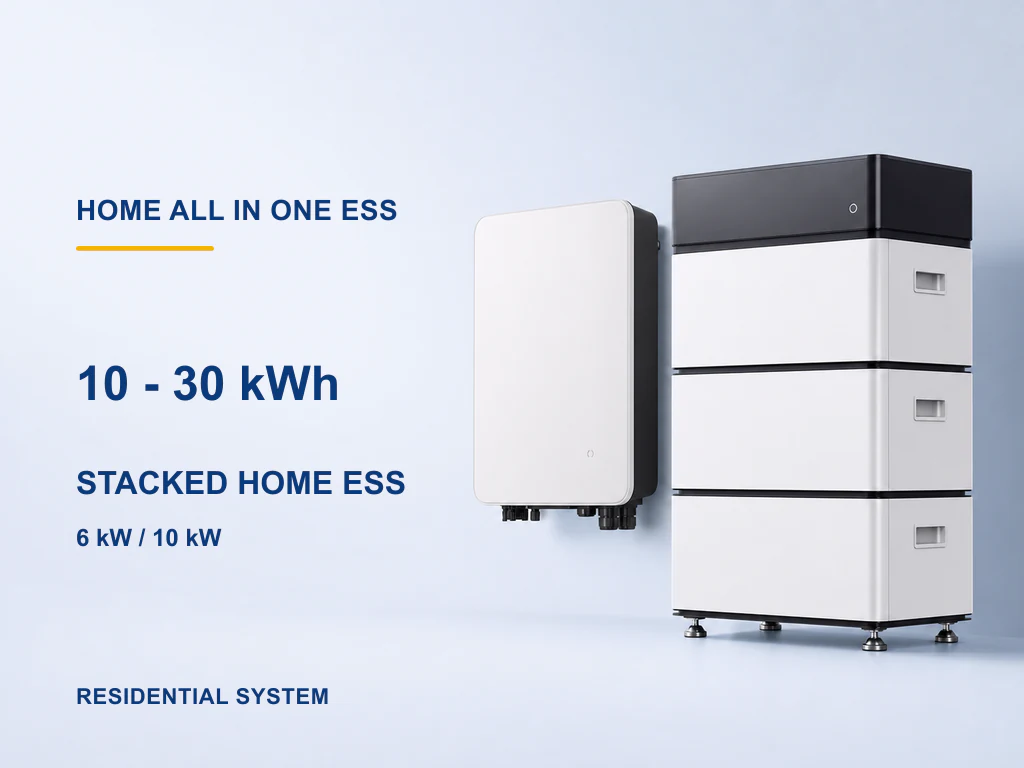
10–30kWh Stacked Home All-in-One ESS Configuration Guide
Current source identity: a multi-configuration platform record, not one fixed 6/10 kW and 10/20/30 kWh bill of materials.
This source-derived indoor platform combines 6 kW or 10 kW inverter options with nominal 10, 20 or 30 kWh LFP battery configurations. The current record lists 51.2 V battery modules, a 44.8–57.6 V working range, 90% depth of discharge, up to three batteries in parallel and IP20 installation. The exact inverter–battery BOM, usable AC energy, configuration mapping, backup output, current allocation, grid code, safety files and included protection must be confirmed for each quoted system.
- Displayed power options
- 6 kW / 10 kW inverter
- Displayed nominal energy
- 10 / 20 / 30 kWh
- Battery platform
- 51.2 V LFP modules / 44.8–57.6 V
- Installation
- IP20 indoor stacked system
Current source-derived specifications
These values are preserved from the current product record. Read them with the configuration, compatibility, document and project boundaries below before using them in a quotation.
Battery & Energy
| Nominal Energy | 10 kWh / 20 kWh / 30 kWh |
|---|---|
| Battery Platform | LFP; 51.2 V battery modules |
| Voltage | 44.8–57.6 V battery working range; 48 V DC battery access |
| Recommended Charge / Discharge Current | 100 A |
| Maximum Charge / Discharge Current | 200 A |
| Battery Pack Cycle Efficiency | >95% |
| Cycle Life | ≥6,000 cycles |
| Maximum PV Input Voltage | 500 V DC |
| PV Operating Voltage Range | 90 to 500 V DC |
System & Installation
| System Type | Indoor stacked battery and inverter energy storage system |
|---|---|
| Rated Power | 6 kW / 10 kW inverter options |
| Cooling | Natural or forced-air cooling, depending on system size |
| Protection | IP20 indoor installation |
| Communication | CAN / RS485 |
| Dimensions | 700 × 250 × 1140 / 1580 / 2020 mm |
| Weight | 150 / 240 / 330 kg |
| Recommended Application | Residential solar self-consumption, time-of-use shifting and backup systems |
| Depth of Discharge | 90% |
| Display | LED |
| System Scalability | Up to 3 batteries in parallel |
| Maximum PV Input Power | 2 × 5,500 W |
| Relative Humidity | 5% to 95%, non-condensing |
| Installation Altitude | 3,000 m |
| Safety / Transport | CE / UN38.3 |
Current document status
The record does not attach a configuration matrix, exact inverter and battery model codes, wiring/one-line, usable-energy guarantee, approved battery protocol, installation manual or complete certificate/transport package. Request these for the selected kW/kWh combination.
Current platform evidence
Fix one kW/kWh configuration before comparing price or runtime
A family page must not combine the best values of different system sizes into one implied product.
Power and energy matrix
The record lists 6/10 kW and 10/20/30 kWh options but does not map every permitted pairing, inverter code, battery quantity, dimensions, weight or cooling route.
Battery limits
51.2 V LFP modules, 44.8–57.6 V range, 100 A recommended and 200 A maximum charge/discharge values are listed without a clear per-module or system basis.
PV and backup
The source lists 500 V maximum PV, 90–500 V operation and 2 × 5,500 W maximum PV input. Backup power, surge, transfer, pass-through and output distribution require exact inverter data.
Indoor physical system
IP20, three heights/weights, CAN/RS485 and natural or forced-air cooling are listed. The selected configuration needs a mapping plus clearances, floor loading and environmental limits.
Home ESS RFQ checks
Six decisions needed for a configuration-specific residential ESS quote
The buyer should choose system duty and required usable service before choosing nominal kWh.
Operating objective
Define backup, self-consumption, time-of-use shifting, export control or weak-grid operation and rank these objectives if operating priorities conflict.
Exact kW/kWh pairing
Request the permitted inverter and battery model combination, module quantity, gross and usable energy, charge/discharge power, dimensions, weight and expansion rule.
Load and runtime
Provide essential-load W/VA, startup surge, daily kWh, permitted transfer, desired autonomy, reserve SOC and circuits excluded from backup.
PV and grid
Provide module/string data, destination AC/grid code, export-control requirement, meter/CT, backup topology and local approval needs.
Site and safety
Confirm indoor room, floor capacity, ventilation, temperature/humidity, clearances, egress, fire strategy, AC/DC protection, earthing and installer responsibility.
Documents and scope
Request BOM, datasheets, manual, one-line, certificates, UN38.3 evidence, SDS, packing, warranty, commissioning, included accessories and current terms.
Configuration and runtime boundaries
Nominal 10–30 kWh does not prove usable energy, runtime or a complete installation
Every performance statement must be tied to one battery count, inverter model and operating condition.
Nominal is not usable AC energy
90% DoD does not by itself establish delivered AC kWh. Reserve SOC, conversion losses, temperature, battery limits, aging and warranty rules also apply.
Cycle life needs its test basis
The ≥6,000-cycle label needs cell/module identity, temperature, C-rate, DoD, end-of-life threshold and warranty relationship before comparison.
Parallel wording is not a universal expansion rule
Confirm supported starting size, identical module requirements, firmware, cable/protection layout, commissioning procedure and whether later expansion is warrantable.
All-in-one does not mean turnkey site scope
Distribution, CT/meter, breakers, surge protection, earthing, mounting, fire provisions, grid approval and installation/commissioning may remain outside supply.
Continue the home ESS review
Connect the capacity option to household loads and approved pairing evidence
Use these guides to define the complete system and a transparent usable-energy basis.
Residential solar and backup solution
Define essential circuits, PV, storage, protection, monitoring and local installation as one procurement scope.
Review home-system scope →Battery and backup sizing guide
Choose kW and kWh from loads, operating objective, usable energy, reserve and conversion limits.
Review capacity inputs →10–30 kWh home ESS FAQ
Questions to close for the selected inverter and battery stack
Answers must be configuration-specific rather than copied from the family range.
Can every 6 kW or 10 kW inverter use every 10–30 kWh stack?
Do not assume so. Request the approved configuration matrix with inverter and battery model codes, current limits, protocol, firmware, module count and protection.
Is 30 kWh the usable energy delivered to loads?
No. It is a nominal label. Confirm usable DC and AC energy under stated reserve, DoD, temperature, power, conversion-loss and warranty conditions.
Does all-in-one include a complete installed backup system?
Not automatically. Confirm the BOM and responsibility for distribution, CT/meter, protection, earthing, fire provisions, installation, grid approval and commissioning.
Which files should be requested?
Request the configuration matrix, inverter/battery datasheets, manual, one-line, battery protocol, certificates, UN38.3/SDS, packing, warranty and commissioning scope.
Configure a 10–30 kWh home ESS RFQ
Send the operating objective, essential-load and surge schedule, autonomy target, PV strings, destination grid, indoor site conditions and required documents so one kW/kWh BOM can be validated.
Start with the product, application or project information you have. We can help identify the remaining configuration, document or delivery questions before a final quotation.
Configure the Home ESSRelated Products
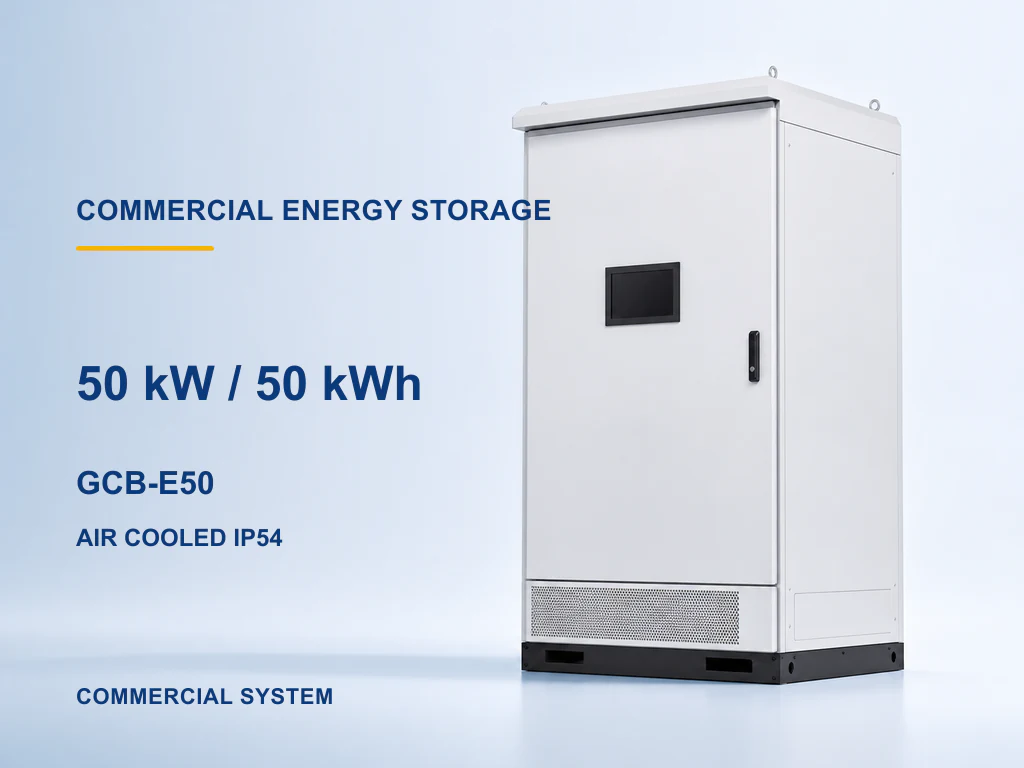
GCB-E50 50kW / 50kWh C&I Energy Storage Cabinet
50 kW rated charge and discharge power / 50 kWh nominal system energy air-cooled commercial & industrial energy storage cabinet for small commercial self-consumption, demand management and backup projects.
View Details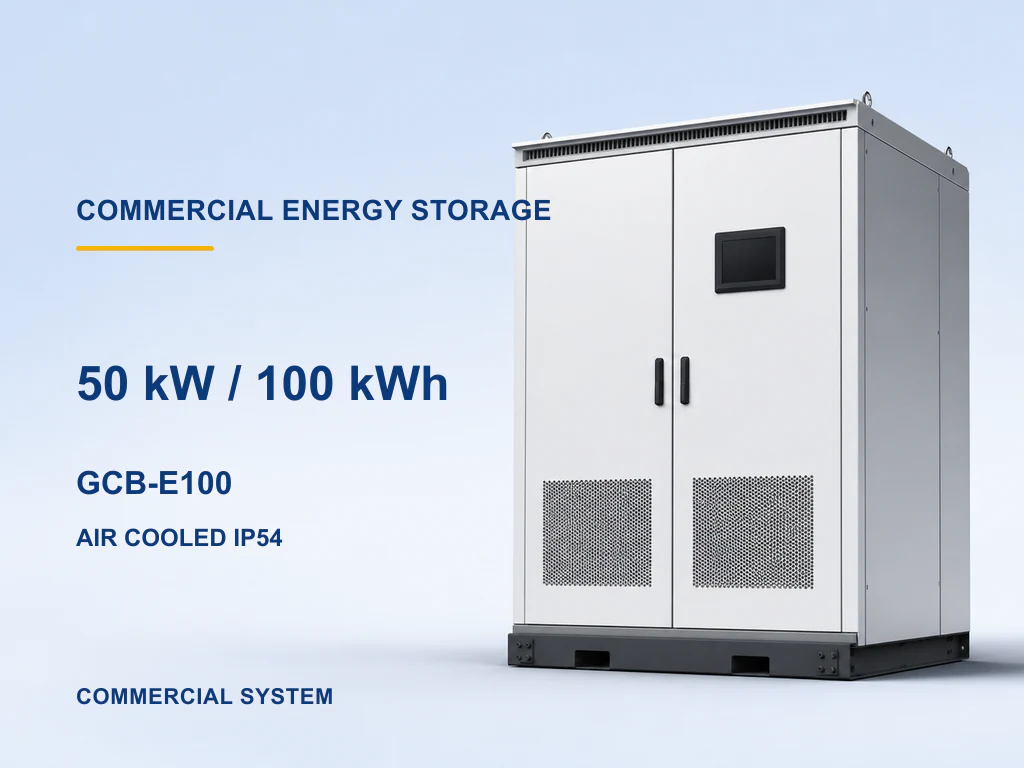
GCB-E100 50kW / 100kWh C&I Energy Storage Cabinet
50 kW rated charge and discharge power / 112.53 kWh / 100.35 kWh, depending on the selected 314 Ah / 280 Ah battery option air-cooled commercial & industrial energy storage cabinet for c&i peak shaving, solar self-consumption and backup support.
View Details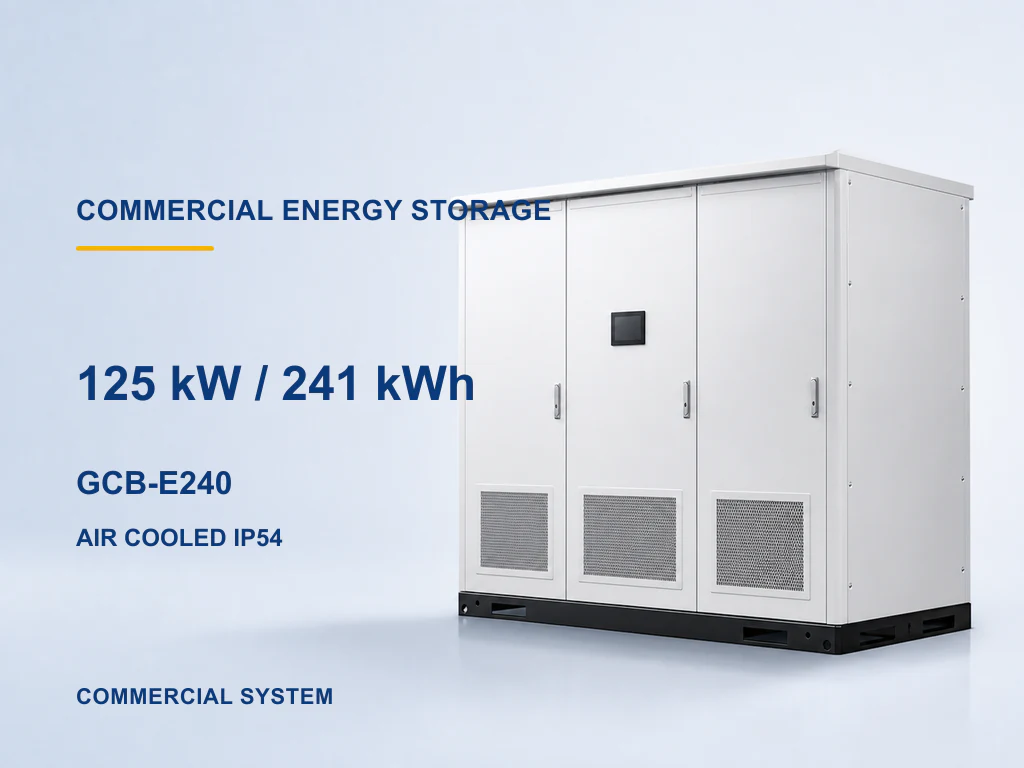
GCB-E240 125kW / 241kWh C&I Energy Storage Cabinet
125 kW rated charge and discharge power / 241.15 kWh / 215.04 kWh, depending on LFP battery option air-cooled commercial & industrial energy storage cabinet for commercial peak shaving, solar-plus-storage and demand-charge management.
View Details