
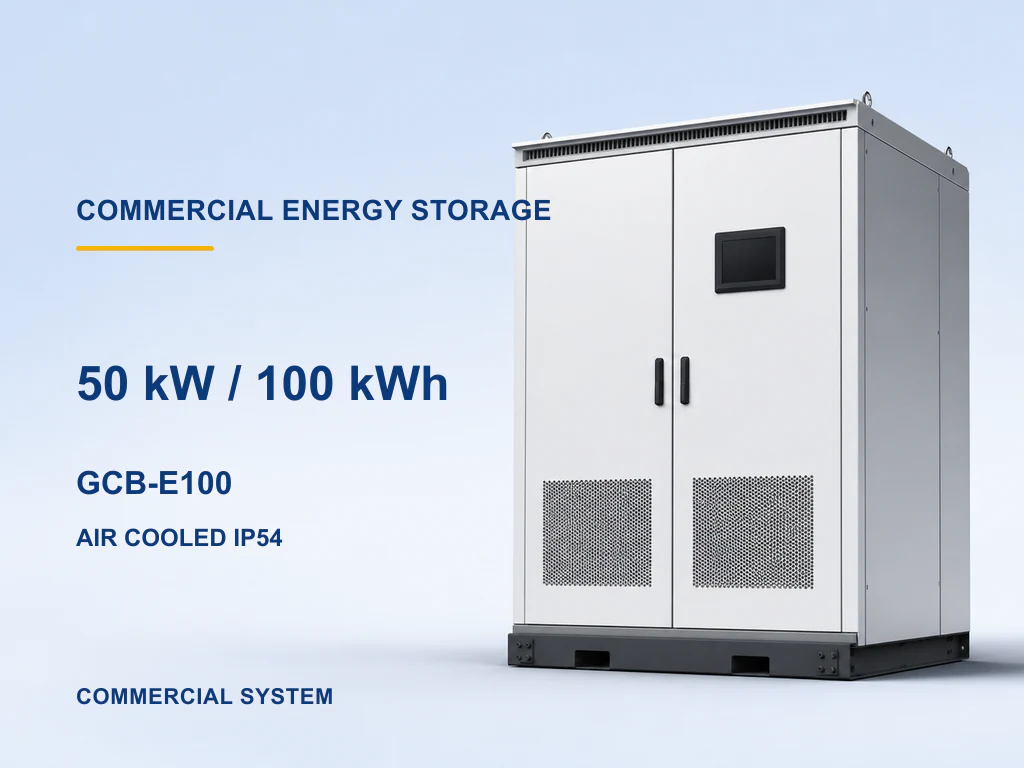
GCB-E100 50kW / 100kWh-Class C&I Energy Storage Cabinet
Current source identity: GCB-E100 family record with separate 314 Ah and 280 Ah energy options; it is not one interchangeable 100 kWh BOM.
The GCB-E100 record describes a 50 kW air-cooled C&I cabinet with two battery options: 112.53 kWh on a 314 Ah route or 100.35 kWh on a 280 Ah route. It lists a 280–403 V battery range, 380 V three-phase AC, IP54, refrigeration/ventilation/heating and an integrated fire-protection label. The exact battery option, Deye PCS model, BMS/EMS BOM, usable energy, duration, auxiliary consumption, protection, approvals and commissioning scope must be fixed before comparison.
- Model family
- GCB-E100
- Displayed power
- 50 kW charge/discharge
- Displayed energy options
- 112.53 kWh (314 Ah) / 100.35 kWh (280 Ah)
- Displayed site route
- 380 V three-phase / IP54 / air-cooled cabinet
Current source-derived specifications
These values are preserved from the current product record. Read them with the configuration, compatibility, document and project boundaries below before using them in a quotation.
Battery & Energy
| Nominal Energy | 112.53 kWh / 100.35 kWh, depending on the selected 314 Ah / 280 Ah battery option |
|---|---|
| Battery Platform | LFP 314/280 Ah cell platform; 51.2 V battery packs stated |
| Voltage | 280–403 V battery range; AC 380 V three-phase grid |
| Rated AC Current | 76 A |
| Current Harmonic Distortion | <3% |
System & Installation
| System Type | Air-cooled commercial & industrial energy storage cabinet |
|---|---|
| Rated Power | 50 kW rated charge and discharge power |
| Cooling | Air cooling with refrigeration, ventilation and heating listed |
| Protection | IP54; integrated fire-protection system listed |
| Communication | RS485 / CAN |
| Dimensions | 1200 × 803 × 2375 mm |
| Weight | 1300 kg |
| Recommended Application | C&I peak shaving, solar self-consumption and backup support |
| Inverter Listed | Deye |
| Grid Type | Three-phase, four-wire |
| Grid Frequency | 50 Hz |
| Power Factor Range | -1 to 1 |
| Operating Temperature | -10 to 50°C |
| Relative Humidity | 0% to 95% |
| Installation Altitude | <2,000 m |
| Noise | ≤75 dB |
| System Efficiency | ≥90% |
Current document status
Request the configuration matrix and exact battery/PCS/BMS/EMS item numbers, datasheets/manuals, one-line, usable-energy and efficiency basis, HVAC/fire design, grid documents, transport data, warranty and FAT/SAT plan for the chosen option.
Current GCB-E100 evidence
Choose the battery option and complete BOM before using the 100 kWh label
The title is a product class; the current record contains two materially different nominal-energy routes.
Two energy configurations
112.53 kWh for the 314 Ah option and 100.35 kWh for the 280 Ah option are listed. Confirm exact pack/rack count, DC voltage, usable energy, dimensions and weight for each.
50 kW PCS route
The record lists 50 kW, 380 V, 76 A and a Deye inverter label without a complete PCS model, DC/AC limits, overload, backup/black-start status or grid-code scope.
Air cooling and environment
Refrigeration, ventilation and heating, -10–50°C, <2,000 m, ≤75 dB and IP54 are listed. Capacity/derating, auxiliary power and siting conditions need exact evidence.
Efficiency and fire labels
≥90% system efficiency, <3% current harmonics and integrated fire protection are source labels. Test points, included equipment, standards and approval basis are not supplied.
GCB-E100 RFQ checks
Six decisions needed for a configuration-specific cabinet quote
The buyer should compare the selected battery route and complete AC system, not a rounded 100 kWh name.
Battery option
Select 314 Ah/112.53 kWh or 280 Ah/100.35 kWh and request the exact cell, pack, rack, BMS, voltage/current and usable-energy schedule.
Duty and duration
Define continuous/peak kW, duration, cycles/day, reserve SOC, backup or grid-connected duty, degradation assumptions and end-of-life requirement.
PCS and controls
Fix the Deye PCS model/suffix, EMS/controller, meter/CT, BMS protocol, operating modes, export control, monitoring and remote-access boundaries.
AC/grid and protection
Provide 380 V system, fault level, grounding, transformer/POC, breaker/switchgear, protection study, grid code and local interconnection requirements.
Site/thermal/fire
Confirm foundation, clearances, ventilation, ambient/altitude, noise, HVAC auxiliary load, fire detection/suppression, emergency shutdown and AHJ requirements.
Documents/acceptance
Request BOM, one-line, certificates, transport/lifting, warranty, FAT/SAT, commissioning, capacity/efficiency test basis, training, spares and service.
GCB-E100 system boundaries
50 kW / 100 kWh shorthand does not define one two-hour system
Nominal energy, usable AC energy, sustained power and included system scope must be verified together.
Energy options are not interchangeable
The 314 Ah and 280 Ah routes have different nominal energy and may differ in pack/BMS, voltage, current, weight, availability and warranty.
Nominal duration is not guaranteed
100 kWh divided by 50 kW does not account for reserve, DoD, losses, auxiliary load, current limits, temperature, degradation or power derating.
System efficiency needs a test boundary
The ≥90% label must identify DC or AC boundary, power/SOC/temperature, auxiliary loads, charge/discharge cycle and measurement tolerance.
Integrated fire protection needs a design
Confirm detector/suppression type, zoning, agent, ventilation shutdown, alarms, standards, test reports, site interfaces and local approval.
Continue the GCB-E100 review
Connect the cabinet option to C&I duty and an exact BOM
These pages help define project scope and capacity assumptions before quotation.
Commercial solar and storage solution
Coordinate the cabinet with PV, grid, loads, EMS, protection, site works and commissioning.
Review C&I storage scope →Storage sizing and duty guide
Choose power and usable energy from load profile, objective, reserve, losses and operating conditions.
Review kW/kWh inputs →GCB-E100 FAQ
Questions created by the two battery options
The final answers must name the selected 314 Ah or 280 Ah configuration.
Is the GCB-E100 exactly 100 kWh?
Not for every option. The record lists 112.53 kWh for a 314 Ah route and 100.35 kWh for a 280 Ah route. Require the exact configuration matrix and BOM.
Does 50 kW / 100 kWh guarantee two hours?
No. Confirm usable AC energy, reserve, DoD, losses, auxiliary load, current limits, temperature, degradation and whether 50 kW is sustained across the operating range.
Is the listed Deye inverter enough to confirm the PCS?
No. Request the full PCS model/suffix, ratings, firmware, grid code, operating modes, communication and warranty for the chosen battery option.
What should FAT/SAT verify?
Define BOM/serial checks, insulation/protection, BMS/EMS/PCS controls, alarms/fire interfaces, charge/discharge, capacity/efficiency basis, communications, commissioning and handover.
Configure a GCB-E100 cabinet RFQ
Send the selected battery option, duty profile, usable-energy target, AC/grid interface, site/fire conditions, monitoring and acceptance requirements.
Start with the product, application or project information you have. We can help identify the remaining configuration, document or delivery questions before a final quotation.
Verify the GCB-E100 OptionRelated Products
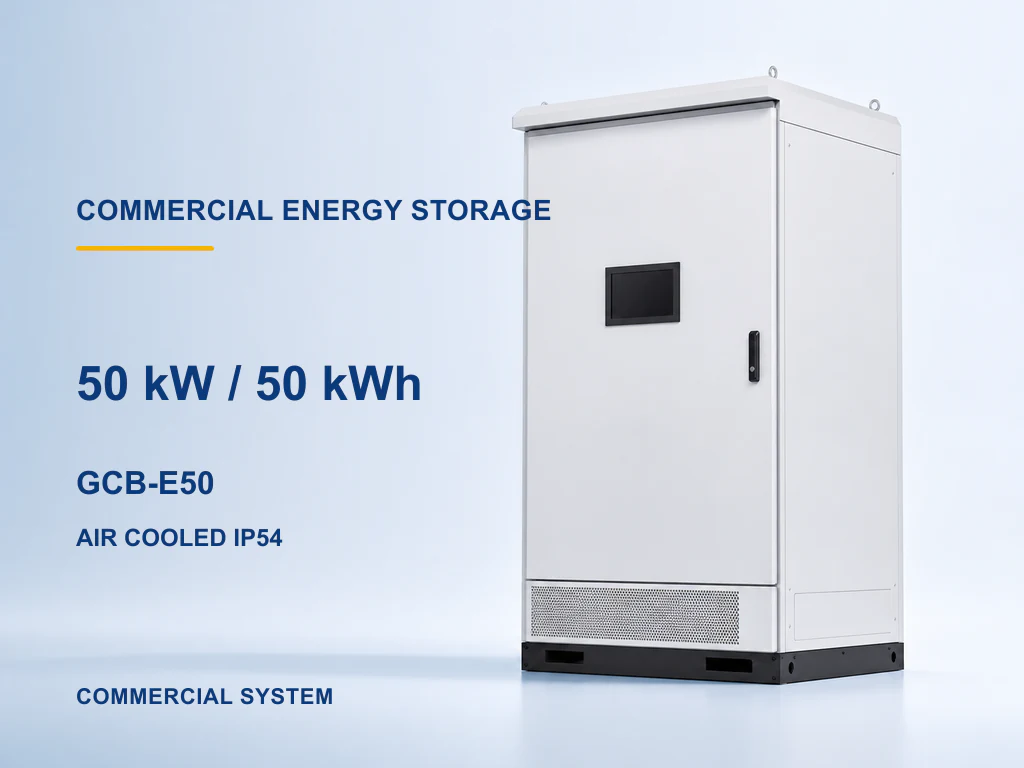
GCB-E50 50kW / 50kWh C&I Energy Storage Cabinet
50 kW rated charge and discharge power / 50 kWh nominal system energy air-cooled commercial & industrial energy storage cabinet for small commercial self-consumption, demand management and backup projects.
View Details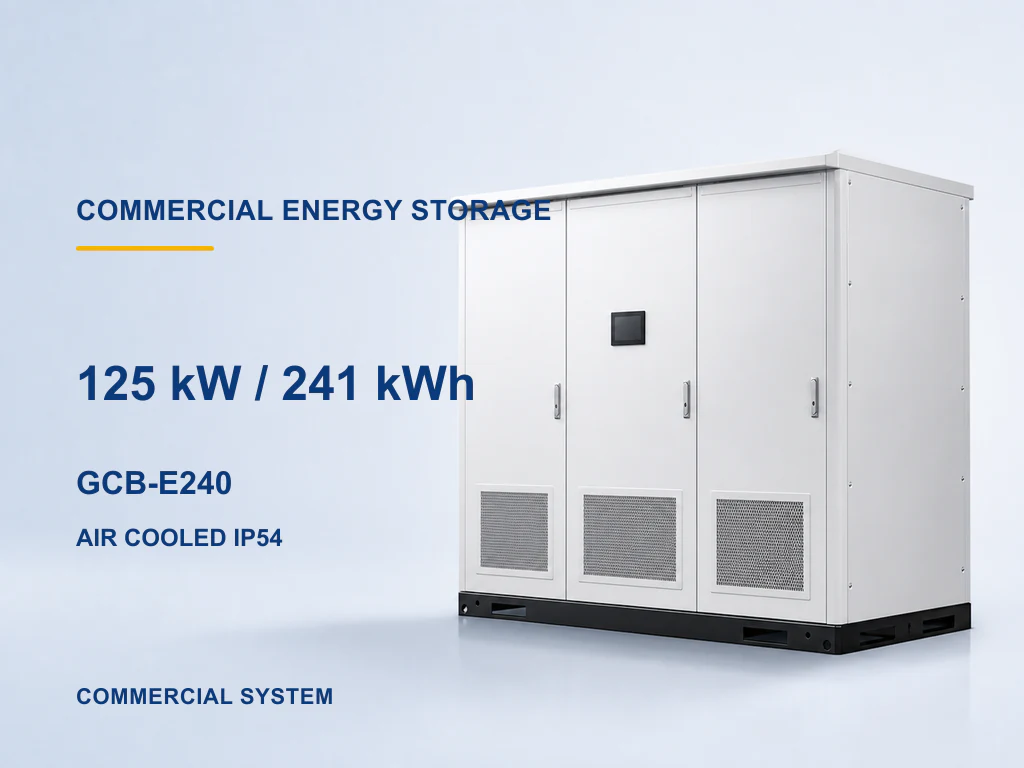
GCB-E240 125kW / 241kWh C&I Energy Storage Cabinet
125 kW rated charge and discharge power / 241.15 kWh / 215.04 kWh, depending on LFP battery option air-cooled commercial & industrial energy storage cabinet for commercial peak shaving, solar-plus-storage and demand-charge management.
View Details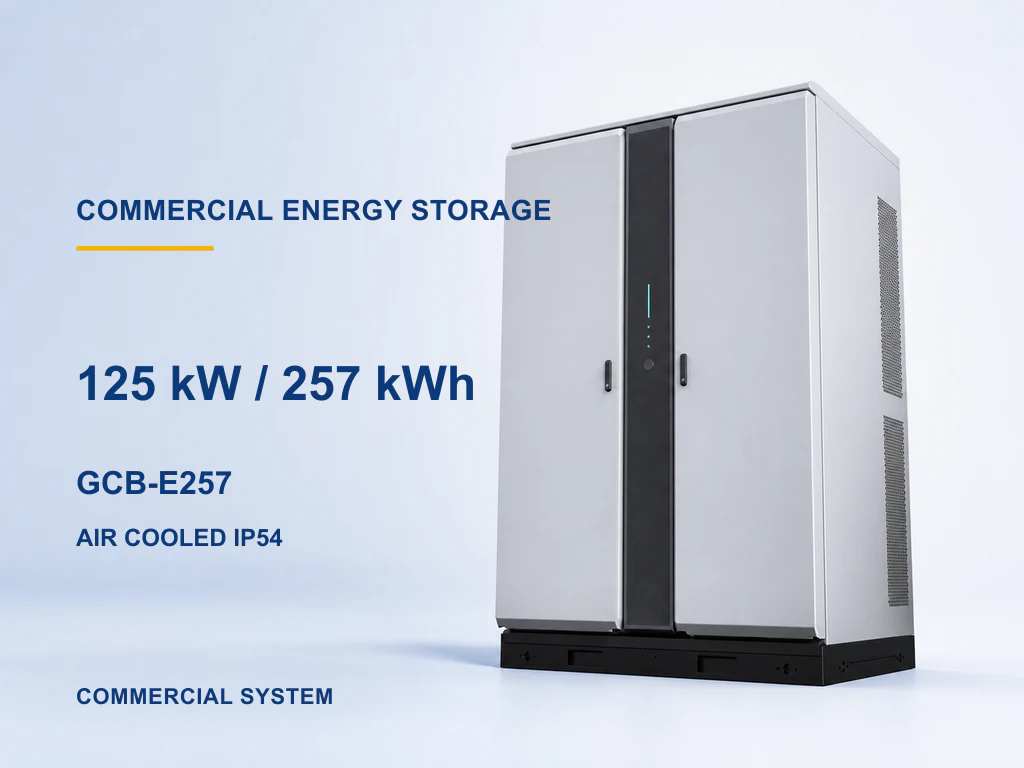
GCB-E257 125kW / 257kWh C&I Energy Storage Cabinet
125 kW / 257 kWh air-cooled commercial & industrial energy storage cabinet for larger c&i solar-plus-storage, load shifting and grid-connected backup projects.
View Details