
Can you add more solar panels to an existing system?
Before buying more panels, establish what the old array, inverter, connection point and approval can actually accommodate—and which expansion route keeps the design reviewable.
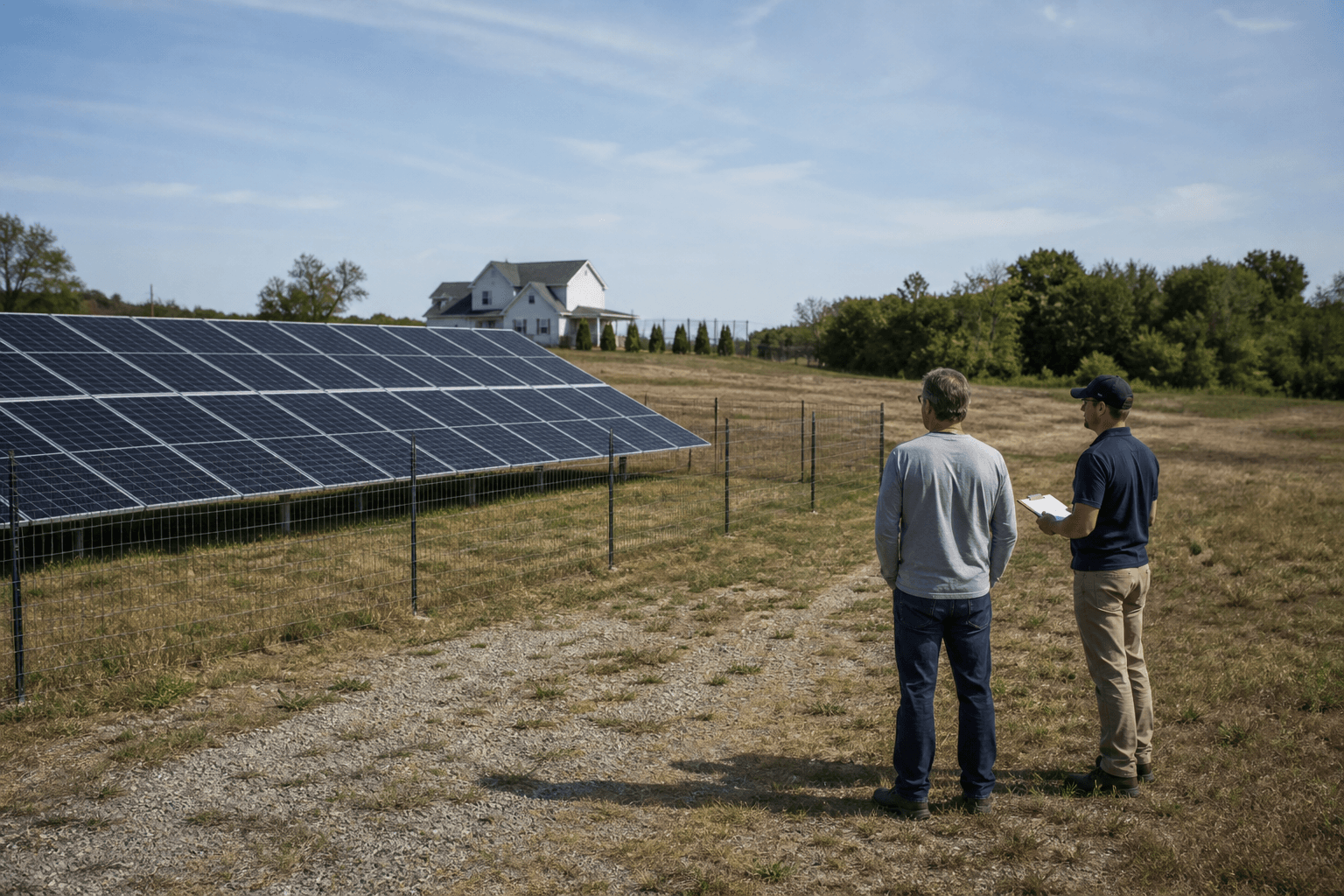
A solar array that once covered most of a property's consumption may fall behind after an electric vehicle, air-conditioning, heat pump or business load is added. More panels sound like the direct answer. On an existing grid-tied system, however, the available roof or land is only one of several limits.
The first job is to recover the design basis of the system already in service. The second is to decide whether the new array should share its power-conversion equipment, use a separate input, operate through a second inverter, or form part of a wider inverter-and-storage upgrade. Buying modules before those questions are settled can leave a technically awkward mix of old and new equipment.
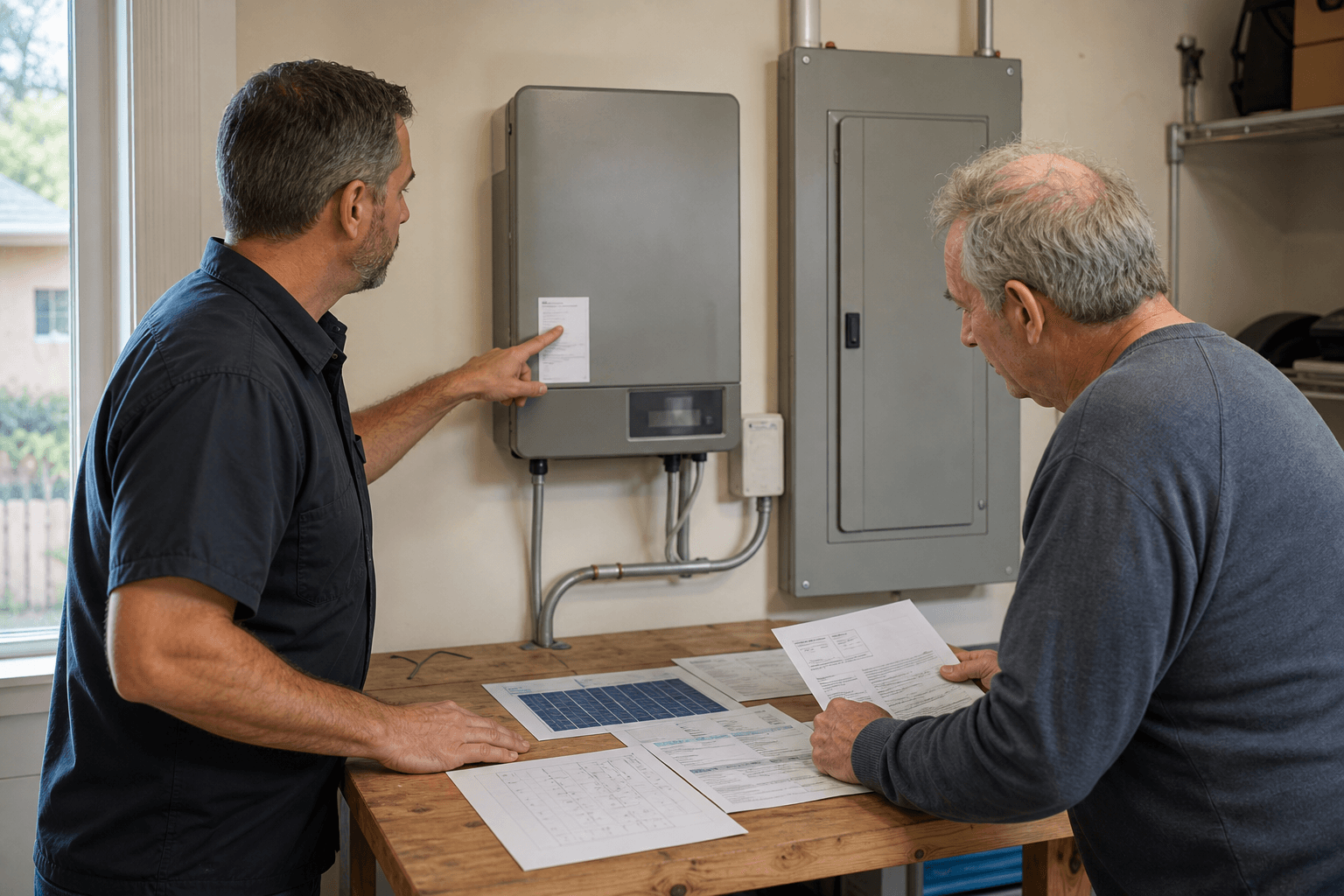
This guide is for owners and buyers preparing an expansion brief, not for live electrical work. String calculations, conductor and protection design, structural work, grid applications and commissioning belong with the appropriately qualified parties in the installation market. The photographs are illustrative editorial images rather than Rongkai project records.
Start with the reason for adding panels
Use recent consumption and production records to describe the shortfall. Monthly bills can reveal the seasonal pattern; interval data can show whether the added demand occurs while solar is producing or after sunset. That distinction changes the value of array expansion. More PV may offset daytime cooling or workplace demand directly, while an evening EV or household peak may still depend on the tariff, charging schedule, grid or a separately assessed battery.
Do not size the addition from a single high bill. Record ordinary days, seasonal peaks, known future loads and any export limitation. Then compare annual energy, daytime power and outage needs as separate questions. PV modules add generation. They do not make a normal grid-tied system operate during an outage, and a larger array does not by itself create a backup circuit.
An energy model can test several array sizes and orientations before equipment is selected. NLR's PVWatts, for example, treats array DC capacity and inverter AC capacity as separate inputs. This is useful because an expansion may improve morning, afternoon or annual energy even when the inverter limits peak AC output at some times. Any forecast should retain its weather, shading, loss, orientation and curtailment assumptions rather than being presented as a guaranteed yield.
- At least 12 months of electricity use and solar production, with interval data where available.
- New loads, their power, expected operating hours and whether they can be shifted into solar hours.
- The actual objective: lower grid imports, support a planned load, use available export capacity, or prepare for storage and backup.
- Known export limits, tariff terms and any planned change to the site's electrical service.
Should you add panels or add a battery to an existing solar system?
They solve different problems. Panels add generation when irradiance is available; a battery shifts energy and may support selected loads if the complete system is designed for backup. Use interval consumption and solar data to identify whether the shortfall is generation, timing, power or resilience before comparing the two investments.
Reconstruct the existing system before selecting new hardware
An expansion review needs more than the inverter's headline kilowatt rating. Find the original single-line diagram, module and inverter model codes, string layout, commissioning records, utility approval and monitoring history. If the documents are missing, the system needs a site survey and model-level inspection before a supplier can sensibly match new equipment.
For the DC side, the responsible designer will review the existing modules' open-circuit voltage, operating voltage, current and temperature coefficients against the exact inverter's maximum input voltage, MPPT window, per-input current limits and permitted string arrangement. The condition of the array matters too. Ten-year-old modules do not automatically need replacing, but age, faults, repaired connectors, shading changes and measured performance can affect whether they should share an electrical input with new modules.
The AC side has its own boundary. Inverter output, distribution-board capacity, point of connection, protection, metering, export control and utility rules all need review. A larger inverter may trigger work that was not part of the original installation. For a ground mount, include cable route, trench condition, foundations, row spacing, drainage, vegetation control and access. For a roof, include remaining roof life, structure, setbacks and mounting interface.
- Exact module, inverter, optimiser or microinverter models, quantities, datasheets and serial or installation records where available.
- Original and current string or branch layout, array orientation, shading, monitoring data and known faults or repairs.
- Main distribution equipment, point of connection, service rating, protection arrangement, metering and export-control details.
- Approved interconnection capacity, permit records, warranty terms and the parties who can alter the existing system without voiding obligations.
- Site plan covering usable area, mounting condition, cable route, access and any structural or civil constraints.
Choose an expansion architecture, not just a larger inverter
There are several legitimate routes, and none can be selected from total panel wattage alone. If the existing inverter has documented DC and MPPT headroom, a designer may be able to add a compatible string. If the new modules face a different direction, experience different shading or have materially different electrical characteristics, a separate MPPT or separate power-conversion path may keep the arrays easier to control and diagnose.
Replacing the inverter can consolidate the expanded PV capacity and introduce functions the old unit lacks. It also forces a fresh review of every existing string, the AC connection, monitoring, protection, approvals and product warranties. A second inverter or another independently converted array can leave the original equipment intact, but adds another connection, protection and monitoring interface. The best route depends on input boundaries, site layout, downtime risk, local rules and the cost of changing service equipment—not on a blanket preference for one or two inverters.
DC oversizing needs careful language. A PV array may have a higher DC nameplate capacity than the inverter's AC rating, and modelling tools explicitly account for a DC-to-AC ratio. That does not grant permission to exceed the manufacturer's voltage, current, string or temperature limits. It may also produce inverter clipping during high-output periods. Model annual energy and clipping together, then have the exact array design checked against the inverter documentation and local requirements.
Can you add panels without replacing the existing inverter?
Sometimes. It requires documented input headroom, an acceptable string or branch design, compatible equipment, AC-side capacity and approval for the modified system. The inverter's AC rating alone cannot answer the question.
Will a larger PV array always increase peak output?
No. It may raise annual generation or extend productive hours while peak AC output remains limited by the inverter, export control or interconnection agreement. A model should show expected clipping and curtailment as well as total energy.
Treat old and new panels as two known datasets
An exact replacement module is often unavailable years after the first installation. New modules may differ in current, voltage, physical size, connector, frame, clamp zone and warranty terms even when their wattage looks similar. Comparing only watts hides most of the retrofit risk.
Mixing modules is not universally prohibited, but the proposed electrical grouping must be justified. Modules in the same series string share current; parallel strings operate within the inverter's input arrangement. Differences in electrical characteristics, orientation, shade and ageing can reduce output or push a proposed design outside an input limit. Keeping unlike arrays on separate MPPTs or separate inverters is one possible design response, not a rule that can be applied without the model data.
Physical fit can be just as awkward. A new module format may not align with the existing rails or table, and a changed wind or snow design may alter the mounting solution. Connector mating also needs exact-manufacturer confirmation; visually similar connectors should not be treated as interchangeable. Ask for the datasheet, installation manual and relevant model evidence for both generations before releasing a module order.
- Electrical comparison by exact model: Voc, Vmp, Isc, Imp, temperature coefficients and maximum system voltage.
- Module dimensions, weight, frame, mounting zones, connector make and installation-manual requirements.
- Planned grouping of old and new modules by string, MPPT, optimiser, microinverter or separate inverter.
- Measured or monitored condition of the existing array, including faults that should be corrected independently of the expansion.
- Model-specific warranty and document consequences of modifying the original installation.
Can old and new solar panels be mixed?
Potentially, but not from wattage alone. The designer must compare exact electrical characteristics, input topology, orientation, shading, connectors, mounting and equipment instructions. Separating unlike groups may be appropriate when direct matching is poor.
Plan future battery and backup functions as a separate scope
A future-looking inverter can reduce rework, but the phrase 'battery-ready' is not enough. Confirm the supported battery voltage class and exact compatibility route, BMS communication, charge and discharge power, usable MPPT arrangement after the PV expansion, firmware policy and whether the intended battery can be added under the destination's approval rules.
Backup requires additional decisions: which loads remain energised, their continuous and starting power, expected duration, changeover equipment, isolation from the grid and the location of any critical-load distribution. An automatic transfer function or backup output is not proof of whole-property backup. These items should appear as a future design brief even if the battery is not included in phase one.
Finish the expansion RFQ with two schedules. The first records the installed system and evidence. The second records proposed equipment, quantities, electrical assumptions, site work, documents, approvals, commissioning and exclusions. That makes quotations easier to compare and exposes costs outside the panel-and-inverter line items: mounting or foundations, cables and routes, protection and switchgear, distribution upgrades, monitoring, engineering, permits, utility work, removal or reuse of old equipment, testing and handover.
- Installed-system schedule with exact models, layout, records, present faults and approval status.
- Expansion objective, proposed PV capacity, array locations or orientations and production-model assumptions.
- Preferred architecture plus permitted alternatives, with every MPPT, inverter and connection assumption visible.
- Future battery, EV charging and backup requirements described by load and operating behaviour rather than product labels.
- Scope and budget lines for civil or structural work, balance of system, AC upgrades, approvals, monitoring, commissioning and handover.
- Named responsibility for final electrical design, structural review, installation, grid application and local compliance.
Related Articles

Do solar panels cause roof leaks or damage your roof?
Solar panels do not normally make a sound roof leak. Problems are more often linked to roof condition, unsuitable mounting, damaged materials or poor workmanship.
Read Article→
How to size solar panels, a home battery and an EV charger for a villa
Size the panels for energy, the inverter for loads that run together, the battery for evening use and backup, and the charger for the car's daily refill.
Read Article→
Solar only vs solar plus battery: which pays back faster?
Solar alone often pays back sooner on bill savings. A battery can change the calculation, but the extra cost and extra savings need their own line.
Read Article→