
How should you connect a ground-mount solar array 100 feet from an off-grid building?
A remote solar array can work well, but the best cable route depends on voltage, equipment location, cold weather and how the battery system is meant to operate.
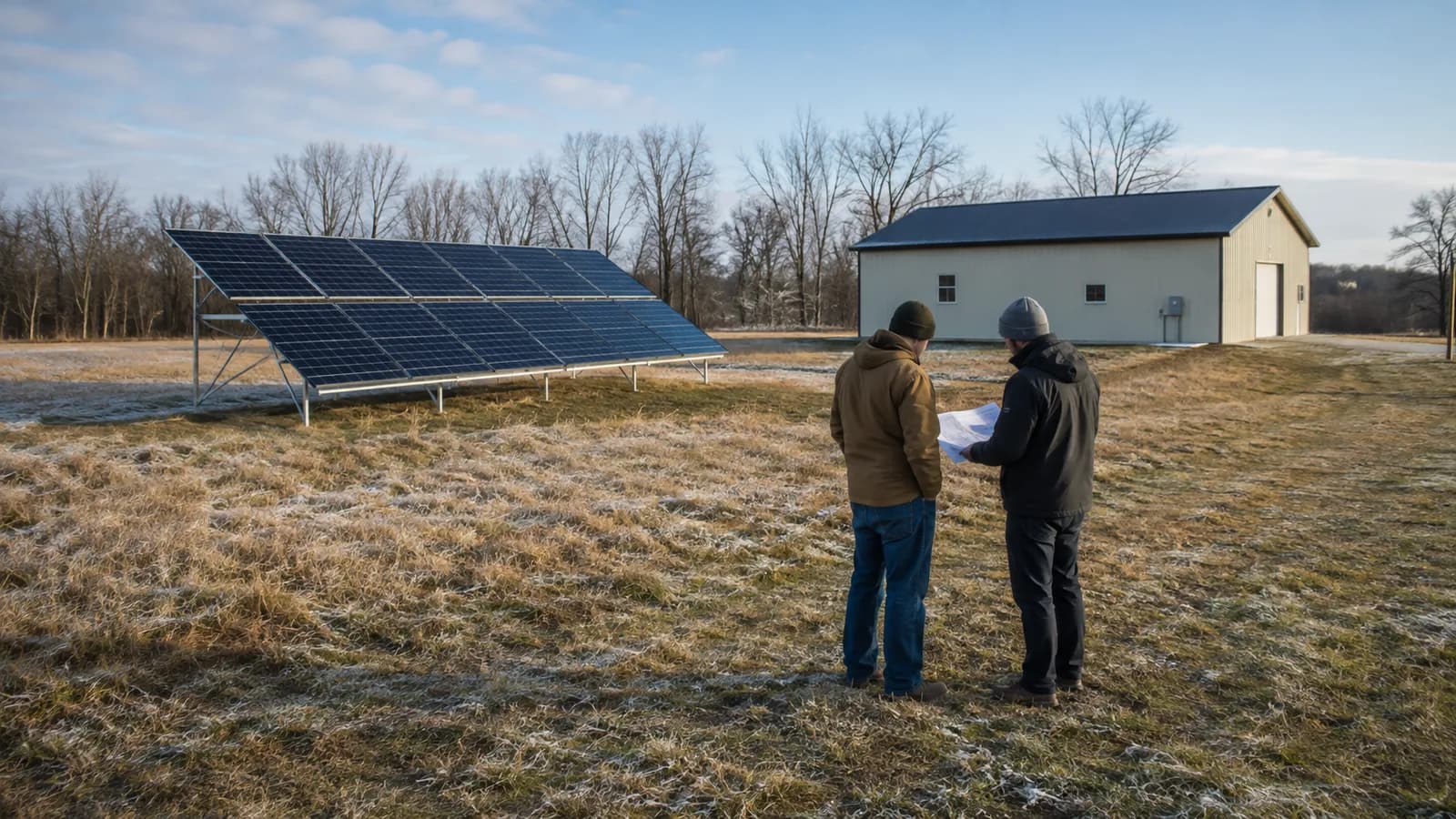
The best sunny patch of land is often some distance from the building that needs power. That leaves a practical question: should a ground-mount solar array send DC power to an inverter inside the building, or should an inverter sit beside the panels and send AC back instead?
For many small off-grid projects, one sensible route is to bring the solar-panel DC into a protected indoor equipment area and keep the battery close to the inverter or inverter/charger. That is a starting point, not a universal answer. The panel string voltage, cable route, equipment limits, weather and future expansion can change the decision.
This guide explains what to compare before buying equipment or opening a trench. It stays at planning level. High-voltage DC, battery connections, underground cable routes and protection design can be dangerous when handled incorrectly, so the final design and installation belong with the qualified people responsible for the site.
One hundred feet is useful information, but it is not the answer
A 100-foot (about 30-metre) gap between a ground-mount array and a building is not automatically too far. It is also not enough information to approve a cable or choose the inverter location.
Start by confirming what the distance means. A site sketch may show 100 feet in a straight line while the real trench has to go around a driveway, drainage area, rock or another structure. Electrical loss is based on the complete path that current travels. The product discussion also needs the array size, expected string voltage, current, lowest temperature and the exact input limits of the equipment at the building.
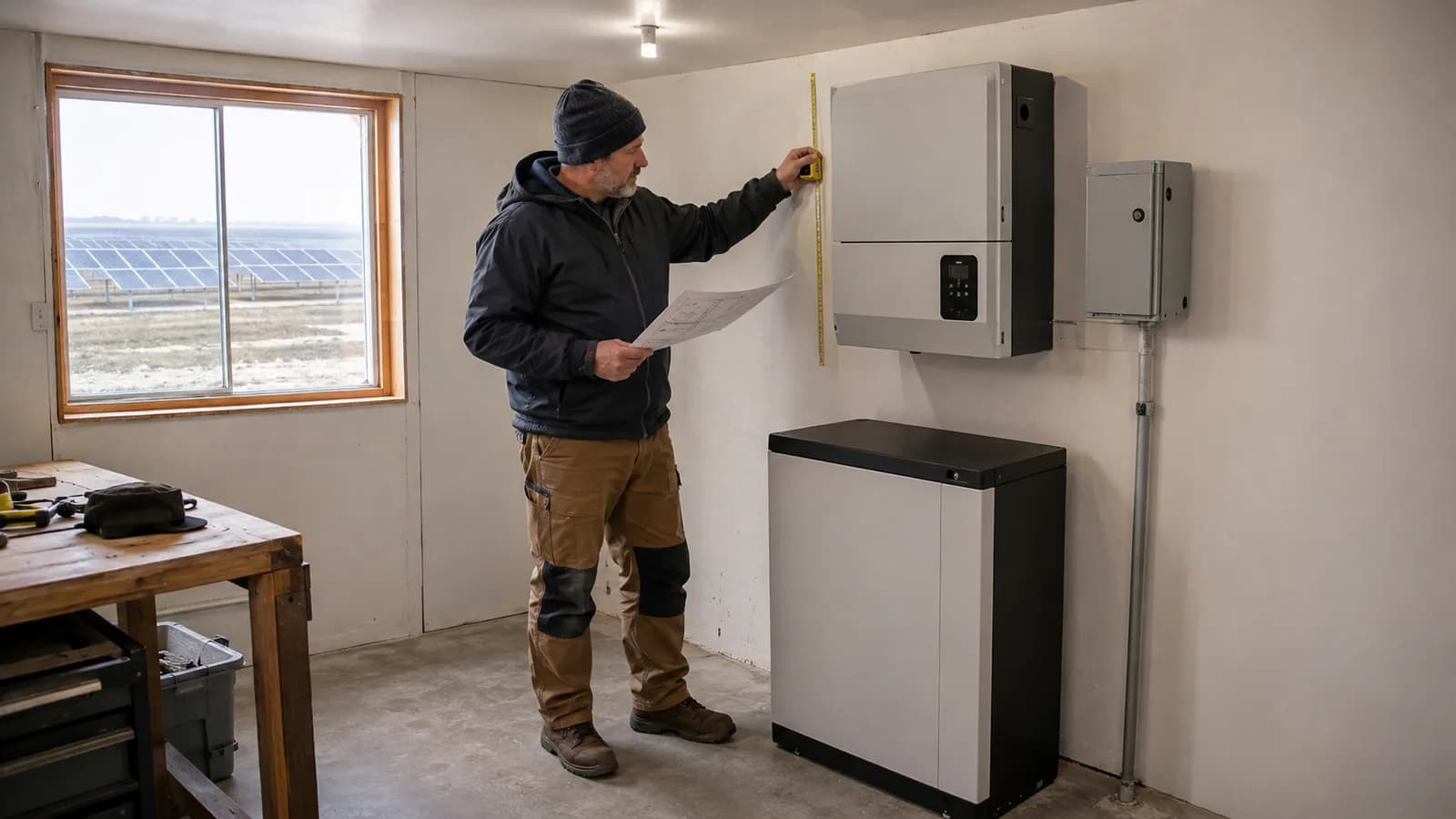
Think about access as well. An inverter placed beside the array has to live in that outdoor environment and remain reachable for service. Equipment inside a suitable utility space is easier to inspect, but the incoming solar circuit still needs a planned route and the required isolation and protection. There is no useful design until the physical route and the electrical route are shown on the same page.
High-voltage solar DC is different from 48V battery DC
The word DC covers two very different parts of an off-grid system. A series string of solar panels may operate at a few hundred volts while carrying a moderate current. A 48V battery feeding a useful building load works at much lower voltage and can carry far more current.
Here is a deliberately simplified teaching example. Moving 4,000W at 400V is about 10A. Moving the same 4,000W at 48V is about 83A. The calculation ignores conversion losses and operating changes, so it is not a cable-sizing result. It simply shows why “run DC for 100 feet” is an incomplete statement. The type and voltage of that DC matter.
Long battery cables can become large, costly and difficult to manage because of the higher current. That is one reason designers often keep the battery and inverter close together while allowing the solar array to sit farther away. High-voltage solar DC brings its own risks and rules, however. It should never be treated as the easy or safe option simply because the current is lower.
- Possible layout
- Solar DC from the array to indoor equipment
- Why it may be considered
- Keeps the inverter, charger and battery together in a more controlled location
- What needs proof
- Cold-weather string voltage, MPPT range, current limits, cable loss, route and protection
- Possible layout
- PV inverter beside the array, then AC to the building
- Why it may be considered
- Moves the conversion point outdoors and may suit a documented AC-coupled design
- What needs proof
- Outdoor rating, AC cable route and full compatibility with the off-grid battery inverter
- Possible layout
- Controller or battery equipment beside the array, then low-voltage DC
- Why it may be considered
- May appear simple in a small diagram
- What needs proof
- High current, voltage loss, battery temperature, enclosure, service access and equipment limits
| Possible layout | Why it may be considered | What needs proof |
|---|---|---|
| Solar DC from the array to indoor equipment | Keeps the inverter, charger and battery together in a more controlled location | Cold-weather string voltage, MPPT range, current limits, cable loss, route and protection |
| PV inverter beside the array, then AC to the building | Moves the conversion point outdoors and may suit a documented AC-coupled design | Outdoor rating, AC cable route and full compatibility with the off-grid battery inverter |
| Controller or battery equipment beside the array, then low-voltage DC | May appear simple in a small diagram | High current, voltage loss, battery temperature, enclosure, service access and equipment limits |
The table compares system layouts. It does not select conductors, protection devices or installation methods for a real site.
Keep the battery decision close to the inverter decision
An off-grid battery has two jobs. It stores energy for later, measured in kilowatt-hours, and it delivers power to the inverter, measured in kilowatts. The connection between those two pieces of equipment can carry high current even in a modest system.
Placing the battery near its compatible inverter or inverter/charger can shorten that high-current path and keep model-specific communication cables together. Near does not mean touching. The battery manual may require spacing, ventilation, a certain mounting position and an approved temperature range. The inverter may have separate clearance and environmental requirements.
Moving batteries indoors because the climate is cold can be reasonable, but “indoors” is not a product rating. A living room, damp basement and purpose-planned utility space are not the same. Check whether the exact battery is approved for the proposed location, how heat can leave the equipment, whether water could reach it and how it will be isolated for service. Final fire, building and electrical requirements still need local confirmation.
Should an off-grid battery be installed beside the solar panels?
Usually the battery location is planned around the compatible inverter, temperature limits and service conditions rather than around the panels. A battery beside a remote array may create a long low-voltage, high-current route and may expose the battery to an unsuitable environment. The exact equipment and site still decide the layout.
AC coupling is a complete control choice, not a cable shortcut
Putting a PV inverter beside the ground array changes the long run to AC. That can be a valid design, especially in a larger or deliberately AC-coupled system. The important part happens when the building is truly off grid.
A normal grid-connected PV inverter expects an existing AC grid. In an off-grid system, the battery inverter must create that local AC supply. It also needs a supported way to tell the PV inverter to reduce output when the loads are small and the battery is full. Some documented systems do this by changing the local AC frequency within a controlled range. The two exact inverter models, software and system limits have to support the same method.
Without that coordination, the fact that both products produce AC does not make them a working pair. Ask the manufacturer or supplier for the current AC-coupling document covering the named models and off-grid operating mode. If the answer is only “they are both 230V” or “they are both 60Hz,” the control question has not been answered.
Is AC always better for a long run from a solar array?
No. AC can be practical when the outdoor PV inverter and indoor battery system form a documented AC-coupled design. A suitable high-voltage PV string may make a long DC run practical too. Compare the complete layouts, equipment limits, losses, environment and service needs instead of choosing from the letters AC or DC alone.
Cold weather changes the panel check and the battery check
Cold conditions affect both ends of the system in different ways. The open-circuit voltage of a solar string can rise as the panels get colder. A string that stays within an inverter's limit on a mild day may cross that limit on a very cold morning. The review needs the exact panel data, number of panels in series, temperature information and the exact inverter or charge-controller input limit.
Lithium batteries have another concern. Some products reduce or stop charging when the cells are cold. The threshold and behaviour depend on the model and its battery-management system. A self-heating label may help in some locations, but the manual still needs to explain when heating starts, where the energy comes from and what happens if the battery is too cold to accept charge.
Keeping the battery in a suitable conditioned space can simplify the temperature problem. It does not remove the need to check the manual. Likewise, bringing the inverter indoors does not remove the cold-voltage calculation for the panels outside. Treat these as two separate checks.
Do the energy check before spending money on the cable route
A 4kW solar array describes its rated power under specified test conditions. It does not promise 4kW all day or tell you how many kilowatt-hours will reach the battery in winter. Shade, panel direction, temperature, weather and system losses all change the result.
Begin with the loads. Record the watts each appliance uses, how many hours it normally runs and which items may start together. Then look at the difficult season rather than the best summer week. An off-grid system needs enough energy to run the chosen loads and enough power to handle their overlap. It also needs a recovery plan after poor weather.
Trying to cover the single worst stretch of weather with batteries alone can make a small project grow quickly. A backup generator may be part of the plan, or the user may agree to reduce loads during long cloudy periods. Neither choice is automatically correct. What matters is that the operating plan is written down before somebody recommends a battery from the array rating alone.
Once the energy plan is believable, compare the cost of the complete routes. Include the actual trench length, conductors, conduit or other required containment, outdoor enclosures, disconnecting and protection equipment, communications, labour, testing and any future expansion allowance. A cheaper cable can become an expensive layout if it forces sensitive equipment outdoors.
Prepare one site brief before requesting equipment
A simple site brief lets a supplier, designer and installer discuss the same project. It does not need to decide the final conductor or protection. Its job is to make the distance, environment, loads and open choices visible.
Draw the array, proposed equipment room and real cable route on one page. Add the expected lowest and highest temperatures. List the appliances that must run and identify any generator or existing equipment. If a panel, inverter or battery has already been chosen, use its full model code rather than a product-family name.
Ask each supplier to return a proposed power path and name the equipment at both ends. The response should show which model-level compatibility evidence is available and which items remain with the site designer or installer. That is enough to avoid buying a remote array, indoor battery and two inverters that were never meant to operate together.
- One-way distance and the realistic route between the array and the building.
- Array location, shade, ground conditions, access and expected temperature range.
- Appliance list, daily operating time, starting loads and allowed load reductions in poor weather.
- Exact panel, inverter, charge-controller and battery models already owned or shortlisted.
- Preferred equipment area, generator plan, monitoring needs and likely future expansion.
- Named responsibility for final electrical design, trench details, protection, installation and acceptance.
Can solar panels be 100 feet from the inverter?
They can be in many properly designed systems. Distance alone does not approve the layout. The designer must check the real route, string voltage in cold conditions, current, cable loss, inverter input limits, protection and installation requirements for the exact site.
Related Articles
How do solar panels perform in clouds, heat, salt air and dust?
A panel's watt rating cannot describe every site. Learn what changes in cloudy, hot, coastal and dusty locations, and which details belong in a supply quote.
Read Article→
How to compare solar battery specifications before buying
Two batteries with the same kWh label can do different jobs. Here is how to read the numbers, check the missing details and compare like-for-like quotes.
Read Article→
Solar self-consumption and grid export: what equipment do you need?
For project buyers, installers and distributors: what to source as an equipment package, what to arrange locally, and what a useful supply quote should include.
Read Article→